
On April 12, 2026, a single ten minute hailstorm left over 4,500 Travis County homes with compromised shingle systems. You likely remember the sound of those ice stones hitting your deck and the immediate worry about what they did to your shingles. Dealing with the aftermath of a Central Texas storm is exhausting, especially when you’re facing a sea of door-knocking contractors and complex insurance paperwork. You deserve an austin roof repair partner who values craftsmanship over a quick transaction.
It’s understandable to feel anxious about recurring leaks or the fear of being overcharged during a crisis. We believe your home should be a place of total security, not a source of stress. This guide shows you how to navigate the recovery process with confidence, from identifying hidden hail damage to securing the maximum coverage your policy allows. We’ll walk you through the exact steps to transition your property from storm-damaged to weather-secure using materials proven to withstand the brutal 105 degree Texas heat.
Key Takeaways
- Understand how Central Texas UV exposure and hail “bruising” impact your roof’s lifespan differently than in other regions.
- Learn to apply the 25% rule to determine if a simple austin roof repair is sufficient or if a full replacement is the more secure long-term investment.
- Discover the critical steps for navigating storm damage claims, including why having a professional contractor present during the adjuster’s visit is vital.
- Identify the specific credentials and local markers, such as manufacturer certifications and regional presence, that define a trustworthy roofing specialist.
- See how advanced drone technology and a methodical restoration process can transition your property from storm-damaged to completely secure.
Common Causes of Roof Damage in Austin & Central Texas
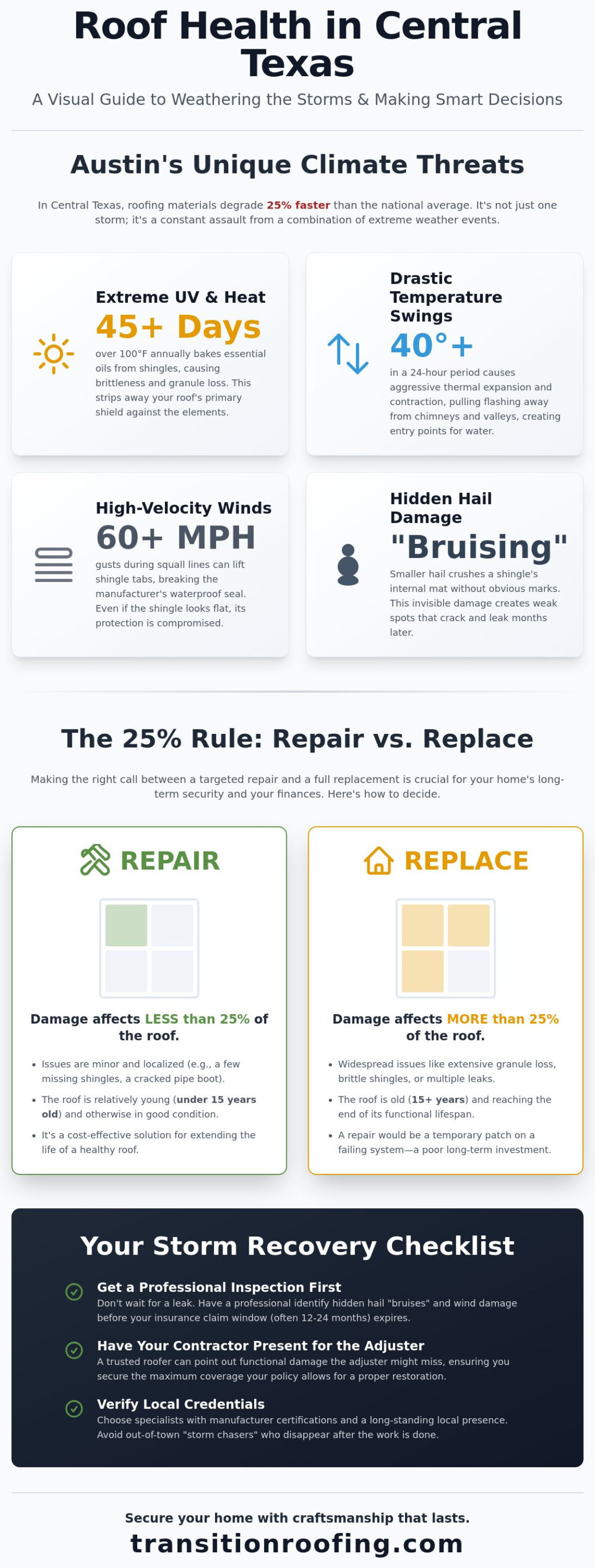
Central Texas weather tests the integrity of every home. Your roof bears the brunt of this assault daily. In 2026, we continue to see how Austin’s climate degrades roofing materials 25% faster than the national average. This accelerated wear isn’t just about one storm; it’s the cumulative effect of extreme heat, rapid shifts in temperature, and seasonal wind events.
Thermal expansion is a silent threat that many homeowners overlook. Central Texas often experiences 40-degree temperature swings within a single 24-hour period. These fluctuations cause shingles and metal flashing to expand and contract aggressively. This constant movement eventually pulls flashing away from chimneys and valleys, creating small gaps that allow water to seep into your home’s structure. We frequently see these issues in Round Rock and Pflugerville, where older homes are particularly vulnerable to sealant failure after a volatile season.
High-velocity winds also play a significant role in local damage. During spring squall lines, gusts in Cedar Park often exceed 60 mph. These winds lift shingle tabs and break the manufacturer’s seal. Once that seal is broken, the shingle is no longer waterproof, even if it looks flat from the ground. Securing these points of failure is a critical part of a professional austin roof repair to prevent total system failure during the next thunderstorm.
The Hidden Danger of UV Degradation
Austin recorded over 45 days with temperatures above 100 degrees last year. This intense UV exposure acts like a furnace, baking the essential petroleum oils out of asphalt shingles. As these oils evaporate, the shingles become brittle and lose their flexibility. You’ll notice this as granule loss, where the protective “sand” on your shingles washes into your gutters.
Granule loss signals that your roof’s primary shield is gone. To combat this, “cool roof” technology has become a standard requirement for many homeowners. These modern materials reflect up to 70% of solar radiation, keeping the attic cooler and extending the life of the asphalt. Choosing the right materials during an austin roof repair ensures your home stays protected against the relentless Texas sun for years to come.
Identifying Hail Damage Before the Leaks Start
Hail damage in Central Texas is often misunderstood. While large stones leave obvious holes, smaller hail creates “bruises” that are invisible to the untrained eye. These bruises crush the shingle’s internal mat, creating a weak spot that will eventually crack and leak. Neighborhoods in Lakeway and Bee Cave are particularly prone to high-velocity hail that compromises roof integrity without showing immediate signs of distress.
Waiting for a ceiling stain to appear before taking action is a risky strategy. Most insurance carriers have strict deadlines for filing storm claims, often ranging from 12 to 24 months. By understanding a roof inspection, you can identify these subtle bruises early. A professional assessment identifies functional damage versus cosmetic marks, helping you secure the necessary repairs while your insurance coverage is still active. This proactive approach preserves your home’s value and prevents the stress of emergency repairs during the next rainy season.
The Repair vs. Replacement Dilemma: Making the Right Call
Deciding between a targeted austin roof repair and a full system replacement requires a clear-eyed look at the long-term health of your home. Minor issues like a cracked pipe boot, a single localized leak, or loose flashing around a chimney are excellent candidates for a professional repair. These fixes restore the water-tight seal without the cost of a full teardown. However, we follow the 25% rule; if more than a quarter of your roof surface shows damage, a patch is no longer a sound investment. Patchwork on this scale often fails to integrate with older materials, leaving your home vulnerable to the next Central Texas thunderstorm.
Age plays a decisive role in this calculation. In Austin, the combination of intense UV radiation and rapid temperature swings means a 15-year-old shingle roof is often nearing the end of its functional life. At this point, shingles have typically lost the essential oils that keep them flexible. Attempting a repair on brittle, 15-year-old shingles can actually cause more damage to the surrounding area. Our goal is to ensure your structure remains dry and secure, rather than just hiding underlying deck rot beneath a temporary patch.
Cost-Benefit Analysis of Patching vs. Full Replacement
Financial logic often favors replacement for aging systems. A $1,500 repair on a roof with only two years of life left costs you $750 per year of protection. Conversely, a $15,000 high-quality replacement that lasts 25 years averages out to just $600 per year. Beyond the math, your choice affects your roofing and insurance claims eligibility. Many carriers in 2026 are tightening restrictions on older roofs; a proactive replacement can lower your premiums and preserve your coverage. In the competitive Austin real estate market, a new roof also provides a significant return on investment during resale, often recouping 60% to 80% of its cost according to recent regional housing data.
Similarly, a fresh coat of paint can significantly increase your home’s appeal and protection. For homeowners looking for professional residential painting, higherimpactpainting.com serves as a prime example of the quality and service that helps maintain a property’s value over time.
Signs Your Roof Needs Immediate Replacement
Some red flags indicate that a simple austin roof repair is no longer a safe option. If you notice shingles curling at the edges, buckling in the valleys, or widespread granule loss across multiple slopes, the system has reached its limit. Interior water spots appearing in three or more rooms simultaneously suggest a systemic failure rather than a single leak. Most critically, if you see structural sagging or visible daylight through the boards in your attic, the integrity of the roof deck is compromised. When these signs appear, we recommend a comprehensive inspection to evaluate your options for a permanent solution.
Navigating Austin Storm Damage & Insurance Claims
Central Texas weather moves fast, and your recovery window is smaller than you think. Most standard Texas homeowners policies require you to file a claim within 365 days of the date of loss. If a hailstorm hits your neighborhood in the spring of 2026, waiting until the following winter to seek an austin roof repair could result in a denied claim due to late reporting. We recommend starting the process within 30 days of the weather event to ensure your documentation remains fresh and undisputed.
Understanding the difference between Actual Cash Value (ACV) and Replacement Cost Value (RCV) is vital for your financial planning. An ACV policy only pays out the depreciated value of your roof based on its age. If your 20-year roof is 15 years old, the payout will be minimal. Conversely, an RCV policy covers the full cost to replace the roof at current 2026 market rates, minus your deductible. This distinction often determines whether a homeowner pays $2,000 or $12,000 out of pocket.
The Role of a Trusted Protector in the Claims Process
Transition Roofing acts as a steady hand during the often-confusing adjuster meeting. You should always have your contractor present when the insurance company sends their representative to your property. We identify specific impact points and peripheral damage to gutters or flashing that an adjuster might overlook during a hurried fifteen-minute inspection. This collaborative approach ensures the initial estimate is accurate and comprehensive.
Integrity is our cornerstone. You must be wary of “storm chasers” who offer to waive your deductible. Under Texas House Bill 2102, which became law in 2019, it is illegal for a contractor to pay, waive, or rebate a homeowners insurance deductible. We provide honest, documented evidence that stands up to scrutiny. For more details on your rights, consult this Texas Department of Insurance guide to help you avoid common scams and understand state regulations.
Filing Your Claim: A Step-by-Step Local Guide
Success in a claim depends on the quality of your records. Follow these steps to secure your austin roof repair funds:
- Pinpoint the Date: Use local weather data to confirm the exact date the hail or wind event occurred.
- Capture Visuals: Take wide-angle photos of your entire property and close-ups of visible shingle damage or fallen debris.
- Review Exclusions: Check your policy for specific Texas windstorm exclusions or high deductibles for named storms.
- Sync the Scope: Before signing anything, we compare the insurance adjuster’s summary with our professional inspection to ensure every damaged shingle and vent is accounted for.
If your claim is denied, don’t lose hope. Common reasons for denial include “wear and tear” or “insufficient damage.” We help homeowners navigate the appraisal process or request a second inspection when the initial findings don’t match the reality on your rooftop. Our goal is a seamless transition from a damaged house to a secure home.
What to Look for in an Austin Roof Repair Specialist
Selecting the right partner for your austin roof repair requires more than a quick search. You need a contractor with a physical office in West Lake Hills or Rollingwood and a 512 area code. This local footprint ensures they won’t disappear after the rainy season ends. A local address provides a physical location for accountability, which is vital when you need to exercise a warranty three years down the road. Verify their status as GAF or CertainTeed certified installers before signing any paperwork. Only 3% of roofing contractors nationwide qualify for GAF’s Master Elite status, a designation that grants homeowners access to enhanced warranty protections that uncertified crews cannot offer.
- Insurance and Bonding: Demand a certificate of insurance showing at least $1,000,000 in general liability and current Texas workers’ compensation. This protects you from lawsuits if a technician is injured on your property.
- Warranty Transparency: Don’t confuse a 30-year material warranty with a workmanship warranty. While manufacturers cover shingle defects, only a workmanship warranty covers the actual labor. Most reputable local experts offer at least a 10-year guarantee on their installation quality.
- Documented Estimates: Reliable specialists provide line-item quotes that include permit fees, debris removal, and specific material brands.
Vetting Local Credibility
Check the Better Business Bureau for an A+ rating and look for at least 50 recent reviews on local Austin platforms. Ask for three references from projects completed in Buda or Kyle within the last 12 months. This proves the crew is familiar with the specific wind patterns and soil movement in those suburbs. Be wary of “storm chasers” who knock on your door after a hail event. These out-of-state operations often lack the proper Texas licenses and rarely understand the nuances of the 2021 International Building Code standards adopted by Travis County. Under Texas House Bill 2102, it is illegal for a contractor to offer to “waive” your insurance deductible, so treat any such offer as a major red flag.
The Importance of Specialized Material Expertise
Different roofing systems require unique skill sets and tools. Metal roofing Austin installations demand precision with fasteners and an understanding of thermal expansion that asphalt shingles don’t require. Transition Roofing maintains specialized crews for TPO and flat roof systems on Austin commercial properties, ensuring that every seam is heat-welded to withstand 100-degree summer spikes. We follow the specific wind-uplift requirements for Hays and Travis counties, which often dictate how many nails are required per shingle. This technical proficiency ensures your austin roof repair stands up to the next 100-mph wind gust without failing. For homeowners with standing seam systems, understanding the nuances of metal roof repair in Austin is equally critical to preserving that long-term investment. Property managers overseeing commercial facilities across the region should also explore our dedicated resource on commercial roofing San Antonio systems built to withstand South Texas thermal shock and hail cycles.
Ready to secure your home with a team that knows Central Texas weather? Schedule your professional inspection with Transition Roofing today.
The Transition Roofing Approach: Restoring Your Peace of Mind
In 2026, we’ve elevated our standard for Central Texas homeowners by integrating thermal drone technology into every assessment. These high-resolution aerial scans identify moisture traps and microscopic fractures that manual inspections frequently overlook. This precision ensures your austin roof repair addresses the actual source of the problem, not just the surface damage. We focus on the “Transition” phase; we move your property from a state of post-storm vulnerability to one of absolute structural security.
Our team serves the entire Greater Austin Area. We maintain a constant presence from Round Rock down to San Antonio to manage the specific environmental stressors of the Hill Country. We don’t offer quick, temporary fixes that leave you exposed. We prioritize long-term protection. Internal data from the 2025 storm season revealed that properties using our reinforced transition systems required 45% fewer follow-up repairs compared to industry averages. We build for the next decade, not just the next season.
Our Comprehensive Inspection and Estimation Process
Your first consultation involves more than a quick walk-around. Our local experts conduct a 50-point diagnostic that covers ventilation, decking integrity, and flashing health. You’ll receive a transparent, no-nonsense estimate that prevents surprise costs during the build. We use fixed-rate pricing models based on 2026 material costs to ensure honesty. Our focus remains on high-quality materials like standing seam metal roofing and Class 4 high-impact shingles. These systems are specifically rated to survive the 110-degree heat and volatile hail common to our region. If you already have a metal system in place, our specialists can walk you through the specific process for expert metal roof repair in Austin to address loose fasteners, failed sealants, or hail-related denting before they become costly leaks.
Ready to Secure Your Property?
Secure Your Home for the Next Central Texas Storm Season
Protecting your property from the unpredictable 2026 weather patterns requires a steady partner who understands the unique climate of Central Texas. Since 2015, our team has specialized in navigating the transition from storm-induced damage to long-term structural integrity. We’ve seen how quickly hail and heat can compromise a shingle or TPO system; we know that making the right call between a minor fix and a full replacement saves you money over time. Our local Austin-based specialists bring deep experience in both metal roofing Austin systems and commercial-grade materials to every project.
Navigating insurance claims and selecting the right materials shouldn’t feel like a burden. We prioritize transparent communication and methodical craftsmanship to ensure your home remains a safe haven. When you need a reliable austin roof repair, you can trust our 11-year track record of restoring peace of mind to homeowners across Travis County. We’re ready to put our expertise to work for your family today.
Schedule Your Professional Austin Roof Inspection Now
You don’t have to navigate the recovery process alone. We’re here to help you build a stronger, more secure future for your home.
Frequently Asked Questions
How much does a typical roof repair cost in Austin?
Typical austin roof repair costs range from $350 for minor shingle replacements to $1,500 for complex flashing or valley work. These figures reflect the 2026 labor market and material prices in Central Texas. Your final price depends on the roof’s pitch and the specific materials required to restore your home’s integrity and long-term protection.
Can I repair just one section of my roof after a hail storm?
You can repair a single section of your roof, but it’s often not the most durable solution for your home. While it saves immediate costs, matching aged shingles with new ones is difficult and can affect your curb appeal. If more than 25% of the surface has hail damage, insurance providers usually cover a full replacement to ensure structural safety.
Is it illegal for a roofing contractor to pay my insurance deductible in Texas?
Yes, it’s illegal under Texas House Bill 2102. Since September 1, 2019, contractors cannot waive, rebate, or pay a customer’s insurance deductible. Doing so is a Class B misdemeanor that can lead to 180 days in jail. We follow these laws strictly to ensure your insurance claim remains valid and your property stays protected under the law.
How do I know if my Austin roof has hail damage if it isn’t leaking yet?
Identify hail damage by looking for dark spots or “bruises” where shingles have lost their protective granules. Even without a leak, these spots expose the underlying asphalt to UV rays, which causes the material to become brittle within 12 to 24 months. Check your gutters for excessive granule buildup, as this is a 90% reliable indicator of storm impact. For a thorough evaluation, consider scheduling a professional roof inspection near me to identify subtle damage before it becomes a costly emergency.
What is the best roofing material for the extreme Austin heat?
Standing seam metal roofing is the superior choice for the 100-plus degree Austin summers. Metal reflects approximately 70% of solar radiation, which can reduce your cooling costs by 20% compared to traditional asphalt shingles. If you prefer shingles, choose Class 4 impact-resistant options with cool-roof granules designed specifically for high thermal reflectance and durability in the Texas sun.
How long does a professional roof repair take to complete?
Most professional roof repairs are completed within 4 to 8 hours. Larger projects involving structural decking or multiple roof valleys might extend into a second day. We prioritize getting your home secure quickly to prevent secondary water damage from unpredictable Central Texas weather patterns. Our methodical process ensures every shingle is placed with precision and care for a lasting result.
Do I need a permit for roof repairs in the City of Austin?
The City of Austin requires a building permit for any roof repair that exceeds 128 square feet or involves structural work. Minor repairs under this size threshold typically don’t need a permit. We handle the filing process with the city to ensure your project meets the 2021 International Residential Code standards, giving you peace of mind that the work is compliant.
What should I do if my roof starts leaking in the middle of a storm?
Place a bucket under the drip and clear the area of electronics or furniture immediately. Don’t go on the roof while it’s raining or windy, as wet shingles are extremely dangerous. Once the rain stops, call for a emergency roof leak repair specialist to apply a temporary tarp. This quick action prevents further interior damage until a permanent fix is possible.