Last April, an Austin homeowner discovered that a single 20-minute hailstorm caused $15,000 in undetected damage to their shingle system. You shouldn’t have to wait for a ceiling stain to realize your home’s first line of defense is failing. Searching for a reliable roof inspection near me often feels like an invitation for aggressive door-knockers to swarm your neighborhood, but your safety isn’t a sales pitch. You deserve a partner who understands how the 105-degree Central Texas heat bakes your roof long before the first storm clouds gather.
We agree that protecting your property should be a straightforward, transparent process. This guide explains exactly what happens during a professional roof inspection and how to choose a local specialist who values integrity over a quick transaction. You’ll learn how to secure a detailed health report, document damage for your 2026 insurance requirements, and find total peace of mind before the next hail season arrives. We’re here to help you transition your roof from a state of uncertainty to one of total security.
Key Takeaways
- Understand how Austin’s extreme heat accelerates shingle degradation and why a specialized local audit is essential for your home’s thermal protection.
- Discover the specific details included in a 20-point professional inspection, from structural ridge alignment to material-specific wear patterns.
- Learn to distinguish a professional “roof inspection near me” from the high-pressure “free” estimates often used by out-of-state storm chasers.
- Get actionable tips on preparing your property to ensure a safe, efficient, and thorough evaluation by a local roofing expert.
- Gain the clarity needed to interpret technical reports and transition your property from a state of vulnerability to total security.
Why a Local Austin Roof Inspection is Critical in 2026
A professional roof inspection is a 20+ point technical audit of a building’s thermal and moisture protection system. It’s a specialized process that goes far beyond a simple visual check from the curb. While often included as a component of a comprehensive home inspection, a dedicated roofing assessment focuses on the structural integrity of the deck, the health of the underlayment, and the precision of the flashing. When you search for a roof inspection near me, you aren’t just looking for a price quote; you’re seeking a detailed health report for your home’s first line of defense.
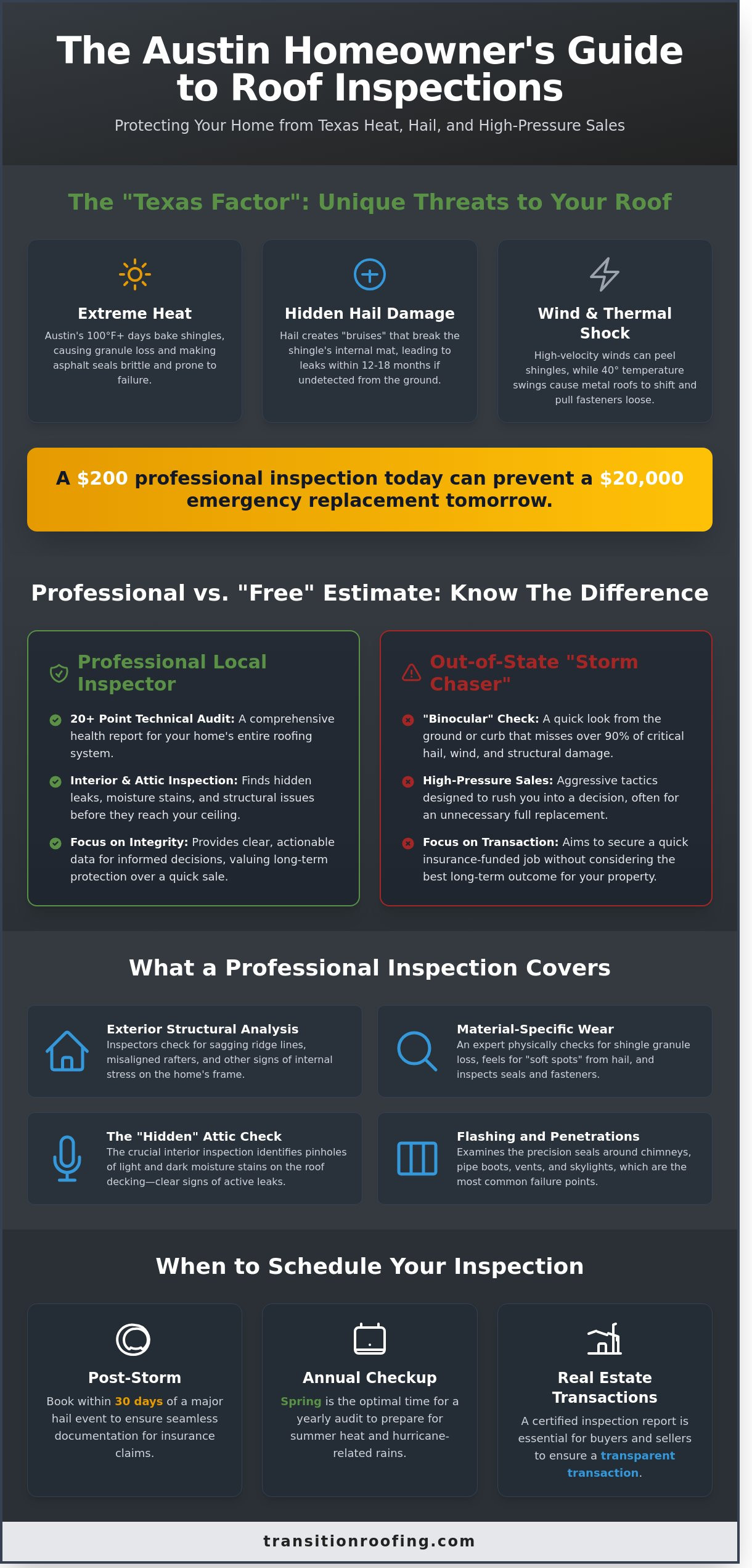
The “Texas Factor” makes these audits mandatory for local homeowners. During the scorching summer of 2025, Austin recorded 45 days with temperatures exceeding 100 degrees. This extreme heat accelerates the loss of shingle granules and causes the asphalt seals to become brittle and fail. Without a physical check, these microscopic failures remain hidden until the first major thunderstorm of 2026 causes internal water damage.
Relying on ground-level “binocular” inspections is a common mistake that leaves properties vulnerable. These distant views miss 90% of critical structural issues. Hail often creates “bruised” shingles, where the impact breaks the fiberglass mat underneath the granules. You can’t see this from the ground, but an expert on the roof can feel these soft spots. If left unaddressed, these bruises become leaks within 12 to 18 months. Knowing what to do when those leaks appear suddenly is equally important, which is why every Austin homeowner should understand the steps involved in emergency roof leak repair before a crisis strikes.
Investing $200 in a professional inspection today can prevent a $20,000 emergency replacement tomorrow. Transition Roofing focuses on identifying these minor vulnerabilities before they escalate into structural failures. We believe in providing clear, actionable data so you can make informed decisions about your property’s future.
The Impact of Central Texas Weather on Your Roof
Weather patterns in the Austin-San Antonio corridor are uniquely aggressive. Hail damage is categorized into “functional” and “cosmetic” issues. Functional damage affects the roof’s ability to shed water, while cosmetic damage only impacts appearance. In West Lake Hills, metal and TPO roofs face extreme thermal expansion. These materials can shift significantly when temperatures swing 40 degrees in a single 24-hour period, potentially pulling fasteners loose. Meanwhile, properties in Lakeway and Bee Cave face high-velocity wind uplift that can peel back shingles if the starter strips weren’t installed to modern 2026 standards.
When to Schedule Your Inspection
Scheduling your checkup at the right time is vital for insurance and maintenance. You should always book an inspection within the 30-day “Post-Storm” window after a major hail event. Waiting longer can complicate insurance claims, as adjusters may argue the damage occurred during a different, uninsured period. Spring is the optimal time for an annual checkup to clear debris and seal pipe boots before hurricane-related rains move inland. For those in the competitive Cedar Park real estate market, a certified inspection report is an essential tool for buyers and sellers to ensure a transparent transaction. Finding a qualified roof inspection near me ensures your investment stays protected during the peak 2026 storm season.
The 20-Point Technical Checklist: What Happens During an Inspection?
A professional roof inspection is a methodical diagnostic process. It goes far beyond a simple visual check from the curb. When you search for a roof inspection near me, you deserve an expert who examines the structural integrity of your home from the ridge down to the decking. We begin with an exterior structural analysis. Our team looks for sagging ridges or misaligned rafters that suggest internal stress. These issues often stem from the 30 to 40 inches of annual rainfall common in Central Texas, which can compromise older timber over time.
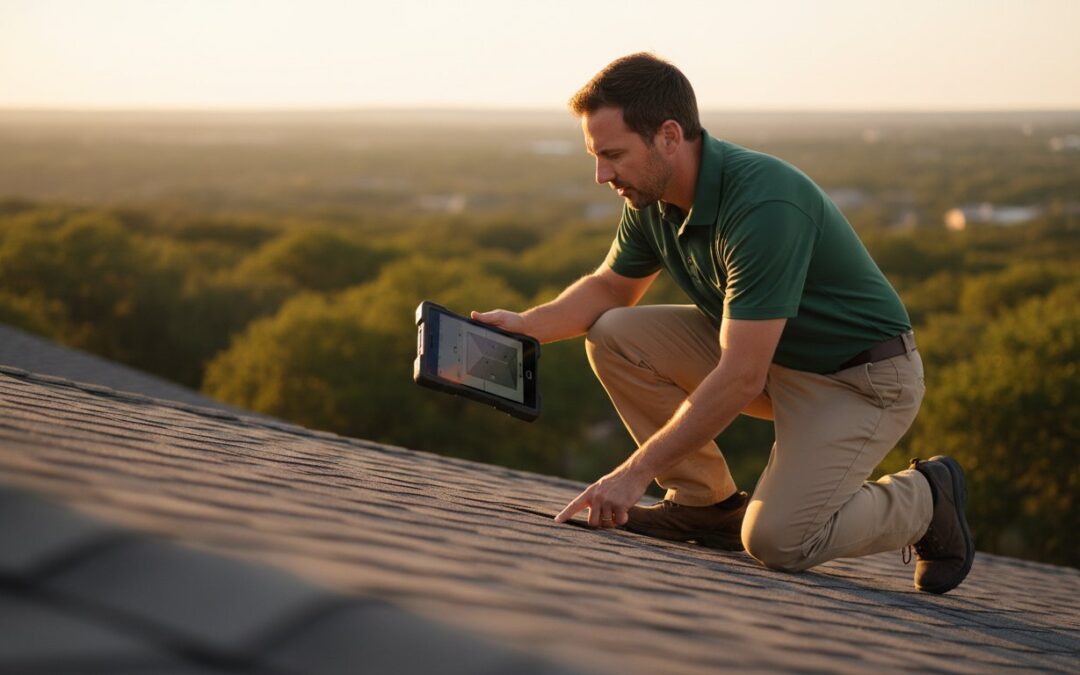
A true professional must enter the attic. This “hidden” inspection reveals what the exterior cannot. We look for pinholes of daylight or dark moisture stains on the underside of the roof deck. These signs indicate active leaks that haven’t reached your interior ceiling yet. This level of detail mirrors the rigorous standards found in FEMA’s home inspection process, which emphasizes identifying structural hazards and moisture intrusion after major weather events. We document every finding using high-resolution photography and drone thermography. These thermal sensors detect temperature variances that suggest trapped moisture under the surface, providing a clear map for necessary repairs.
Checking the ‘Armor’: Shingles, Metal, and Flat Systems
Shingle health depends on granule retention. We identify “bald spots” where UV exposure has stripped the protective layer, leaving the asphalt vulnerable to 105-degree Austin afternoons. For metal roofing, especially in Round Rock industrial zones, we inspect every fastener and rubber gasket. Rust at the seams can compromise the entire panel system if left unaddressed. If you already have a metal system showing signs of wear, understanding the options for metal roof repair in Austin can help you decide between a targeted fix and a full replacement before minor issues escalate. On flat commercial roofs, we prioritize finding “ponding” water. If water remains 48 hours after a storm, it increases the risk of membrane punctures and structural load issues.
The Critical Details: Flashing, Vents, and Gutters
Flashing remains the primary culprit for interior damage. Roughly 80% of leaks in older Austin homes originate around chimneys and skylights where the original sealant has cracked or pulled away. We also audit your ventilation health. Your roof needs to breathe to keep attic temperatures below 130 degrees during a peak Texas summer. While roofing handles external heat, you should also ensure your internal cooling systems are optimized; for expert guidance on climate control, check out E.R.S. Heating & Cooling. Finally, we conduct a gutter system audit. Clogged gutters cause water to back up, leading to fascia rot and foundation shifts over time. If you’re concerned about your roof’s current state, you can request a professional assessment to secure your home’s long-term integrity.
Professional Inspection vs. ‘Free’ Estimates: Avoiding the Storm Chaser Trap
Searching for a roof inspection near me often triggers an influx of door-knockers after a Central Texas hailstorm. These storm chasers use high-pressure tactics to secure immediate signatures on contingency agreements. They offer a free look, but their goal is a quick insurance claim rather than a detailed assessment of your home’s integrity. Transition Roofing operates differently. We focus on technical accuracy and long-term protection, ensuring your property remains secure against the 105-degree heat and unpredictable weather patterns common in the Hill Country.
A professional evaluation provides a level of detail that a generic handyman cannot match. Our team utilizes a comprehensive roof inspection checklist to identify subtle issues like thermal cracking or granular loss that untrained eyes miss. Insurance adjusters in Austin frequently prioritize reports from established local companies because our documentation is thorough and evidence-based. This transparency speeds up the claims process and reduces the likelihood of a denied claim. When you search for a roof inspection near me, you deserve a technical breakdown of every flashing, seal, and shingle rather than a vague verbal estimate.
Red Flags of Unreliable Roof Inspectors
Watch out for contractors who demand a signature before they even step onto a ladder. In the Pflugerville and Round Rock areas, scammers often promise a “free roof” if you sign their paperwork immediately. This is a predatory tactic designed to lock you into a contract before you’ve seen a single photo of the alleged damage. Always verify local credentials. An out-of-state license offers no protection when you need warranty support three years later. If an inspector cannot show you high-resolution photos of specific damage, the damage likely doesn’t exist.
The Value of a Paid Professional Audit
Choosing a paid audit ensures the inspector’s primary motivation is accuracy, not a commission. This unbiased reporting creates a vital paper trail for your home’s maintenance history, which is essential for future property sales or insurance renewals. You’ll receive a clear timeline of your roof’s remaining lifespan. Knowing whether your shingles have 4 years or 14 years of life left allows you to budget effectively. It’s about moving from a state of uncertainty to total security. We provide a no-pressure consultation that feels like a conversation with a neighbor. This grounded approach has helped us maintain a high satisfaction rate across Travis County for over a decade.
How to Prepare for Your Inspection and Interpret the Results
Preparing your property ensures our team can perform a thorough evaluation without delays. You should clear a 10-foot perimeter around the entire house to allow our technicians to set up 28-foot extension ladders safely. Move patio furniture, potted plants, or vehicles that might obstruct access to the eaves. We also ask that you secure pets and keep children indoors during the process. Our inspectors maintain a strict “drop zone” directly beneath the roofline where loose shingles or debris may fall. When you search for a roof inspection near me, you deserve a professional who prioritizes this level of site safety and efficiency.
Having your home’s history ready is just as vital as clearing the yard. If you had minor leak repairs in 2024 or filed a partial insurance claim in 2025, keep those receipts and documents handy. We use these records to track the progression of wear and identify if previous patches are still holding up against the Central Texas heat. Our goal is to move your home from a state of uncertainty to one of total security through a methodical, transparent process.
The Interpretation Guide: Reading Your Roof Report
Your digital report will categorize findings into Urgent and Monitor status. Urgent items, such as exposed underlayment or active leaks, require immediate attention to prevent interior damage. In the Texas insurance market, adjusters look for functional damage. This isn’t just a cosmetic scuff; it’s a specific type of impact, like a hail hit larger than 1.25 inches, that compromises the shingle’s ability to shed water. If we identify this, it often triggers a successful insurance payout.
We also provide a life expectancy estimate tailored to local conditions. For a standard 30-year shingle in Buda or Kyle, the 100-degree summer streaks often reduce that lifespan to 20 or 22 years. We apply the 30% rule to help you decide your next move. If the estimated repair costs exceed 30% of the total replacement value, we recommend a full system upgrade to ensure long-term integrity and better ROI for your property.
Next Steps: From Inspection to Restoration
Once the inspection is complete, your report serves as a professional evidence file. It contains the high-resolution photos and technical measurements your insurance company needs to process a claim quickly. Using the same company for the inspection and the repair is a smart choice. We’ve already mapped every valley and ridge on your roof, which eliminates the risk of miscommunication during the restoration phase. If a sudden storm exposes vulnerabilities before repairs are scheduled, having a plan for emergency roof leak repair in Austin ensures you can contain damage quickly and protect your home’s interior while awaiting professional restoration. If you’re looking for a roof inspection near me that leads to a seamless repair, continuity is key.
Scheduling the work requires timing. The Austin roofing season peaks between March and May. By finalizing your plan immediately after the inspection, you can avoid the 6-week backlogs that typically hit during the spring storm season. We focus on a steady, organized timeline to get your home back to its best condition without unnecessary stress.
Transition Roofing: Your Trusted Protector in Central Texas
We’ve spent over 25 years studying the specific ways Texas sun and sudden hailstorms impact local properties. Our team doesn’t just work here; we live in the same neighborhoods we serve, from the hills of Rollingwood to the waterfront properties in Lakeway. This deep local connection drives our “Trusted Protector” philosophy. You won’t find high-pressure sales tactics or aggressive closing techniques here. Instead, we provide 100% transparent estimates and a commitment to long-term property integrity that safeguards your investment.
Every roof tells a story of its environment. Our technicians are trained to read the signs of wear unique to the Austin and San Antonio corridors. We bring specialized expertise to both residential shingle applications and complex commercial TPO or Metal systems. We believe that a roof is more than just a cover; it’s a shield for your family or your business. By prioritizing quality craftsmanship over quick turnovers, we’ve built a reputation for reliability that spans decades of service in Central Texas.
Why Austin Property Owners Choose Transition
Documentation is the foundation of a successful insurance claim. We provide detailed, photo-heavy inspection reports that clearly illustrate every point of concern, from wind-lifted shingles to compromised flashing. This transparency simplifies the process for homeowners searching for a reliable roof inspection near me. We utilize premium materials from industry leaders like GAF and Owens Corning to ensure every repair or installation meets rigorous durability standards. Our crew excels in Residential Roof Replacement and specialized commercial systems, providing a versatile solution for any property type.
- Evidence-Based Reporting: We use high-resolution imagery so you see exactly what our technicians see.
- Manufacturer Partnerships: As certified installers, we offer enhanced warranties that “tailgate” contractors can’t match.
- Local Weather Knowledge: We understand how 100-degree days followed by rapid cooling affects sealants and thermal expansion. Homeowners with standing seam systems can also explore our dedicated guide to metal roof repair in Austin to understand how fastener failures and valley sealing issues are diagnosed and resolved.
Start Your Transition to a Secure Roof Today
Securing your property shouldn’t be a time-consuming chore. You can book your local Austin or San Antonio inspection in under 60 seconds through our streamlined online portal. During our first visit, a technician performs a comprehensive 21-point assessment of your entire roofing system. We look at the gutters, the ventilation, and the structural integrity of the decking to identify small leaks before they evolve into $10,000 structural problems. If you need a professional roof inspection near me, our team is ready to provide the clarity you deserve. Schedule your professional roof inspection with Transition Roofing today!
Secure Your Texas Home for the 2026 Storm Season
Your roof serves as the primary shield against the volatile Central Texas climate. Maintaining its integrity requires more than a quick glance from the ground. By implementing our 20-point technical checklist, you identify subtle hail damage and structural fatigue before they become costly emergencies. Choosing a qualified professional over high-pressure “free” estimates protects you from the common storm chaser traps that plague our region after heavy weather events.
If you’re currently searching for a reliable roof inspection near me, you need a local specialist with a proven track record. Transition Roofing has served homeowners across Austin and San Antonio since 2015. We focus on transparent, photo-verified reports that provide a clear roadmap for your property’s long-term health. Our team specializes in hail and storm restoration, ensuring every shingle and flashing meets our rigorous standards for durability and safety.
Don’t leave your most valuable asset to chance. Secure Your Home with a Professional Austin Roof Inspection today. We’re ready to provide the peace of mind and professional protection your family deserves.
Frequently Asked Questions
How much does a roof inspection cost in Austin, TX?
Standard visual assessments for storm damage or maintenance are typically free for Austin homeowners. If you require a formal, written certification for a real estate transaction, expect to pay between $200 and $450 depending on your home’s square footage. We focus on identifying immediate vulnerabilities like thermal cracking or hail bruising to ensure your property remains secure and weather-tight.
How often should I have my roof inspected in Central Texas?
Schedule a professional evaluation at least once every 12 months or after any weather event with hail exceeding 1 inch in diameter. Central Texas experienced over 15 major hail events in 2024 alone, making regular checkups essential for your home’s longevity. Catching minor shingle delamination early can prevent a small leak from turning into a $15,000 full replacement project later.
Will my insurance company pay for a roof inspection?
Insurance carriers don’t usually pay for the inspection itself, as they view it as basic home maintenance. However, if our team identifies verifiable storm damage from a specific date, your policy should cover the subsequent repair or replacement costs minus your deductible. We provide the detailed documentation and photo evidence required to help you navigate the claims process with total transparency and confidence.
Can I do my own roof inspection with a drone or binoculars?
You can use binoculars to spot missing shingles, but this method misses 70% of critical issues like soft decking or internal flashing leaks. A professional roof inspection near me involves a physical walk-through to check for granular loss and seal failure. We use specialized tools to detect moisture trapped beneath the surface that a drone camera cannot see from the air.
What is the difference between a roof estimate and a roof inspection?
A roof estimate is a price quote for a specific scope of work, while an inspection is a comprehensive diagnostic health check. During an inspection, we evaluate every component from the ridge vents to the drip edge to find hidden defects. An estimate tells you what a new roof costs; an inspection tells you if you actually need one or if a $500 repair is sufficient.
How long does a professional roof inspection take for a standard home?
A thorough evaluation for a standard 2,500-square-foot home typically takes between 45 and 90 minutes. This timeframe allows our experts to examine the attic ventilation, check every pipe boot, and document shingle conditions across all slopes. We take the time necessary to ensure no detail is overlooked, providing you with a clear roadmap for your property’s long-term protection and stability.
What if the inspector finds damage but my insurance denies the claim?
You should request a re-inspection if your claim is denied despite clear evidence of damage. We’ll meet the insurance adjuster at your property to point out specific 1-inch hail hits or wind-lifted tabs they might have missed. In 2025, roughly 20% of our successful claims were approved only after a second walkthrough with a professional advocate present to explain the technical findings.
Do I need to be home for the roof inspection?
Your presence isn’t mandatory for the exterior portion of the assessment, but we recommend being home to allow us attic access. Checking the interior side of the decking is the only way to spot 100% of active leaks or structural sagging. If you can’t be there, we’ll provide a digital report so you can review our findings. Searching for a roof inspection near me ensures you get a local expert who understands Austin’s specific construction standards.