
What if replacing a failing roof could protect your building without bringing daily operations to a halt? For property managers weighing commercial roof replacement in downtown Austin, both concerns matter. Recurring leaks, storm damage, or repairs that keep returning can put the building and its occupants at risk. At the same time, tenants, customers, and staff still need access to the property. Austin’s heat, hail, and severe storms add stress to commercial roofing systems.
This guide explains how to tell when repairs may no longer be enough, what shapes a replacement project’s scope, and how to plan the work around building operations. You’ll learn what to review, including the existing roof system, signs of damage, rooftop equipment, drainage, and site access. We’ll also cover the factors that affect project cost and how a clear plan can reduce avoidable disruption. The goal is a sound next step, not a rushed decision.
Key Takeaways
- Track recurring leaks, visible roof wear, and repeat repair needs to help judge whether another repair is practical or a broader replacement assessment is needed.
- A clear commercial roof replacement in downtown Austin plan should match the roof’s condition, building use, and selected system.
- Map access needs and share the work plan with tenants and staff so they can prepare for changes during installation.
- Use the assessment to distinguish among targeted repairs, full replacement, and preventative maintenance, then shape the plan around the building’s needs.
When Does Commercial Roof Replacement in Downtown Austin Make Sense?
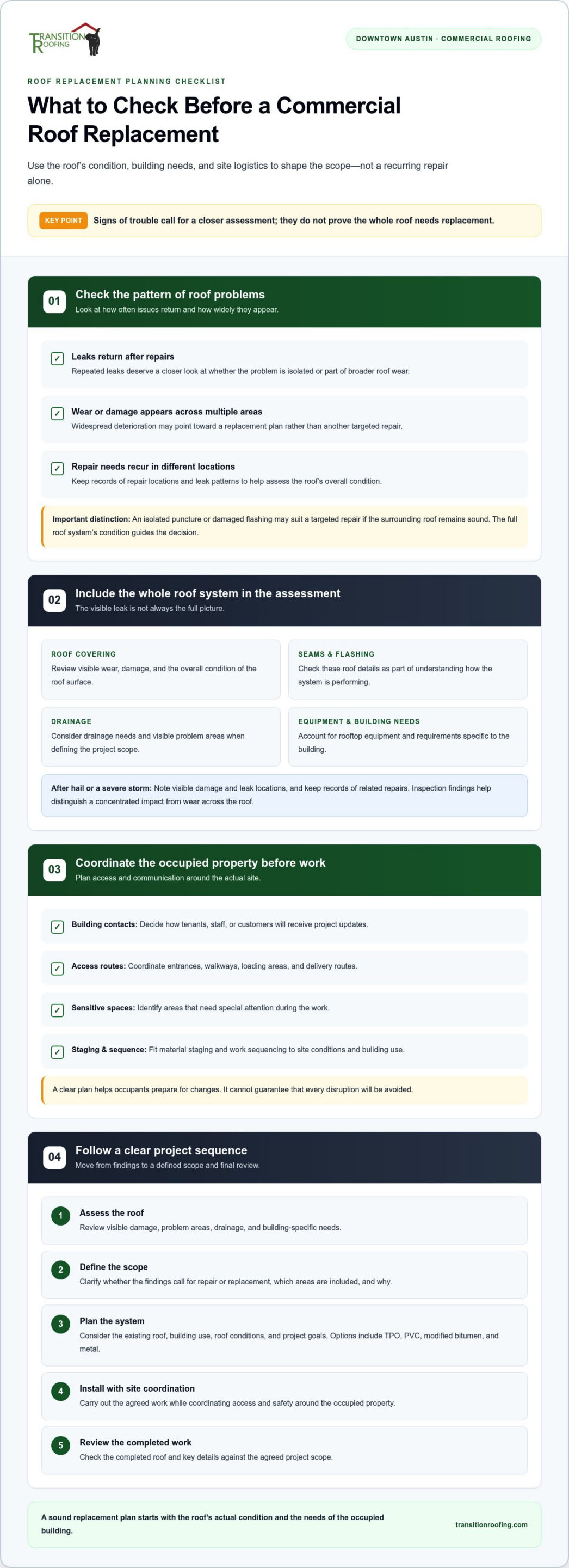
Recurring leaks, aging materials, and concerns about protecting an occupied building deserve a careful assessment, not another repair by default. A leak may come from one damaged area, while repeated problems in different locations can point to broader wear. Look for persistent leaks, visible deterioration across several roof areas, and repairs that keep being needed. These signs call for a closer look, but don’t prove on their own that the entire roof needs replacement.
An assessment helps determine whether the issue is localized or affects more of the roof system. The roof covering, seams, flashing, and drainage all contribute to how the system performs. For a basic overview of types of commercial roofs, consider how different designs use different materials and structures. Transition Roofing’s commercial roofing services in Austin include assessment, repair, and replacement planning.
- Leaks that return after repairs
- Visible wear or damage across multiple roof areas
- Repair needs that recur in different locations
Which roof problems suggest replacement rather than another repair?
An isolated puncture or damaged flashing may be suitable for a targeted repair if the surrounding roof remains in sound condition. Repeated leaks or deterioration across broad areas may call for a replacement plan instead. Interior staining shows where water appeared, but not necessarily where it entered or how much of the roof is affected. Replacement decisions depend on the extent and condition of the complete roof system. An on-site assessment is needed before deciding whether repair remains practical.
How Austin heat, hail, and storms affect assessment
Austin heat, hail, and storms can affect roof performance in different ways. Heat can stress materials over time, while hail or a severe storm may cause more concentrated damage. Inspection findings help distinguish a specific impact from wear spread across the roof. If you’re considering commercial roof replacement in downtown Austin, documenting the location and pattern of damage helps build a plan around the roof’s actual condition. After a storm, note visible damage and leak locations, and keep records of related repairs.
How Commercial Roof Replacement Works in Downtown Austin
A well-planned project moves from inspection to a defined scope, system choice, installation, and final review. For commercial roof replacement in downtown Austin, each step should account for the roof’s condition and how the building is used. Low-slope roofing is roofing on a roof with only a slight incline, rather than a steep pitch.
- Assess the roof. Review visible damage, problem areas, drainage, and building-specific needs.
- Define the scope. Use the findings to determine whether the work calls for repair or replacement and what areas are involved.
- Plan the system. Match the proposed roofing system to the existing roof, building use, and project goals.
- Install the system. Complete the agreed work while coordinating site access and safety around the occupied property. OSHA’s guidance on OSHA safety standards for roofing projects is a useful reference for understanding fall-protection requirements.
- Review the work. Check the completed roof and key details against the project scope.
What happens during the roof assessment and scope planning?
The assessment looks at the roof’s overall condition, visible problem areas, drainage, rooftop equipment, and building-specific requirements. These findings help distinguish an isolated repair need from conditions that call for broader replacement work. A clear scope explains what work is proposed, which areas are included, and why. Transition Roofing’s commercial roofing services in Austin include project-specific assessment and planning.
How is a commercial roofing system selected?
System selection should fit the building, the existing roof, and the project goals, not follow a one-size-fits-all ranking. TPO, PVC, modified bitumen, and metal are commercial roofing system categories Transition Roofing works with. The assessment helps determine which option fits the project and its roof conditions. If you’re planning a replacement, you can connect with our commercial roofing team to discuss a clear project plan.
Planning a Downtown Austin Commercial Roof Replacement Around Business Operations
A commercial roof replacement can be planned around tenants, customers, building access, and daily operations. That doesn’t mean every disruption can be avoided. It means the project scope and communication should give property managers a clear picture of what work is planned, which areas may be affected, and what occupants need to know. In broader commercial building renovations, general contractors like strotherbuiltconstruction.com similarly emphasize careful site logistics and phased scheduling to keep active properties running. For a commercial roof replacement in downtown Austin, access and material staging should be based on the site, not assumed in advance.
What should property managers coordinate before work begins?
Before work starts, align the project team and building contacts on the details occupants will need. Note business-hour needs, sensitive areas, entry points, delivery routes, and any walkways that should remain clear. Site conditions shape where materials can be staged and how work can be sequenced. For properties featuring integrated parking facilities, technical planning references such as Design recommendations for multi-storey and underground car parks. Institution of Structural Enginee can offer useful insights into navigating structural and vehicle logistics. A defined scope makes it easier to share practical updates and prepare occupants for changes during installation.
- How tenants, staff, or customers will receive project updates
- Which entrances, walkways, or loading areas need coordination
- Whether sensitive spaces need special attention during work
- How material staging and work sequencing fit the property
When is a flat-roof specialist relevant?
Many commercial buildings have low-slope roofs, where drainage paths, seams, edges, and rooftop equipment can affect how replacement work is planned. These details need to fit the existing roof and the building’s use. A project involving a low-slope system can draw on flat roofing services in Austin to plan around those roof-specific conditions.
Clear communication starts with a clear assessment and scope. If you’re planning work on an occupied property, discuss a commercial roof assessment to map out the building’s needs and operating considerations.
Choosing a Commercial Roof Replacement Plan in Downtown Austin
The right plan matches the roof’s condition to the building’s needs. A repair may address a defined problem, while widespread deterioration may call for replacement. Maintenance helps keep a roof in serviceable condition through ongoing care. For commercial roof replacement in downtown Austin, the recommendation should come from the assessment, not a generic checklist.
Repair, replacement, or maintenance: which path fits?
These options serve different purposes. A project-specific assessment helps show which one fits the roof and avoids treating every leak as a reason for full replacement. The assessment should also consider the system, building use, access, and the pattern of past repairs. Transition Roofing’s commercial roofing services in Austin include repair, replacement, and preventative maintenance.
- Repair: For a defined issue when the surrounding roof remains in suitable condition.
- Replacement: For broader roof-system needs that a targeted repair won’t address.
- Maintenance: For ongoing upkeep suited to the roof’s current condition.
What happens after requesting an assessment?
The next step is to review roof conditions and project needs with the property decision-maker. Be ready to discuss known leak areas, past repairs, building use, and operational concerns. That information helps shape a clear scope. Price, timing, and the final recommendation depend on the roof and project details, so they should be based on an assessment rather than assumed in advance.
If you’re weighing repair against replacement, schedule a commercial roof inspection in Austin to review the roof and get a clear next step.
Set a Clear Next Step for Your Austin Property
A roof decision doesn’t have to start with a commitment to replace. Start by getting a clear view of the roof’s condition and the work it may need. That gives you a sound basis for planning, whether the next step is targeted repair, ongoing care, or a larger project. For an occupied downtown property, having that direction can also help you prepare building decision-makers and occupants before work is planned.
Transition Roofing serves Austin and Central Texas communities, including Round Rock, Pflugerville, Cedar Park, Lakeway, Hays, Bear Creek, San Leanna, Rollingwood, West Lake Hills, Buda, Kyle, and Bee Cave. If recurring issues have you considering commercial roof replacement in downtown Austin, bring the building’s concerns and operating needs into the assessment. A project-specific review can help turn uncertainty into a practical plan.
Schedule a commercial roof assessment in Austin to review your building’s roof, discuss its operating needs, and plan the right next step.
Frequently Asked Questions
How do I know if a commercial roof in downtown Austin needs replacement?
A commercial roof may need replacement when leaks recur in separate areas, repairs keep accumulating, or deterioration extends beyond one isolated spot. For commercial roof replacement in downtown Austin, have the full roof system assessed before deciding. Keep a record of leak locations and dates, and gather prior repair notes to help show whether problems are isolated or recurring. Interior stains alone can’t show how much of the roof is affected.
Can a commercial roof be replaced while a business stays open?
Yes, a business may be able to stay open during roof work, depending on the building layout, project scope, access, and work sequence. Before work starts, identify entrances, delivery routes, customer areas, and spaces with special access needs. Share those details during planning so the project team can coordinate around building use. Managers should prepare occupants for possible changes during the work rather than expect zero disruption.
How long does commercial roof replacement take in Austin?
There isn’t one reliable duration for every commercial roof replacement in Austin. The schedule depends on the roof area, existing conditions, selected system, scope of removal, site access, and weather during the work. A roof with complex details or restricted staging may require a different sequence than a straightforward project. The project schedule should be based on the building and defined scope.
What roofing systems are used for commercial roof replacement?
Commercial replacement systems include TPO, PVC, modified bitumen, and metal roofing. The right option depends on the building, existing roof, project goals, and how the roof is used. For example, a low-slope roof and a metal roof have different system requirements, so material choice should follow an assessment rather than a general ranking. Transition Roofing works with commercial roofing systems suited to project-specific needs.
Does hail damage mean a commercial roof must be replaced?
No, hail damage doesn’t automatically mean a commercial roof needs replacement. The extent and location of damage, along with the roof’s overall condition, help determine whether a targeted repair or broader work is appropriate. After a storm, record where damage is visible and arrange an assessment to review the roof surface and details. Transition Roofing also provides hail damage repair and insurance claim assistance.