
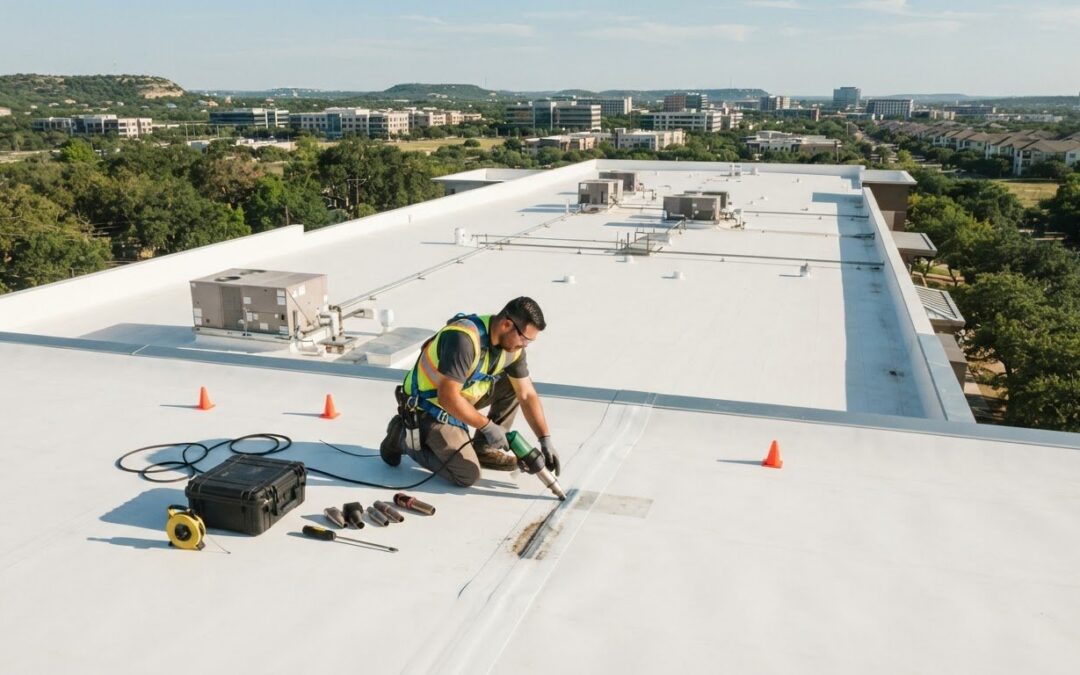
Smearing caulk or black roof cement over an open flat roof seam will never fix a commercial leak; it only traps moisture until your insulation is ruined. When single-ply systems pull apart under relentless sun, getting dependable TPO seam failure repair Austin property managers can rely on demands a permanent heat weld rather than a cheap, temporary patch.
You already know how stressful it is to discover wet drywall or threatened inventory after a sudden downpour, wondering whether you face a localized repair or a disruptive full tear-off. In this guide, you will learn how commercial property managers identify, repair, and permanently prevent TPO seam failures in the demanding Central Texas climate. We examine how professional probe testing uncovers hidden breaches, how manufacturer-certified hot-air welding restores original watertight strength, and how proactive maintenance keeps your commercial warranty intact.
Key Takeaways
- Learn how to spot early signs of membrane separation and water entry before sub-roof insulation sustains extensive damage.
- Discover why extreme Texas heat shifts trigger seam splits and how professional probe testing locates breaches fast.
- Understand why proper TPO seam failure repair Austin facilities require relies on calibrated hot-air welding rather than temporary mastics or sealants.
- Find out how to structure semi-annual roof inspections to safeguard active manufacturer warranties and avoid unnecessary full roof tear-offs.
TPO Seam Failure Repair Austin: Diagnosing Membrane Leaks in Austin, TX
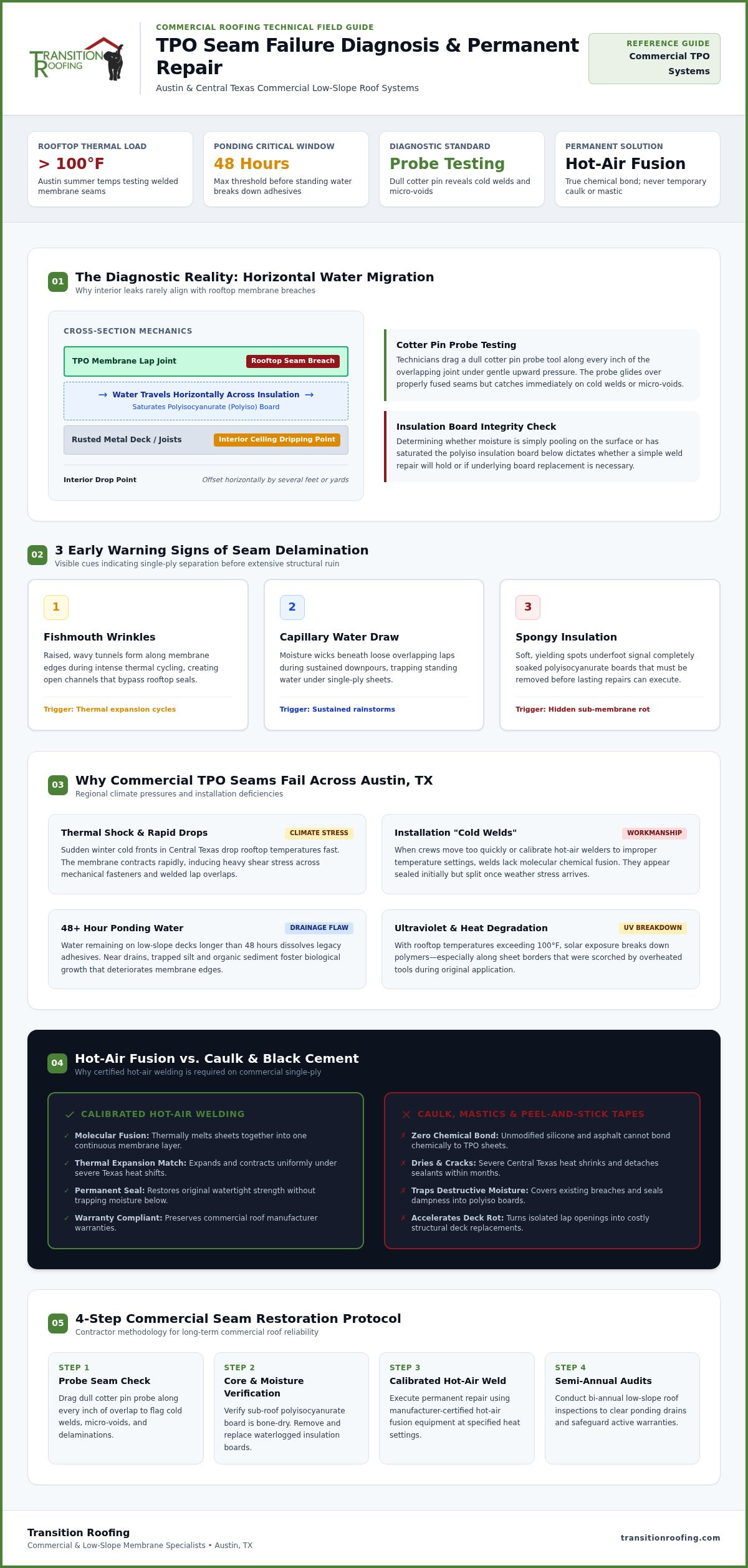
True seam failure occurs when hot-air welded overlaps in Thermoplastic polyolefin (TPO) membranes pull apart, breaking the rooftop seal. In commercial properties, this often manifests as ceiling moisture rings, dripping ceiling tiles, or rusted metal decking. Because water travels horizontally beneath single-ply sheets, interior dripping points rarely align directly beneath the actual membrane puncture.
To pinpoint the breach, experienced contractors avoid guessing. Technicians drag a dull cotter pin probe tool along every inch of the overlapping joint, applying gentle upward pressure. The probe glides over solid welds but catches immediately on cold welds or micro-voids. Knowing whether water is simply pooling on the surface or has saturated the polyiso insulation board below dictates whether a simple weld repair will hold or if underlying board replacement is necessary.
To see how commercial roofing crews weld intricate transitions, watch this demonstration:
Early Warning Signs of Delaminated TPO Seams
- Fishmouth wrinkles: Raised, wavy tunnels form along membrane edges during intense thermal cycling.
- Capillary water draw: Moisture wicks under loose laps during sustained storms, leaving water trapped below.
- Spongy insulation: Soft spots underfoot signal soaked polyisocyanurate boards that need removal before executing lasting repairs.
Why Temporary Caulk and Mastic Fail on Commercial Seams
Unmodified silicone and asphalt mastic cannot bond chemically to thermoplastic polyolefin sheets. The severe Central Texas heat causes standard sealants to dry, crack, and pull away within months, accelerating sub-membrane rot. If you notice split laps on your facility, partnering with an experienced team for commercial roofing in Austin ensures durable hot-air welded fixes rather than failing caulk.
Why Commercial TPO Roof Seams Fail Across Austin, TX Properties
Commercial rooftops in Austin face brutal weather extremes. Summer rooftop temperatures routinely exceed 100°F, placing relentless pressure on single-ply membranes. While high-grade TPO reflects significant solar radiation, intense thermal loads continuously test welded sheet boundaries across large commercial facilities.
When an installation crew moves too fast or sets hot-air welding equipment to incorrect temperature settings, the resulting weld remains incomplete. These cold welds look fine on the surface initially. However, they lack complete chemical fusion. Once severe weather hits, structural shifts expose those weak points, making timely TPO seam failure repair Austin building owners need essential to halt deck rot.
Central Texas Thermal Cycling and UV Degradation
Austin weather often shifts violently within hours. Rapid drops during sudden winter cold fronts trigger severe thermal shock. The membrane contracts quickly, creating intense shear stress along mechanical fasteners and seam overlaps.
- Extreme heat cycles: Continuous expansion and contraction pull weak joints apart.
- Ultraviolet breakdown: Harsh sun degrades surface polymers if sheets were scorched during installation.
- Stress along fasteners: Wind loads and building movement pull seams directly against internal plates.
Ponding Water and Poor Slope Drainage
Low-slope decks with poor drainage invite standing water. When water remains ponded for more than 48 hours after heavy rainfall, it breaks down residual seam adhesives used in legacy repairs. Silt and organic debris accumulate near commercial drains, fostering biological growth that eats away at membrane edges. If you suspect your low-slope deck is retaining water after heavy storms, have an experienced flat roofing contractor assess the drainage to stop recurring seam failures before sub-insulation gets saturated.
Contractor Guide: TPO Seam Failure Repair in Austin, TX
Permanent seam repairs require certified hot-air tools, never adhesive glues or peel-and-stick tapes. Before any repair begins on commercial low-slope decks, technicians verify deck integrity and confirm the underlying polyiso boards are bone-dry. Trapping moisture under a newly fused seam leads directly to internal blisters and structural rust. Performing reliable TPO seam failure repair Austin properties demand follows a strict, five-step technical process.
Step 1 & 2: Surface Preparation and Weathered Membrane Cleaning
Aged TPO develops a stubborn film of oxidation, road exhaust, and biological buildup from Central Texas storms. Crews prepare the repair zone through careful detailing:
- Scrub the membrane using dedicated TPO weathered membrane cleaner.
- Rinse away loosened dirt to expose the raw thermoplastic polymer.
- Allow all solvent cleaner to fully flash off so heat guns do not ignite lingering fumes.
Step 3 to 5: Hot-Air Welding, Rolling, and Edge Sealing
Once the surface dries completely, technicians restore the seam using heat and pressure:
- Hot-air fusion: An electric hand welder heats the membrane interface to the exact manufacturer-specified temperature window.
- Mechanical rolling: The technician follows the heat nozzle with a 2-inch silicone pressure roller, fusing the molten layers into a single homogeneous sheet.
- Targeted patching: An unreinforced TPO cover strip is welded over the repaired lap, extending at least two inches past the breach.
- Probe inspection: Technicians run a dull probe along the edge after it cools, applying edge sealant over any cut membrane scrim.
If your commercial building has active leaks around aged laps, schedule a professional roof inspection to restore your seams before interior assets suffer damage.
Preventing Commercial TPO Seam Leaks in Austin, TX Facilities
Stopping leaks before water penetrates your facility requires structured, bi-annual reviews. In Austin, TX, schedule commercial evaluations early in spring before severe hail rolls in, and again in late autumn ahead of winter rains. Keeping roof drains, gutters, and perimeter scuppers free of debris prevents ponding water from accelerating lap fatigue. A clear maintenance log also helps differentiate between localized flaws that need fast hot-air welding and widespread degradation requiring major membrane recovery.
Preventative Maintenance and Warranty Compliance
Major single-ply manufacturers like Versico and Duro-Last require documented preventative maintenance to keep commercial material and labor warranties fully active. Routine probe testing catches hairline edge separations long before water trickles onto interior inventory or office drywalls. If severe storms hit your area, check our Austin roof repair guide to learn how localized weather impacts commercial roof assemblies across Central Texas.
Working with Certified Central Texas Commercial Contractors
Single-ply systems require factory-approved methods. Property owners must ensure crews carry certified robotic and hand-welding gear rather than basic sealant tubes.
- Choose teams backed by over 15 years of hands-on Texas commercial roofing experience.
- Verify factory credentials with trusted manufacturers like Versico and Duro-Last.
- Demand physical probe checks and moisture scans before agreeing to full tear-offs.
- Rely on prompt TPO seam failure repair Austin specialists provide to protect active warranties.
This is usually when we recommend having a trained technician walk the roof surface. If you are dealing with open seams or persistent flat roof leaks, schedule a commercial roof inspection in Austin today to receive an honest assessment and an actionable plan.
Protect Your Commercial Roof with Permanent Seam Solutions in Austin, TX
A failing seam doesn’t have to trigger an expensive full roof tear-off. Quick caulk fixes always break down under relentless Texas sunshine. Lasting protection demands certified hot-air welding that fuses single-ply sheets at the molecular level. Catching separations early through routine probe testing keeps sub-insulation dry and ensures your commercial warranty stays completely valid.
At Transition Roofing, our crews bring over 15 years of Texas commercial roofing experience to every facility. As factory-certified installers of Versico, Duro-Last, and GAF commercial membranes, our technicians rely on calibrated industrial robotic and hand-held hot-air welders. We deliver the precise TPO seam failure repair Austin properties need to withstand sudden severe storms and blistering summer heat waves.
If you’re dealing with commercial roof leaks, we can take a look and give you a clear plan. Schedule a roof inspection in Austin today to secure your building and protect your investment.
Frequently Asked Questions About Flat Roof Seams in Austin, TX
Can you patch a failing TPO seam with silicone caulk or roofing tar?
No, you should never use silicone or roofing tar on single-ply membranes. Thermoplastic polyolefin requires thermal bonding to remain watertight. Caulk and asphalt products lack chemical adhesion to TPO, so intense Central Texas summer heat quickly cracks them away. Relying on makeshift mastic traps pooling water underneath the sheet, creating hidden rot across the sub-deck.
How do technicians verify a TPO seam weld is structurally sound?
Technicians verify weld integrity using a physical cotter pin probe tool and standard peel test protocols. Once the weld cools, the inspector drags the dull metal probe firmly along the seam edge. The probe slips cleanly over fused material, but catches on unbonded voids. For permanent TPO seam failure repair Austin crews confirm the membrane tears before the heat weld pulls apart.
What causes TPO roof seams to pull apart shortly after installation?
Early seam separation almost always stems from poor contractor technique during initial installation. If the crew welds over dirty, uncleaned sheets or operates the hot-air welder at incorrect heat and speed settings, cold welds occur. Sudden temperature drops during Austin cold fronts cause thermal contraction. This contraction places severe shear tension on those weak joints, popping the bond wide open.
How much wet insulation can remain under a repaired TPO seam?
Zero wet insulation can safely remain underneath a welded repair. Leaving water-logged polyisocyanurate boards below sealed single-ply sheets causes trapped moisture to boil in hot weather. This generates steam blisters, degrades structural decking, and invalidates manufacturer warranties. Professional commercial contractors cut out saturated insulation sections and install dry, clean replacement boards before completing any hot-air seam weld.
How long does a professional hot-air welded TPO seam repair last?
A properly executed hot-air weld lasts for the remaining lifespan of the surrounding roof membrane. Because the electric welder fuses the sheets into a continuous, singular layer rather than sticking them with glues, the joint resists moisture and UV degradation. When backed by regular commercial maintenance across Austin facilities, a certified single-ply repair provides durable protection for well over a decade.