

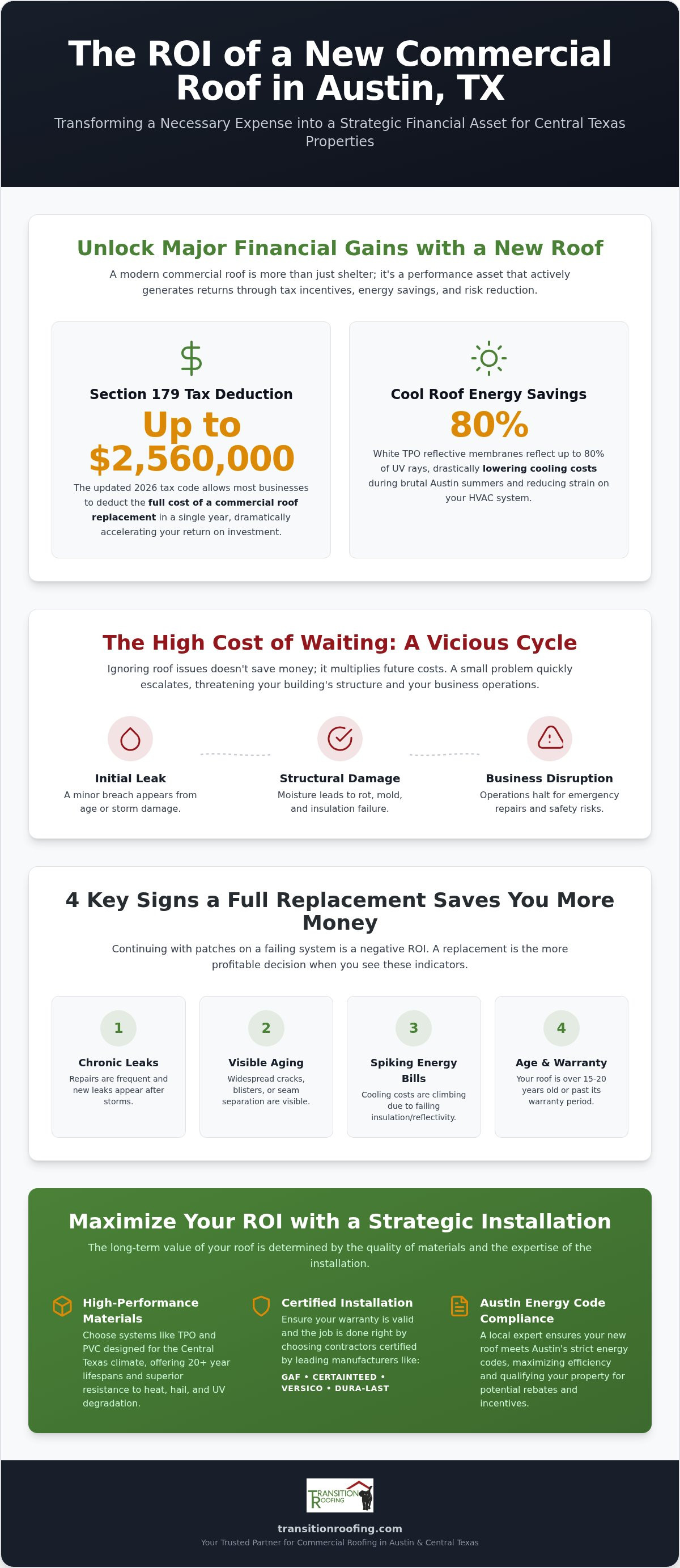
Most Austin property owners view a roof replacement as a massive expense; however, in 2026, the updated Section 179 tax code allows you to deduct up to $2,560,000 for the full cost of a new installation in a single year. When you factor in these incentives, the ROI of a new commercial roof becomes a strategic financial tool rather than just a maintenance headache. We know that managing a building in Central Texas feels like a constant battle against rising utility bills and the lingering stress of the next hail storm. It’s frustrating to face high insurance deductibles while your operational costs continue to climb.
This guide will show you how a smart roof investment pays for itself through 179D energy deductions, lower HVAC demand, and significantly reduced insurance risks. We’ll break down the specific ways high-performance materials like TPO protect your bottom line and property appraisal. You’ll learn exactly how to transform a vulnerable structure into a secured asset that provides predictable maintenance costs for the next 20 years. By understanding the current tax landscape and local energy codes, you can turn a necessary repair into a long-term profit driver.
Key Takeaways
- Learn how the 2026 Section 179 tax code allows you to deduct the full cost of a roof replacement in a single year.
- Discover how white TPO membranes reflect up to 80% of UV rays to significantly lower cooling costs during Austin summers.
- Understand how to calculate the total ROI of a new commercial roof by weighing energy savings against long-term asset value.
- Identify the four specific signs that indicate a full roof replacement will save more money than continuing emergency repairs.
- See how choosing a certified local contractor ensures your building remains compliant with Austin’s strict energy codes.
Defining the ROI of a New Commercial Roof in Austin, TX
In the business world, Return on Investment (ROI) measures the efficiency of an investment by comparing the net profit to the original cost. Calculating the ROI of a new commercial roof involves looking past the initial invoice to see the long-term wealth it generates. It’s the difference between a building that drains your bank account through repairs and one that actively saves you money every month. We view a roof as a performance asset, not just a lid on a building.
To better understand this concept, watch this helpful video:
We categorize these gains into “hard” and “soft” returns. Hard ROI includes measurable savings like lower energy bills and immediate tax deductions. Soft ROI involves the peace of mind that comes with tenant satisfaction and a professional building appearance. In Austin, TX, our roofs face extreme stressors like 100-degree summers and sudden hail storms that can ruin a low-quality system in months. Contractor logic dictates that investing in a 20-year warranted system is always more profitable than spending five years on a treadmill of emergency patches.
Initial Capital Expenditure vs. Lifecycle Value
The cheapest bid is often the most expensive choice you can make. A low-cost roof usually fails early, leading to a negative ROI because you’re paying for a replacement twice in the time a quality system would still be under warranty. Choosing Transition Roofing’s commercial services allows you to compare systems like TPO and metal that extend your break-even point. These high-quality materials, installed by experts with over 15 years of experience, ensure your capital expenditure translates into decades of protection.
The True Cost of Deferred Maintenance
Waiting to act on a failing roof is a gamble with your structural integrity. Small leaks quickly evolve into structural rot and mold, turning a simple membrane fix into a massive remediation project. Beyond the physical damage, you must consider business interruption. Avoiding a “closed for repairs” sign is a significant part of the ROI of a new commercial roof. We use certified systems from GAF, Certainteed, Versico, and Dura-last to ensure your facility stays open and dry, regardless of the Central Texas climate.
Energy Efficiency and HVAC Savings for Austin, TX Facilities
Austin summers are relentless. With temperatures regularly hitting 100 degrees, your HVAC system works overtime just to keep your facility habitable. A traditional dark roof absorbs heat; a white TPO membrane reflects up to 80% of UV rays. This “Cool Roof” effect creates a massive shift in the ROI of a new commercial roof by cutting cooling costs immediately. According to the U.S. Department of Energy, using Energy-Efficient Cool Roof Products can significantly reduce a building’s cooling load and lower interior temperatures.
Beyond monthly bills, you’re protecting your expensive HVAC equipment. When a roof reflects heat, the air intake temperatures for rooftop units are lower. This reduces thermal stress on your equipment, meaning your units break down less often and last years longer. If you’re seeing your energy bills spike, we can help you evaluate a high-performance flat roof system that qualifies for local Austin Energy rebates. These rebates provide an immediate cash injection that shortens your payback period.
Reflective Membranes: TPO and PVC ROI
Systems from GAF and Versico are engineered to stay white and reflective for decades. In Texas, utility companies often charge “peak demand” fees during the hottest parts of the day. A reflective roof keeps your building cooler during these peak hours, which slashes those specific surcharges. This is a direct, hard-dollar return that most property managers overlook when calculating the ROI of a new commercial roof.
Insulation Upgrades (R-Value) During Replacement
A roof replacement is the only time you can cost-effectively double your insulation. We define R-value as the measure of thermal resistance in roofing assemblies. The higher the R-value, the better your building holds its temperature. Adding extra polyiso insulation board during a re-roofing project is one of the fastest ways to see a return. It turns your roof into a thermal barrier that works 24/7 without any moving parts or maintenance costs.
Tax Advantages and Insurance ROI for Central Texas Roofs
Financial gains from a roof replacement go beyond energy savings. The current tax code provides a powerful mechanism to recoup your costs quickly. Historically, commercial roofs were depreciated over a 39-year period. However, under Section 179, business owners can now deduct the full cost of a new roof in the year it is installed. For 2026, the deduction limit has increased to $2,560,000. This immediate expensing turns a major capital expenditure into a significant tax shield, dramatically improving the ROI of a new commercial roof.
In addition to the standard deduction, you might qualify for the tax deduction for energy-efficient commercial buildings under Section 179D. These incentives are specifically designed to reward owners who invest in high-performance systems. We recommend consulting with your CPA to ensure you maximize these first-year write-offs before the December 31st deadline. Taking advantage of these codes allows you to keep more capital in your business while securing your property.
Section 179: Turning a Liability into a Tax Shield
The 2026 tax benefits for non-residential building improvements are substantial. With the phase-out threshold set at $4,090,000, most Central Texas small and mid-sized businesses can fully leverage this deduction. By writing off the entire project in year one, you significantly shorten your payback period and increase your immediate cash flow.
Reducing Insurance Liability and Deductibles
In areas like Round Rock and Pflugerville, often called “Hail Alley,” the risk of storm damage is a constant threat. Installing Class 4 impact-resistant materials provides a double benefit. First, it protects your building from the physical impact of large hail. Second, many Texas insurers offer premium discounts for buildings with these certified systems. A new, warrantied roof also reduces the likelihood of “interior finish” claims, which makes your property more attractive to underwriters. If you are currently dealing with damage, we can assist with Austin roof repair and storm recovery to get your asset back to peak condition.
Insurance carriers in 2026 have tightened their standards, often refusing to cover roofs older than 15 years at replacement cost value. By upgrading now, you secure full coverage and potentially lower your wind and hail deductibles. This proactive approach is a core part of calculating the total ROI of a new commercial roof. If you want to see how a new system can lower your insurance costs, contact our team for a detailed roof assessment today.
Maximizing Your Investment with the Right Installation Strategy in Austin, TX
To secure the highest ROI of a new commercial roof, you must look beyond the day of installation. A strategic approach ensures that your capital expenditure translates into long-term wealth rather than recurring expenses. We’ve spent over 15 years in Central Texas seeing how local expertise prevents the most common failures. Choosing a contractor certified by GAF, Certainteed, Versico, or Dura-last is the first step in ensuring your system meets the strict 2021 International Energy Conservation Code (IECC) requirements enforced in Austin.
We use a simple 4-step framework to help property managers decide when to act:
- The 25% Rule: If localized repair costs exceed 25% of a total replacement, the financial logic shifts toward a new system.
- Systemic Failure Check: We look for widespread moisture in the insulation that indicates the entire assembly is compromised.
- Warranty Comparison: We contrast the 1-year guarantee of a patch with the 20 to 30-year security of a new manufacturer warranty.
- Energy Audit: We evaluate if your current roof is contributing to the “peak demand” charges common in Texas summers.
When Replacement Beats Repair for Long-Term ROI
Localized damage often masks systemic failure. When a roof reaches the end of its lifecycle, continuing to pay for emergency repairs is like throwing money into a sinking ship. Modern 20 to 30-year warranties provide a level of financial predictability that short-term patches cannot match. By investing in a full replacement now, you lock in current material prices and avoid the 5% to 8% annual increases we’ve seen in early 2026. This proactive move stabilizes your operational budget for decades.
Professional Maintenance: Protecting the Asset
Think of a maintenance plan as the insurance policy for your ROI of a new commercial roof. Small issues like clogged drains or slightly separated seams can lead to $50,000 structural failures if ignored. The Transition Roofing maintenance program focuses on bi-annual inspections to catch these vulnerabilities early. Documented inspections are also vital for maintaining your manufacturer warranty and increasing your property’s resale value. If you’re seeing signs of wear, we can take a look and give you a clear plan to protect your investment.
Secure Your Commercial Asset in Austin Today
Investing in your building’s exterior is one of the most effective ways to stabilize your long-term operational budget. By leveraging the updated Section 179 tax deductions and installing high-reflectivity TPO membranes, you transform a necessary maintenance task into a high-yield financial strategy. The ROI of a new commercial roof is measured in decades of protection and immediate energy savings during our intense Austin summers. You aren’t just buying a roof; you’re securing your property’s value and insurability in an increasingly strict insurance market.
We’re here to help you navigate these technical decisions with confidence. Our team brings over 15 years of Central Texas expertise and holds elite certifications with GAF and Versico. If you’re ready to see the numbers for your specific facility, we’ll provide a detailed ROI and energy analysis. Schedule a professional ROI roof assessment in Austin today to get a clear plan for your building’s future. It’s time to move your structure from a state of vulnerability to total security.
Frequently Asked Questions
How long does it take for a commercial roof to pay for itself through energy savings?
Most Central Texas businesses see a return on their energy investment within 7 to 10 years. This timeframe depends on your building’s current insulation levels and the efficiency of your HVAC units. By switching to a white TPO membrane, you reduce the heat load on your building. This typically lowers monthly cooling bills by 15% to 25% during the peak of an Austin summer.
Can I write off the entire cost of a new commercial roof in one year?
Yes, you can deduct the entire cost of your installation in a single year using the Section 179 tax code. For 2026, the deduction limit is $2,560,000 for qualifying non-residential improvements. This immediate expensing is a major driver of the ROI of a new commercial roof. It provides a massive tax shield that offsets your initial capital expenditure immediately.
Does a new commercial roof increase property value in Austin, TX?
A new commercial roof significantly increases property appraisal value in Austin, TX by removing a major liability for future buyers. Investors prioritize properties with warrantied, energy-efficient systems that comply with local ECAD ordinances. Having a certified installation from a local expert with over 15 years of experience provides the documentation needed to justify a higher asking price during a property sale.
How much can I save on insurance premiums with a new commercial roof?
Insurance savings vary, but many Texas carriers offer premium credits for installing Class 4 impact-resistant materials. More importantly, a new roof allows you to maintain “replacement cost” coverage. Without a recent replacement, insurers may switch your policy to “actual cash value,” which pays out significantly less after a storm. This protection is a critical part of the ROI of a new commercial roof.
Is TPO or Metal roofing better for ROI in Central Texas?
TPO generally offers a faster short-term ROI due to its lower installation cost and high solar reflectivity. It is the standard for cooling efficiency in our climate. Metal roofing requires a higher initial investment but provides a superior lifecycle ROI because it can last 50 years or more. We recommend TPO for owners focused on immediate cash flow and metal for those holding the asset for decades.