
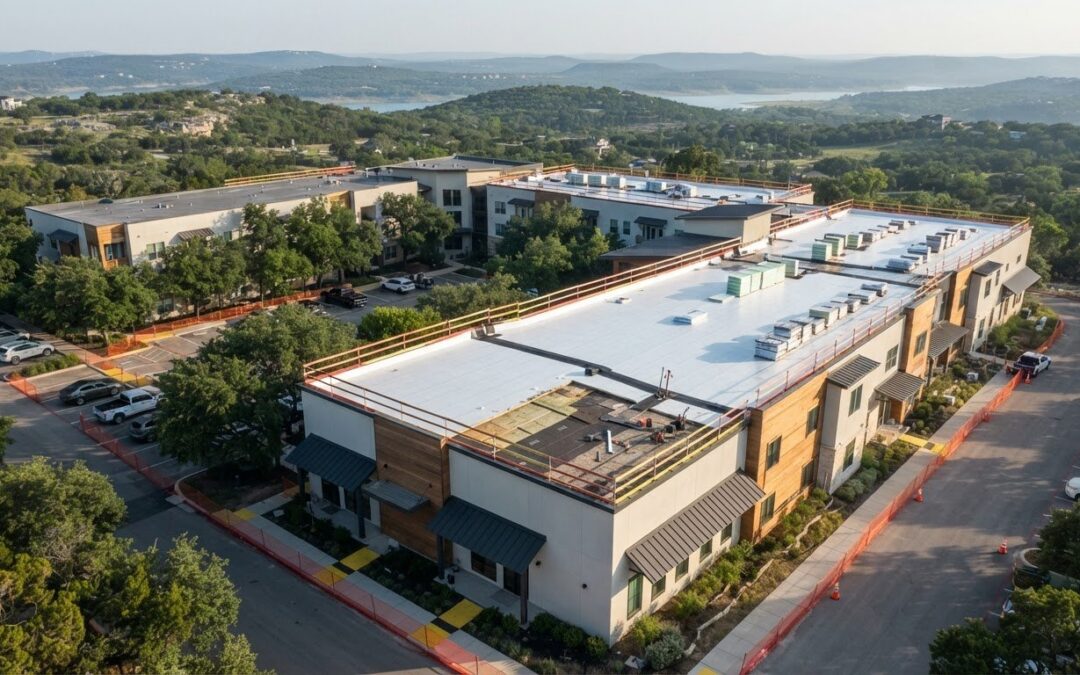
What if the biggest risk in an apartment building reroof isn’t the roof itself, but a scope that leaves residents guessing? For an apartment building reroofing project Lakeway property managers need a clear plan for leaks, work areas, resident access, and parking before crews arrive. Those details matter when Central Texas heat, hail, and storms add stress to a roof.
It’s not always obvious whether targeted repairs can address the problem or whether a full replacement is the better next step. This guide explains what a roof assessment should establish, how to compare TPO, PVC, modified bitumen, and metal, and what a useful written scope should include. You’ll also learn how to sequence work and communicate with residents to limit avoidable disruption. Transition Roofing provides commercial roof installation, repair, and maintenance in Lakeway and Central Texas. A documented scope and resident-aware schedule help turn a complex project into a clear plan.
Key Takeaways
- Use leak history, visible wear, and documented moisture evidence to decide whether repairs may be enough or replacement needs closer review.
- Compare TPO, PVC, modified bitumen, and metal based on roof conditions, maintenance needs, and the details in each proposal.
- Plan an apartment building reroofing project Lakeway residents can navigate with clear notices, parking plans, and defined access areas.
- Review the written scope for removal, drainage, roof penetrations, work areas, and closeout details before approving the project.
Apartment building reroofing project Lakeway: assess the roof and define the need
An apartment building reroofing project Lakeway should begin with evidence, not a blanket assumption that every leak calls for a new roof. Match leak reports and repair history to specific roof areas. Then document the conditions found before deciding what work is needed.
For a general overview of roof construction and roofing systems, see Wikipedia. The video below shows a commercial roof tear-off, one possible part of a reroofing project.
What should a Lakeway apartment roof assessment establish?
Separate observed conditions from proposed work. The assessment should identify affected roof sections, visible wear, drainage paths, roof penetrations, and signs of water entry. Map known leak locations and note which occupied units or shared spaces have reported problems. Record roof access points and restricted areas as well. This gives property managers a clear picture of what was found and why each repair or replacement step is recommended.
When might repair no longer address the property’s needs?
A leak in one area with a clear, localized cause may call for a targeted repair. Repeated leaks in different areas, recurring repair needs, or moisture concerns across several roof sections may signal a broader problem. Base the decision on documented findings, not roof age alone. Transition Roofing assesses commercial roofs and develops project-specific scopes through its commercial roofing services in Austin. This gives owners a clearer basis for comparing repair and replacement.
In Central Texas, heat, hail, and storms can contribute to roof wear. If leak reports increase after severe weather, record the dates, locations, and any visible signs of water entry. This helps connect resident concerns with roof conditions and gives the next project step a sound starting point.
Choose an apartment roofing system for Lakeway and the Austin, TX area
Choose a system to match the roof’s documented condition, layout, drainage, and use, not just its name. For an apartment building reroofing project Lakeway, factor in Central Texas heat, hail, and storms, but don’t treat any material as a guarantee against damage. The National Roofing Contractors Association offers roofing industry resources. The project scope should still explain why the proposed system fits this building.
How do flat-roof systems differ for multifamily properties?
Membranes are sheet materials installed over a roof to help shed water. TPO and PVC are single-ply membranes, while modified bitumen is a layered roof system. Explore flat roofing systems for an overview of relevant options.
| System | Roof conditions to consider | Maintenance focus | Proposal question |
|---|---|---|---|
| TPO | Low-slope areas where a membrane is being considered | Seams, edges, and penetrations | How will seams and details be installed? |
| PVC | Low-slope areas; assess exposure and roof layout | Seams and roof penetrations | Why does this system suit the property? |
| Modified bitumen | Areas where a layered system fits the existing roof conditions | Surface wear and drainage paths | How will transitions and drains be handled? |
| Metal | Roof areas where the structure and layout suit metal panels | Fasteners, seams, and connections | How will penetrations and transitions be detailed? |
Which project criteria matter more than a material label?
Compare the proposed system with the roof’s drainage, existing layers, penetrations, access needs, and occupied use. Poor drainage or complex rooftop equipment can affect detailing and future maintenance regardless of material. Ask for a clear description of the system, removal plan, and how drains and penetrations will be addressed. Any manufacturer or certification claims in a proposal should be specific and verifiable.
Transition Roofing assesses commercial roof conditions and develops project-specific scopes. Review Transition Roofing’s commercial roofing approach as you plan the next step.
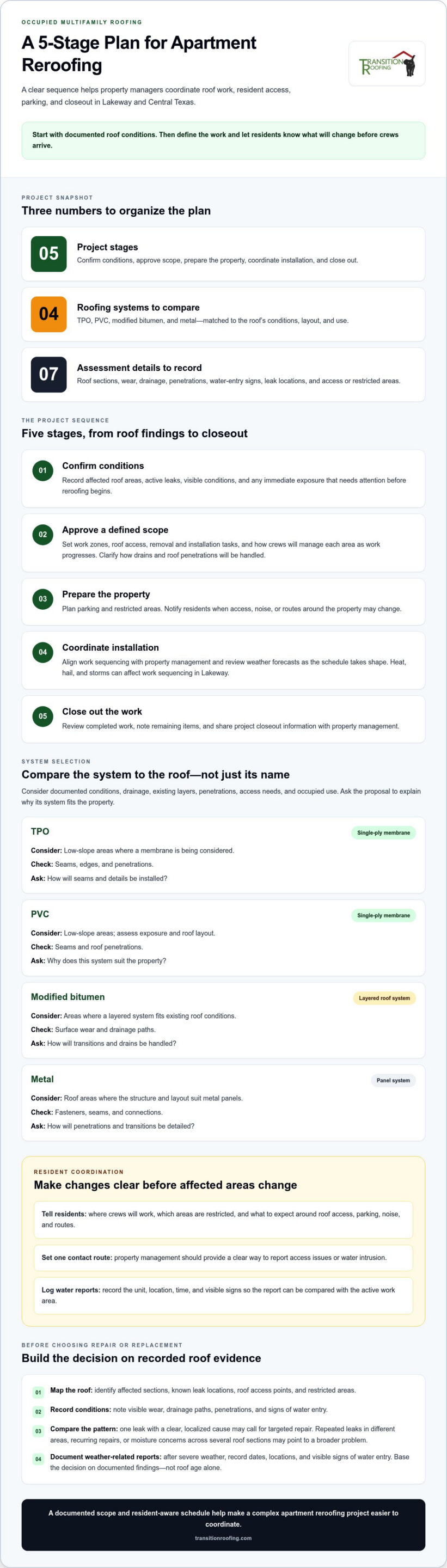
Plan occupied apartment reroofing in Lakeway and Austin, TX
An apartment building reroofing project Lakeway needs a sequence that keeps residents informed and work areas clear. Coordinate decisions through property management, and give residents one clear way to report access issues or water intrusion.
- Confirm conditions: Record roof areas, active leaks, and any immediate exposure that needs attention before reroofing begins.
- Approve the scope: Define work zones, roof access, removal and installation tasks, and how the crew will manage areas as work progresses.
- Prepare the property: Set parking and restricted-area plans. Tell residents when access, noise, or routes around the property may change.
- Coordinate installation: Align work sequencing with property management and review weather forecasts as the schedule takes shape.
- Close out: Review completed work, note any remaining items, and share the project closeout information with management.
What should residents and property managers know before work begins?
Send updates before affected areas change. Explain where crews will work, how residents should avoid restricted zones, and what to expect around roof access and parking. Property management should name one contact route for concerns. If a resident reports water intrusion, record the unit, location, time, and visible signs so the issue can be compared with the active work area.
How should the project team manage weather exposure?
Lakeway’s heat, hail, and storms can affect work sequencing. Forecasts help the team plan which roof areas to open and how to protect exposed sections, but conditions can change. Track active leaks separately from permanent reroofing tasks. Immediate protection addresses current exposure; the approved reroofing scope defines the lasting work. For roofing contractor guidance in Austin, review Transition Roofing’s commercial roofing information.
For help planning an occupied-property project, connect with Transition Roofing about a clear, project-specific scope.
Review the reroofing scope and take the next step in Lakeway, TX
Before approving an apartment building reroofing project Lakeway, check that the proposal explains the work and why it is recommended. Documented moisture evidence, such as mapped leak locations or visible signs of water entry, can help show whether the recommendation addresses a localized problem or broader roof concerns. It also gives property managers a clearer record for comparing repair and replacement options.
What belongs in a clear apartment reroofing proposal?
A useful proposal defines the work areas, roofing system, preparation, and project-specific exclusions. Review it for these details:
- Roof sections included and any areas excluded from the work
- System description and how roof edges, penetrations, and transitions will be handled
- Removal approach and what happens if existing conditions differ from what is visible
- Drainage work, including how drains and water-flow paths will be addressed
- Closeout details, such as how completed work and remaining items will be documented
Estimate factors include roof area, access, existing conditions, selected system, and project complexity. Comparing proposals with these details in view helps explain differences without relying on a material label alone. For an overview of commercial roof installation in Central Texas, see Transition Roofing’s commercial roofing service information.
How can Transition Roofing help move the project forward?
Transition Roofing assesses commercial roofs, reviews their condition and moisture evidence, and develops project-specific scopes that account for occupied areas and site access. The scope sets out the recommended work, from preparation through closeout.
If you’re planning a Lakeway reroof or dealing with recurring leaks, Transition Roofing can assess the property and outline a clear plan.
Set Your Lakeway Reroofing Project Up for Success
A well-planned apartment building reroofing project Lakeway starts with documented roof conditions and a scope that explains why repair or replacement is recommended. Match the roofing system to the building’s drainage, access, and existing conditions, then plan resident notices, parking, and work zones before installation begins. Clear details help property managers compare proposals and prepare residents for the work ahead.
Transition Roofing provides commercial roof installation, repair, and preventative maintenance in Central Texas, including Lakeway and nearby communities such as Austin, Round Rock, Pflugerville, Cedar Park, Hays, Bear Creek, San Leanna, Rollingwood, West Lake Hills, Buda, Kyle, and Bee Cave. Whether you’re tracking recurring leaks or planning a full reroof, an assessment can establish a practical next step for the property.
Schedule a Lakeway apartment roof assessment to review the roof’s condition and outline a clear project plan. A clear scope and resident-aware planning help you move forward with greater confidence.
Frequently Asked Questions
How do I know whether an apartment building needs reroofing or roof repairs?
A roof assessment can show whether problems are localized or spread across several areas. A single leak with a clear cause may be a candidate for repair, while recurring leaks, repeated repair needs, or moisture concerns across multiple roof sections may support considering replacement. For an apartment building reroofing project Lakeway, use documented roof conditions and leak locations to understand the recommendation, rather than relying on age or assumptions alone.
How long does an apartment building reroofing project take?
The schedule depends on roof area, existing conditions, selected system, removal work, access, and project complexity. Weather can also affect sequencing in Lakeway and the wider Central Texas area. An assessment and written scope help define the work phases and likely schedule for the specific property. For an occupied building, planning must also account for resident notices, parking, restricted areas, and coordination with property management.
How much does an apartment building reroofing project in Lakeway cost?
There isn’t one reliable price for every apartment reroof. The estimate depends on roof area, access, existing layers and conditions, selected system, drainage details, penetrations, and project complexity. Compare written proposals by checking that they describe the same work areas, removal plan, system, and closeout. A documented assessment helps explain the basis for repair or replacement and makes proposal differences easier to understand.
Can residents stay in an apartment building during reroofing?
Residents may be able to remain in their units during reroofing, but the plan depends on the property layout, work sequence, and site conditions. Property management should share updates on work zones, noise, parking, access changes, and restricted areas. Set a clear route for residents to report concerns, especially water intrusion. The project plan should also explain how work areas will be managed as installation progresses.
Which roofing systems are considered for apartment buildings in Central Texas?
Options for commercial and multifamily roofs can include TPO, PVC, modified bitumen, and metal. The right system depends on roof condition, drainage, penetrations, existing layers, access, and maintenance needs. Central Texas heat, hail, and storms should inform the evaluation, but no material guarantees performance in every condition. A project-specific scope should explain why the proposed system fits the building and how key roof details will be addressed.
If you’re planning a Lakeway apartment reroof or dealing with recurring leaks, Transition Roofing can assess the property and outline a clear plan.