

A lower roofing estimate doesn’t automatically mean you can keep the difference in insurance money. If you’re deciding what to do when an insurance check is less than a roofing estimate, compare the work, materials, and payment terms in both documents.
The gap may reflect depreciation withheld until repairs are complete, your deductible, or work the insurer hasn’t included. In some cases, you may keep funds if the insurer has paid the covered amount in full, minus your deductible, and the completed work costs less. The policy and claim terms determine what applies.
This guide explains how to compare estimates, understand actual cash value and replacement cost value payments, and document differences that may support a supplement request. For homeowners in Austin and Central Texas, these steps can clarify what the insurance payment covers and what may come next after hail or storm damage.
Key Takeaways
- Check whether the insurance payment reflects depreciation, your deductible, or a difference in the repair scope.
- Compare estimates line by line, including measurements, materials, labor, access, and related damage.
- Clear photos, roof measurements, and written explanations can help support disputed repair items.
- A supplement or reinspection may help address missing or undervalued work when the documentation supports it.
Actual cash value, replacement cost value, and depreciation in Austin, TX
The policy’s payment method can explain why an insurance check is less than a roofing estimate. Actual cash value subtracts depreciation, while replacement cost value may release recoverable depreciation after repairs.
Actual Cash Value
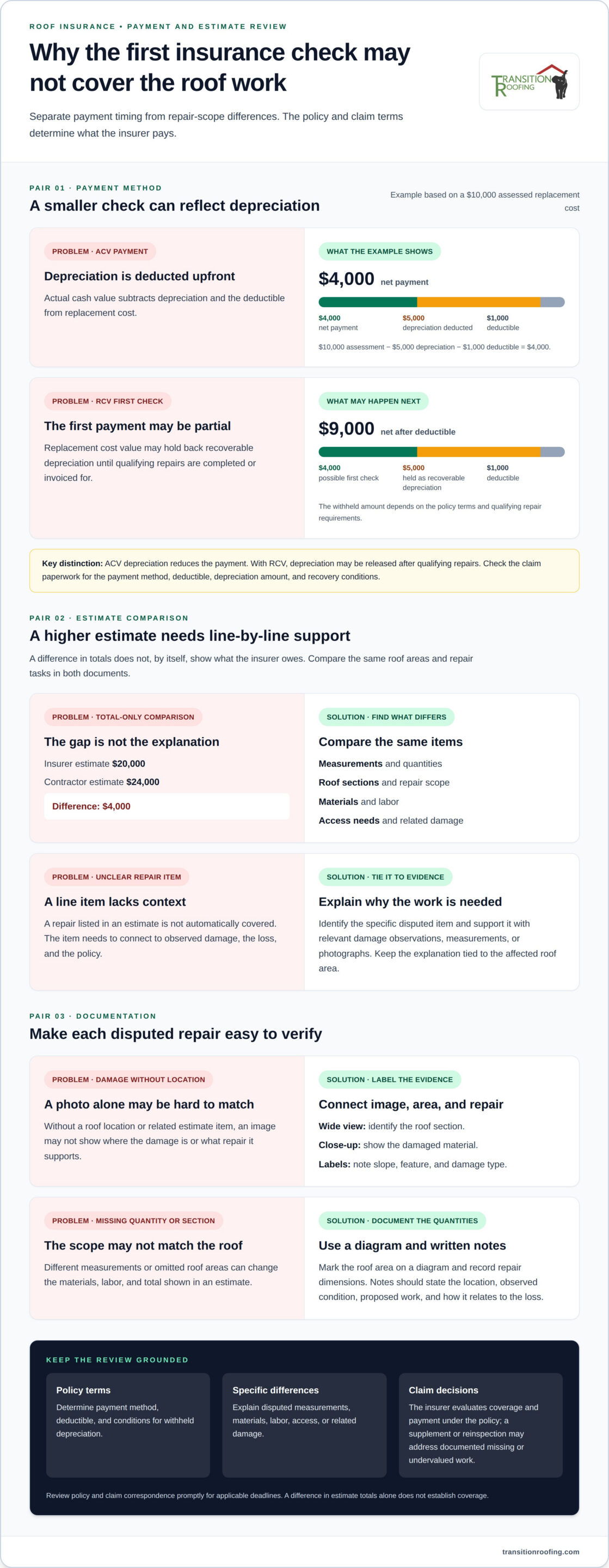
Actual cash value pays the replacement cost less depreciation and the deductible. Depreciation accounts for the roof’s age and condition, so the first payment can be lower than the estimated replacement cost. In an example, a $10,000 assessment minus $5,000 depreciation and a $1,000 deductible leaves a $4,000 net payment. Actual cash value policies usually offer lower premiums, but the homeowner must account for the depreciation deduction when planning repairs.
Replacement Cost Value
Replacement cost value covers the assessed replacement cost, subject to the policy terms and deductible. The payment is commonly split into an initial amount and recoverable depreciation. For a $10,000 assessment with a $1,000 deductible, the net payment is $9,000. The first check may be $4,000, with $5,000 held back as recoverable depreciation. That withheld amount is paid after the roofing work is completed or invoiced for. The timing matters: the first check may not cover the full project cost upfront.
Depreciation is not always recoverable. With an actual cash value settlement, the deduction reduces the payment. With replacement cost value, the policy may release the withheld amount after qualifying repairs. Review the claim paperwork for the payment method, deductible, depreciation amount, and conditions for recovering withheld funds. These details can show whether the smaller check reflects the policy calculation or a difference in repair scope.
A separate contract issue can arise if roofing work is agreed to at the homeowner’s property. According to the Federal Trade Commission, the Cooling-Off Rule applies to qualifying sales of $25 or more made at a buyer’s home. This rule concerns qualifying sales, not how an insurer calculates roof depreciation. Keep the contract terms and claim payment details distinct as you review what the check covers.
How a roofing contractor compares the insurer’s estimate with the contractor’s estimate
A contractor compares the same roof areas and repair tasks across both estimates. A higher contractor estimate does not automatically show how much the insurer owes. For example, an insurer may estimate covered repairs at $20,000, while the roofer estimates the same work at $24,000. The $4,000 difference needs a line-by-line explanation.
Start by comparing measurements and repair scope. The contractor checks whether both documents include the same roof sections, materials, labor, access needs, and related damage. Missing quantities can affect the total, as can differences in material descriptions or the areas included. A clear comparison identifies specific line items that differ, rather than treating the total alone as proof of an error.
Next, connect each disputed item to the observed damage and covered repair work. Necessary work should be explained and tied to the loss and policy. An item’s presence in an estimate does not make it automatically covered. In Austin, hail or storm damage may call for careful documentation of affected areas. The contractor can explain why a repair is needed and provide supporting measurements or photographs.
You can ask a roofing contractor to assess the roof and prepare an estimate. The insurer still evaluates coverage and payment under the policy. For an Austin claim, follow the deadlines in your policy and claim correspondence. Timing depends on the policy terms and type of dispute, so review those documents promptly instead of relying on a universal deadline.
A public adjuster may help document and negotiate a claim, while an attorney can advise on a coverage dispute. Fees depend on the engagement, so review the written terms and scope before agreeing. Watch for pressure to sign immediately, promises of guaranteed claim approval, or offers to absorb your deductible. A sound estimate explains the work without inflating it.
If the estimate leaves repair items unclear, a roofing professional’s review can help organize the differences and supporting details.
How a roofing contractor documents differences with photos and measurements
A contractor documents each disputed repair with evidence tied to a roof area. The file can pair a marked roof diagram with photographs and measurements. For example, a photo of a damaged shingle should identify its roof slope and location. This helps the insurer connect the visible condition to a specific estimate line, rather than relying on the total alone.
Photographs should show both context and detail. A wide view identifies the roof section, while a closer image records the damaged material. The contractor can label images by slope, feature, and damage type, such as a hail mark near a vent. Separate images can show related damage to the roof area and adjoining components. Consistent labels make the evidence easier to compare with the insurer’s inspection notes.
Measurements help explain the quantities in an estimate. A contractor records the roof areas and repair dimensions used to calculate materials and labor. If the insurer’s estimate omits a roof section, a roof diagram can show its location. For a disputed repair, written notes should state the location, observed condition, proposed work, and how the work relates to the loss.
- Photos: identify the slope, roof feature, and visible damage.
- Measurements: connect the affected area to the listed repair quantity.
- Written notes: explain the repair and link it to a specific estimate item.
In Austin, hail and storms can leave damage across different roof slopes. A contractor’s records should distinguish observed storm damage from unrelated wear, rather than grouping every roof condition together. This keeps a supplement focused on the claimed loss and gives the insurer specific evidence to review.
A complete documentation file can include an itemized estimate, labeled photographs, measurements, and a written explanation of disputed repairs. Professional contractors such as Miller’s Home Improvement emphasize that each item should match its supporting evidence. For example, a measurement should correspond to the roof area shown on the diagram, and a photograph should identify that same area. This organized record gives a reinspection or supplement request a factual basis for review.
How can a roofing contractor request a reinspection or supplement for a roof insurance claim?
A contractor builds a supplement request around specific differences between the insurer’s estimate and the roof’s documented repair needs. The request should identify each disputed item, explain why it belongs in the repair scope, and provide evidence for the insurer’s review.
First, organize the claim documents and identify what needs review. If the initial inspection missed a roof area or recorded a repair quantity incorrectly, name the issue directly in the request. A reinspection gives the insurer another opportunity to assess disputed damage. A supplement asks the insurer to consider additional or revised repair items.
A focused submission includes four core pieces:
- Itemized estimate: lists each proposed repair and its quantity.
- Photographs: show the affected roof areas and relevant details.
- Measurements: connect the roof area to the estimate quantities.
- Written explanation: explains each disputed repair and its connection to the covered loss.
For example, if the estimate leaves out a damaged roof section, the contractor identifies it, supplies measurements, and attaches labeled photographs. The written explanation describes the necessary repair and how it relates to the reported event. This gives the adjuster specific points to review instead of a general request for a higher payment.
The policyholder remains part of the process. The contractor can prepare supporting documents, while the homeowner provides claim details and follows the insurer’s submission process. Keep copies of the request and any response with your claim records. If the insurer agrees the damage is covered but disputes its value, negotiation or appraisal may be worth considering. Appraisal does not decide whether damage resulted from a covered event or falls under an exclusion.
If the estimate needs a documented review, get help organizing a roof claim supplement with clear repair details and supporting evidence.
Transition Roofing: Insurance Claim Assistance
Transition Roofing helps homeowners make sense of roof claim differences through Insurance Claim Assistance. Turn to this service when the insurer’s estimate and the documented repair scope do not match, or when you need help organizing information for a supplement request. Clear photographs, measurements, and an itemized estimate can show which repairs need further review.
For storm or hail damage in Austin, a focused review can connect roof conditions to proposed repairs. The goal is a clearer picture of the estimate and supporting documentation, not a promise about the insurer’s decision. If the roof needs covered repairs, the next step is understanding the work required to restore it.
If you need help reviewing a roof insurance claim, contact Transition Roofing.
Make your next roof decision with a clear plan
Before approving work or accepting a settlement described as final, make sure you understand what the agreement resolves and which rights you may give up. Aligning the repair plan with the claim decision can help you move forward with fewer unanswered questions.
If you’re asking what to do when an insurance check is less than a roofing estimate, focus your next conversation on the claim terms and unresolved details.
Discuss your roof estimate with Transition Roofing and take the next step with a clearer plan for your roof.
Frequently Asked Questions
If I get bids lower than what my insurance company paid, can I keep the difference?
Sometimes, but only if the insurer has paid the covered amount in full, minus your deductible, and the work costs less. The policy and settlement terms determine whether you can keep remaining funds. Before treating the difference as yours, confirm whether depreciation is still withheld or payment depends on completed repairs. Don’t assume a lower bid changes the agreed claim amount.
Insurance Estimate Lower Than Your Roofer’s?
A lower insurer estimate calls for comparing the repair scope, not automatically deciding that either estimate is wrong. Check whether both include the same roof areas and repair tasks. For example, one estimate may leave out a damaged slope or related work. A contractor can explain the difference with claim-specific evidence. The insurer then reviews whether the item relates to covered damage under the policy.
Why is my homeowners insurance roof claim estimate lower than the roofing contractor’s estimate?
The estimates may use different measurements, repair quantities, materials, labor assumptions, or access needs. The insurer’s first assessment may also omit damage found during a closer inspection. For example, a contractor might identify a damaged section that the initial estimate doesn’t address. That difference supports a request for review only when the work is necessary and tied to the reported loss and policy.
How does a roofing contractor compare an insurance roof estimate with a contractor’s line-item estimate?
A contractor compares the same roof sections and checks quantities, materials, labor, access, code requirements, and related damage. The goal is to identify specific differences, not simply compare totals. If one estimate includes a roof section and the other does not, the contractor can explain the scope difference and connect it to documented damage. Each item still needs to be evaluated under the policy.
What documentation and photos can a roofing contractor provide to support a roof insurance supplement?
A contractor can provide an itemized estimate, roof measurements, labeled photographs, and a written explanation of disputed repairs. Experienced contractors, such as Higher Levels Roofing, emphasize that strong documentation makes each image and measurement easy to match to a roof area and estimate item. For example, a photograph of a damaged slope should identify its location, while the written note explains the proposed repair and its connection to the reported event.
How do depreciation and recoverable depreciation affect a roof insurance payout?
With actual cash value, depreciation reduces the payment along with the deductible. With replacement cost value, the insurer may hold back recoverable depreciation and release it after the roofing work is completed or invoiced. Review the policy and claim documents to see which payment basis applies and what conditions govern the withheld amount. The amount and timing depend on the claim terms and completed work.