

Could a kitchen grease trap be working properly while grease still puts your roof at risk? Yes. A plumbing grease trap manages fats, oils, and solids in wastewater. Rooftop grease containment limits cooking residue around exhaust equipment. They solve different problems. That distinction is central to restaurant grease trap roof protection Austin property teams can plan with confidence. Grease escaping near roof fans or vents can affect roof surfaces, seams, and drainage areas.
It can be hard to tell whether a buildup belongs in the kitchen maintenance plan, the roofing plan, or both. This guide explains how grease exposure can contribute to roof concerns, what warning signs to document, and how to plan an inspection or repair around an operating restaurant. You’ll also learn what details help a roofing team assess roof condition and define practical next steps. In Austin and Central Texas, heat, hail, and storms add useful context, but they don’t prove what caused a specific defect. The goal is a clear, project-specific response that protects the building while keeping restaurant operations in view.
Key Takeaways
- For restaurant grease trap roof protection Austin, distinguish kitchen wastewater controls from rooftop residue so the concern reaches the right maintenance plan.
- Record where you see residue, standing water, or leaks, and photograph conditions from a safe location to give a roof assessment useful context.
- Note whether roof changes followed Austin heat, hail, or storms, but treat timing as context rather than proof of the cause.
- Use the roof’s observed condition and the scope of any damage to decide whether repair, preventative maintenance, or broader replacement planning is appropriate.
Restaurant Grease Trap Roof Protection Austin: Know What Needs Protecting in Austin, TX
Restaurant grease trap roof protection Austin starts with a roof-side question: has cooking residue reached roof surfaces, equipment supports, or drainage areas? Roof protection means assessing those areas and nearby roof details so property teams can plan the right response. Residue is a reason to look more closely, not a diagnosis of damage.
Note where grease appears and whether it is near exhaust equipment, roof seams, or drains. A plumbing grease trap and rooftop exhaust have separate maintenance needs. Background on grease-trap design is available in What is a Grease Trap?
Look beyond the visible buildup
A roof review considers the affected surface in context, including nearby equipment and drainage paths. A small patch of residue may be limited, while a wider trail may call for closer review of adjacent roof details. Neither pattern proves a particular cause. Record the location and let the roof’s observed condition guide next steps.
Consider Austin conditions during the review
Heat, hail, storms, and mechanical equipment can add context when evaluating a commercial roof in Austin, TX. Weather may make it harder to tell when a change began, but it doesn’t establish the cause of a roof concern. Transition Roofing’s commercial roof assessment in Austin helps property teams understand roof condition and plan next steps around an occupied building.
How Grease Can Affect Commercial Roofs in Austin, TX
Grease from restaurant exhaust may settle on nearby roof surfaces, collect around equipment, or move with rainwater toward seams and drains. The route matters. A visible patch beside a fan is different from residue along a drainage path, and neither finding alone identifies a roof defect. For restaurant grease trap roof protection Austin teams should track where residue appears and have the roof details assessed before choosing a response.
Inspect roof details around exhaust equipment
A roofing assessment can focus on the membrane, seams, flashing, penetrations, equipment curbs, and nearby drains. Flashing helps seal edges and openings where equipment passes through the roof. A roofer can document residue, open seams, worn sealant, or water marks by location and condition, then assess whether those details need attention. This records what is visible without assigning a cause too soon.
Visible grease residue, stains, standing water, or recurring leaks are clues to document, not proof of a specific roofing defect or its cause. Hood cleaning addresses kitchen exhaust equipment, but it doesn’t establish the condition of the roof beneath it. Austin’s grease trap maintenance guidance covers a separate kitchen-system concern.
Match the response to the roof system and condition
TPO and other flat-roof systems use different materials and details, so the roof type and its existing condition matter. A concern at one penetration may call for a focused repair. Several affected areas or wider wear may point to maintenance or broader work. The assessment should connect its findings to a practical scope instead of assuming one remedy fits every roof.
For an occupied building, clear findings help property teams plan work around restaurant operations. Transition Roofing provides commercial roofing services in Austin, including roof repair and maintenance. If residue or recurring leaks have you concerned, a flat-roof assessment can clarify roof-side next steps.
Austin, TX Restaurant Roof Inspection: A Practical Grease-Concern Checklist
A useful roof review starts with clear observations, not guesses. For restaurant grease trap roof protection Austin property teams can make an assessment more efficient by recording where concerns appear, when they began, and how they relate to exhaust equipment or drainage. Keep the information simple and specific.
What to document before a roof assessment
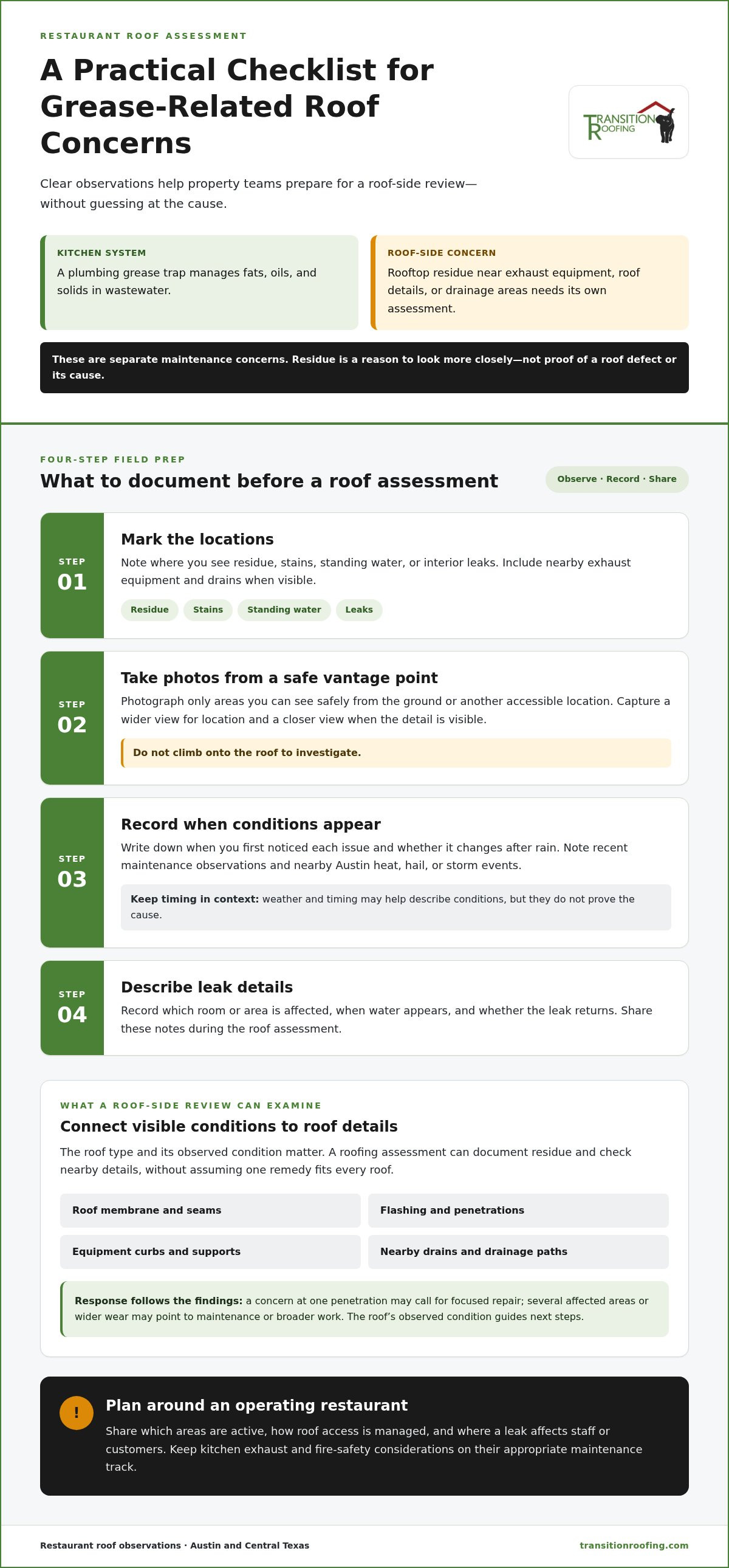
Use this sequence to prepare for a roof-side review. Photograph only areas you can see safely from the ground or another accessible location. Don’t climb onto the roof to investigate.
- 1. Mark locations. Note where you see residue, stains, standing water, or interior leaks. Include nearby exhaust equipment and drains when visible.
- 2. Take photos. Capture the condition from a safe vantage point. Include a wider view to show the location and a closer view if the detail is visible.
- 3. Record timing. Write down when you first noticed each issue and whether it changes after rain. Note recent maintenance observations and any Austin heat, hail, or storm events around that time. Timing adds context, but doesn’t prove a cause.
- 4. Note leak details. Record which room or area is affected, when water appears, and whether the leak returns. Share these notes during a roof assessment.
Plan the review around restaurant operations
Include which areas are active, how roof access is managed, and where a leak affects staff or customers. These details help shape a practical assessment plan for an occupied building. Keep kitchen exhaust and fire-safety considerations on the appropriate maintenance track. The NFPA 96 Commercial Kitchen Standards address commercial cooking operations.
If active leaks or visible roof concerns need a closer look, commercial flat-roof services in Austin can clarify roof-system needs and practical next steps.
Protecting an Austin, TX Restaurant Roof: Repair, Maintenance, or Replacement
For restaurant grease trap roof protection Austin property teams need a response based on roof condition, not a one-size-fits-all rule. An assessment can show whether the concern is limited to one detail, such as a seam or equipment curb, or whether similar problems appear across a wider area. That distinction helps shape a sensible scope and avoids treating a visible symptom as a full diagnosis.
When repair or maintenance may fit
A focused repair may be appropriate when the assessment finds a localized defect and the surrounding roof remains serviceable. If the same area keeps causing trouble, the review should consider why it recurs and whether nearby details also need attention. Preventative maintenance can document roof condition over time, track known concerns, and help property teams plan follow-up work. A single repair or maintenance visit does not guarantee that leaks won’t return, especially if the underlying issue extends beyond the area first observed.
When broader commercial roof work may be considered
Widespread deterioration, multiple failing areas, or repeated repairs across the roof may prompt a discussion about larger project options. That doesn’t automatically mean replacement is needed. The roof’s existing system, documented condition, and extent of affected areas all inform the recommendation. Transition Roofing tailors commercial roof planning to the building and its observed condition. If installation is part of the discussion, commercial roof installation in Central Texas is one option to review alongside repair and maintenance.
The roofing response addresses the roof system. Kitchen exhaust and grease-control work remain separate parts of restaurant upkeep. A clear assessment helps property teams understand what needs attention and plan around an active business.
If grease exposure, recurring leaks, or roof wear has raised concerns, request a project-specific roof review from Transition Roofing for practical next steps.
Set a Clear Next Step for Your Austin Restaurant Roof
Grease concerns are easier to manage when the next step is based on what the roof actually shows. Use your notes and photos to keep the issue visible, then turn those observations into a project-specific plan. For restaurant grease trap roof protection Austin teams don’t need to assume every stain means roof failure or that one repair will address a wider concern. A careful review can clarify what needs attention now and what should be tracked over time.
That clarity matters in an active restaurant, where roof work must fit the building’s needs and daily operations. Transition Roofing serves Austin and nearby Central Texas communities, including Round Rock, Pflugerville, Cedar Park, Lakeway, Hays, Bear Creek, San Leanna, Rollingwood, West Lake Hills, Buda, Kyle, and Bee Cave. The company provides commercial roof repair, installation, and preventative maintenance tailored to the building and roof condition.
If grease residue, water intrusion, or repeat roof trouble has you weighing your next move, request a commercial roof assessment in Austin. Transition Roofing can review the roof and give you a clear plan for next steps.
Frequently Asked Questions
Is a restaurant grease trap the same as a rooftop grease containment system?
No. Use the location of the concern to route the next review: a sink or floor-drain backup points to kitchen plumbing, while residue around rooftop exhaust equipment belongs in the roof-side assessment. Keeping these observations separate helps teams avoid assuming a problem in one system proves damage in the other. Clear notes can help coordinate the work without confusing the findings.
Can cooking grease damage a commercial roof?
Cooking grease can affect some roof membranes, but the material and exposure matter. TPO and EPDM can soften or swell with grease exposure, while PVC is more resistant but may still change over time. Identifying the installed membrane helps focus the assessment. A material name alone can’t confirm damage or establish that the roof has failed.
How often should an Austin restaurant roof be checked for grease concerns?
There isn’t one interval that fits every Austin restaurant. Set the next review based on the roof’s condition and maintenance plan, then consider an earlier review if rooftop equipment is moved or replaced. Record the suggested follow-up point in the assessment notes. This gives the property team a concrete planning reference instead of relying on memory.
What happens if grease reaches a roof drain or seam?
Grease near a drain or seam doesn’t automatically mean the drain is blocked or the seam has failed. Avoid scraping residue or applying cleaning chemicals, which could disturb roof materials or sealants. Note whether water collects nearby or appears inside the building, and share those observations during the assessment. This preserves useful context for reviewing the area.
How much does restaurant grease-related roof repair cost in Austin?
There isn’t a reliable flat price without a project-specific scope. Cost depends on the areas that need work, the roof system and its condition, and whether the scope is limited to a repair or includes broader maintenance or installation. A useful estimate should describe the recommended work, identify which areas it covers, and separate follow-up maintenance from the immediate repair. That detail helps property teams plan restaurant operations around the work without relying on a generic price range.