

Your flat roof is either a heat magnet or a cooling asset, and in Austin, there is no middle ground. If your current system isn’t reflecting the 105 degree Texas sun, you’re likely overpaying on energy bills while risking leaks during our sudden Central Texas thunderstorms. We know the stress of managing a property when the roof feels like a ticking time bomb. This is why tpo roofing is now the most trusted solution for owners who want to transition from constant repairs to long term security.
You deserve a roof that stands up to hail and heat for 20 years or more. This guide provides a professional contractor’s perspective on how to get the most value out of your investment in 2026. We draw on over 15 years of local experience to help you understand the durability of TPO in our unique climate. We will walk you through the clear signs of when to repair versus replace and show you exactly how this material keeps your building cool and your interior dry.
Key Takeaways
- Discover why reflective “cool roof” technology is the standard for managing energy costs and surviving the intense Central Texas heat.
- Learn how to select the proper membrane thickness and reinforcement scrim to defend your property against punctures and UV degradation.
- Compare the cost and performance of tpo roofing against PVC and EPDM systems to find the best fit for your Austin, TX building.
- Get expert insights on how single-ply membranes handle local hail storms and what it takes to maintain seam integrity over 20 years.
- Understand the step-by-step installation process, from substrate preparation to why tapered insulation is vital for preventing standing water.
What is TPO Roofing and Why is it Dominating Austin, TX?
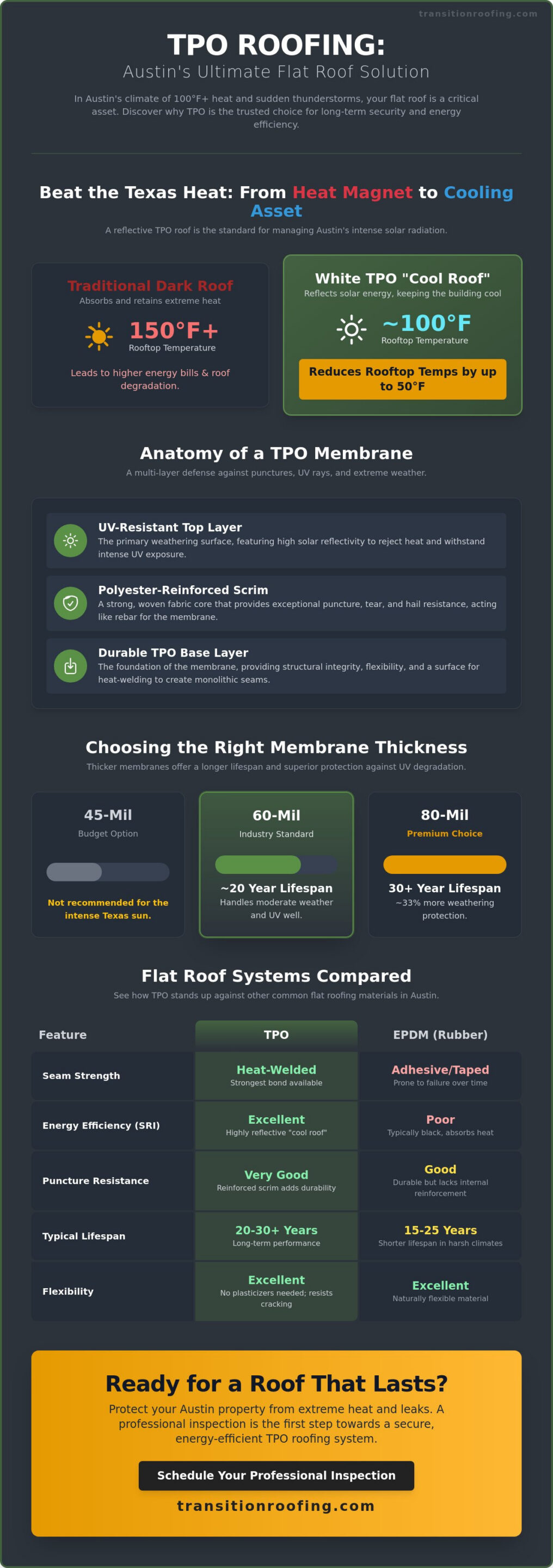
TPO roofing has become the primary choice for commercial and residential flat roofs across Central Texas. It stands for Thermoplastic Polyolefin (TPO), which is a single-ply reflective membrane designed to protect buildings from extreme weather. In Austin, TX, where summer temperatures regularly exceed 100 degrees, this material is the “cool roof” standard. Most modern systems use a three-layer construction. This includes a durable base layer, a reinforced polyester scrim for puncture resistance, and a specialized top layer that handles intense UV exposure. Many property managers are now switching from older built-up roofs (BUR) because TPO is lighter, faster to install, and doesn’t involve the hazardous fumes of hot asphalt.
To better understand how this material is planned and installed on commercial properties, watch this helpful video from GAF:
The Science of Reflectivity: Beating the Austin Heat
Austin properties face intense solar radiation for over 300 days a year. TPO membranes feature a high Solar Reflectance Index (SRI), which measures how well a surface rejects solar heat. By reflecting UV rays, white TPO membranes significantly mitigate the urban heat island effect that raises temperatures in downtown Austin and surrounding business districts. This isn’t just about environmental impact; it’s about your bottom line. TPO can reduce rooftop temperatures by up to 50 degrees compared to traditional dark materials. If you’re seeing your cooling bills climb every July, your roof’s reflectivity is likely the culprit.
Key Properties: Flexibility and Seam Strength in Austin, TX
Transition Roofing recommends TPO because of its superior seam strength. We use a specialized heat-welding process to fuse the sheets together. This creates a monolithic, waterproof surface that is actually stronger at the seams than the membrane itself. Unlike older PVC options, TPO doesn’t require added plasticizers to stay flexible. It remains pliable throughout its lifespan, even after years of exposure to the harsh Central Texas sun. This flexibility helps the roof handle the rapid temperature swings that often lead to cracks in lesser materials. TPO also naturally resists fungus growth and common environmental pollutants like grease or oil. If you’re noticing leaks after a heavy storm, it’s usually a sign that your current seams have failed and a transition to a welded system is necessary.
The Anatomy of a High-Performance TPO System in Austin, TX
A high-quality tpo roofing installation is more than just a white sheet of plastic. It’s a multi-layered shield designed to handle the 100-degree days and sudden hail storms common in Central Texas. The system starts with a solid foundation of Polyiso (polyisocyanurate) insulation. This rigid foam provides the high R-value needed to keep your cooling costs down during an Austin summer. We use Polyiso because it offers the best thermal performance per inch, making it the most efficient choice for our local climate.
Inside the membrane, a polyester reinforcement scrim acts like the rebar in concrete. This woven grid prevents the material from tearing or puncturing under stress. For buildings with frequent HVAC maintenance or equipment upgrades, this internal strength is vital. If you’re concerned about how your current roof is holding up against the elements, it’s a good idea to schedule a professional inspection to check for hidden wear or thinning areas.
Choosing the Right Mil-Thickness for Your Building
TPO membranes come in three standard thicknesses: 45-mil, 60-mil, and 80-mil. While 45-mil is the budget option, we rarely recommend it for the intense Texas sun. The thickness of the top weathering layer determines how long the roof can withstand UV radiation before breaking down.
- 60-mil Membrane: This is the industry standard for most commercial properties. It typically offers a 20-year lifespan and handles moderate weather well.
- 80-mil Membrane: This is the premium choice for long-term protection. It provides roughly 33 percent more weathering protection than 60-mil and can last 30 years or more.
- Fleece-back TPO: For added durability, fleece-back options add a thick cushion to the underside. This is often used for “recover” projects over existing roofs because it provides superior puncture resistance and better adhesion.
If your roof has high foot traffic or dense mechanical equipment, the 80-mil option is the safer investment. It stands up better to dropped tools and frequent walking paths that would eventually wear through thinner materials.
Industry Certifications: Versico, GAF, and Dura-last
Quality materials only perform well if they’re installed to strict standards. Working with contractors certified by major brands like Versico, GAF, and Dura-last ensures your warranty remains valid for decades. These manufacturers set rigorous guidelines for seam welding and flashing details that generic installers often miss.
We prioritize materials that meet or exceed ASTM D6878 standards. This certification confirms the tpo roofing material can withstand long-term heat exposure and constant UV radiation without cracking or becoming brittle. In the Austin, TX heat, these standards aren’t just technicalities; they’re the difference between a roof that lasts 20 years and one that fails in 10. A certified installation provides the peace of mind that your property is secure and your investment is protected by a manufacturer-backed guarantee.
Comparing TPO Roofing to Other Flat Roof Options in Austin, TX
Choosing the right material for flat roofing in Austin, TX depends on your building’s specific needs and your long-term budget. While tpo roofing is the most popular choice for modern commercial projects, it isn’t the only option on the market. We often see property owners weighing TPO against EPDM rubber. In the Central Texas climate, EPDM can be a liability. Its black surface absorbs heat, reaching temperatures up to 160 degrees. TPO reflects that UV radiation, which keeps your cooling costs significantly lower during our 100-degree summer days.
If you are managing a facility with high foot traffic or specific chemical exposures, the comparison becomes more nuanced. Here is how the primary options stack up for local properties:
- TPO: High solar reflectivity and excellent seam strength at a mid-range price point.
- PVC: Superior resistance to chemicals and animal fats, though usually 15 to 20 percent more expensive than TPO.
- EPDM: Very durable and easy to repair, but the heat absorption can increase HVAC strain in Texas.
- Metal: Extremely long lifespan, but requires a much higher initial investment and specialized maintenance.
TPO vs. PVC: Which Single-Ply Wins?
PVC is the heavy-duty cousin of TPO. We recommend PVC specifically for restaurants or food processing plants. This is because PVC resists the animal fats and grease vented through roof traps that would eventually soften and degrade a TPO membrane. For standard warehouses, retail centers, or office buildings, TPO offers a much better cost-to-benefit ratio. It provides similar leak protection and puncture resistance for a lower total project cost.
We also consider the weldability window during installation. TPO remains easy to heat-weld for years, which makes future repairs or equipment additions simple. Some older PVC formulas can become brittle over time, making it harder for contractors to get a perfect seal during a patch or modification. If your building doesn’t have specialized chemical exhaust, TPO is usually the smarter financial move.
TPO vs. Commercial Metal Roofing
Metal systems are known for longevity, but the initial investment is often double the cost of a tpo roofing installation. If you have an older building in downtown Austin, the weight of a new metal system might even require expensive structural reinforcement. TPO is lightweight and installs quickly over most existing roof decks, which minimizes disruption to your tenants.
While we provide commercial metal roof repair in Austin, TX, many owners eventually transition to TPO. A TPO membrane eliminates the hundreds of exposed fasteners that can become leak points in a metal system as it expands and contracts. TPO creates a monolithic, seamless surface that handles the extreme thermal shifts of Central Texas with less risk of water intrusion. If you are looking for the best balance of energy efficiency and leak protection, TPO is the modern standard.
If you aren’t sure which material fits your current structure, this is usually when we recommend a professional assessment. We can help you determine if your current deck can support a transition to a more efficient system.
Dealing with Leaks, Hail, and Maintenance in Austin, TX
Property owners in Central Texas often ask if tpo roofing can survive a classic Austin storm. The answer depends on the age of your system and the size of the hail. While TPO is naturally impact resistant, the extreme heat in our region eventually takes a toll. After 15 to 20 years of intense UV exposure, the membrane can lose its flexibility. This degradation often leads to micro-cracking and compromised seam integrity, which is where most leaks begin.
Common leak points on a commercial roof aren’t usually in the middle of the field. Instead, water finds its way in through these specific areas:
- Flashing: The material around walls and curbs can pull away as the building shifts.
- Penetrations: Sealants around HVAC units, vents, and pipes can dry out and crack.
- Edge Metal: If the perimeter metal isn’t secure, high winds can lift the membrane and allow rain to drive underneath.
The Austin Hail Factor: Protection and Insurance
Standard TPO is durable, but “hail-rated” systems like EverGuard Extreme are designed for the specific volatility of the Texas climate. These premium membranes contain higher levels of stabilizers to resist UV weathering and impact. After a storm in Round Rock or Pflugerville, you should look for “bruising.” This appears as small, fractured circles where the hail has broken the internal reinforcement scrim. If you suspect hail damage, this is usually when we recommend a professional inspection to document findings for your insurance carrier.
Use this post-storm checklist for your property:
- Check for ponding water that remains 48 hours after the rain stops.
- Look for loose metal flashing or coping caps along the roof edge.
- Inspect the ground for white, plastic-like scraps that indicate membrane tearing.
- Search for “star” patterns or indentations on the roof surface.
Repair vs. Replacement: The Contractor’s Logic
We follow the “25% rule” to help owners make a smart financial decision. If the cost of repairing leaks exceeds 25% of the cost of a total replacement, a new roof is usually the more stable investment. However, if your insulation is still dry, a tpo roofing recover might be an option. This involves installing a new membrane over the existing one, which saves you the high cost of a full tear-off and keeps debris out of local landfills. A single moisture scan can save thousands in replacement costs by identifying exactly which sections of insulation are wet and which are still salvageable. Property owners facing a similar decision in nearby markets can find detailed guidance in our overview of San Antonio roof replacement options and durable roofing systems.
If you are worried about a recent leak or storm damage, schedule a professional roof assessment to get a clear plan for your property.
Planning Your TPO Roofing Installation in Austin, TX
A successful tpo roofing project requires more than just high-quality membrane. It starts with a clear timeline and a solid strategy. Most commercial projects in Central Texas take three to five weeks from the initial bid to the final inspection. The actual labor for a 15,000 square foot roof usually spans seven to ten business days; however, weather delays from Austin’s sudden thunderstorms can shift this window. We prioritize a clean substrate because any moisture trapped under the new membrane will lead to premature failure. If your current roof has saturated insulation, we must remove it entirely to protect your investment.
Proper drainage is vital in Austin. We often install tapered insulation systems to eliminate standing water and prevent “ponding,” which can void your warranty. This also helps you meet local building codes. The City of Austin follows the International Energy Conservation Code (IECC), which currently requires a minimum R-value of R-30 for most commercial roof replacements. This thick layer of insulation keeps your cooling costs lower during our 100-degree summers and ensures your building remains energy efficient for decades.
The Installation Process: What to Expect On-Site
We use three primary attachment methods based on your building’s structure. Mechanically attached systems use heavy-duty fasteners to secure the membrane to the deck. Fully adhered systems use bonding adhesive for maximum wind uplift resistance. Induction welding uses electromagnetic heat to bond the membrane to plates without piercing the top layer. We minimize business disruption by scheduling noisy tasks early in the morning and keeping staging areas clear of customer parking. After the crew finishes, a manufacturer’s inspector from companies like GAF or Versico visits the site. This final walk-through is mandatory to secure your 20-year No Dollar Limit (NDL) warranty.
Getting a Reliable Estimate for Your Property
Several variables impact the final cost of tpo roofing. We look at the height of the building; structures over 40 feet require cranes or specialized lifts. Site access is also a factor, as tight urban spaces in downtown Austin increase labor time. We count every HVAC curb, vent pipe, and penetration because these require detailed hand-welding. If you already have two existing roof layers, Texas building codes require a full tear-off before the new system goes down. We provide transparent estimates that account for these factors without hidden fees or “fluff” charges. To keep your warranty valid, we recommend a preventative maintenance program that includes bi-annual cleanings and drain inspections. Whether you’re managing a property in Austin or searching for a trusted roofing company in San Antonio, the same principles of vetting certified contractors and understanding local building codes apply across Central Texas.
If you are noticing leaks or your energy bills are spiking, it is time for a professional assessment. Schedule your roof inspection in Austin with Transition Roofing to get a clear plan for your property.
Securing Your Austin, TX Commercial Investment
Choosing the right roof for your property doesn’t have to be a stressful process. We’ve seen how tpo roofing provides the best balance of energy efficiency and durability against intense Central Texas hail storms. By selecting a high-performance system, you’re protecting your building from 100-degree summer days and sudden downpours. A quality installation ensures your investment lasts for decades rather than failing after the first major weather event.
Our team brings over 15 years of local experience to every project in Austin, TX. As Versico and GAF Certified Installers, we specialize in high-heat and hail-resilient systems designed for our specific climate. We’ve helped hundreds of property owners transition from leaky, outdated roofs to total security with a methodical and transparent process. You deserve the peace of mind that comes from working with a neighborly expert who values integrity and quality craftsmanship. Don’t wait for the next storm to test your building’s integrity. Ready to protect your commercial investment? Schedule your professional TPO roof inspection in Austin, TX today. We look forward to helping you keep your property safe and secure for years to come.
Frequently Asked Questions About TPO Roofing in Austin, TX
How long does a TPO roof last in the Austin heat?
You can expect a TPO roof to last between 15 and 25 years when exposed to the Central Texas climate. The intense UV radiation in Austin can degrade lower-quality materials, but high-quality membranes from brands like GAF or Versico are engineered to reflect heat. Proper installation and routine maintenance are the most critical factors in reaching that 25-year milestone without leaks. If you haven’t had your roof checked in over 3 years, it’s time for a professional assessment.
Is TPO roofing puncture-resistant against hail?
TPO roofing provides excellent puncture resistance, especially when you choose a 60-mil or 80-mil thickness. While 1-inch hail rarely penetrates the membrane, larger stones can cause damage if the roof is older and less flexible. If you’re worried about the frequent storms in Central Texas, we often recommend a fleece-backed TPO system for added impact protection. This specific material adds a layer of cushion that helps the membrane absorb energy from hail strikes.
How much does TPO roofing cost per square foot in Austin, TX?
Most property owners find that tpo roofing costs between $6.00 and $13.00 per square foot based on recent regional industry data. This range covers the membrane, insulation, and professional installation. Your total price is influenced by the roof’s complexity, the type of insulation used, and whether we’re removing old layers. We provide a detailed estimate after a physical inspection to ensure your quote is accurate and accounts for all local building codes.
Can you install TPO over an existing flat roof?
You can install TPO over an existing roof if there’s only one layer currently in place and the structure is sound. Texas building codes generally limit roofs to two total layers. We perform a moisture scan first to ensure no water is trapped in the old system. Installing a new membrane over wet insulation leads to premature failure and structural rot. This is usually when we recommend a full tear-off to protect your building’s integrity.
Does white TPO roofing really lower energy bills?
White TPO membranes reflect up to 80% of solar radiation, which significantly lowers cooling costs for Austin properties. Data from the Cool Roof Rating Council shows that reflective surfaces can reduce peak cooling demand by 15% during the summer. This transition to a cool roof helps your HVAC system run less frequently, extending its life and saving you money every month. It’s a proven way to combat the rising utility costs in Central Texas.
What is the difference between 45-mil and 60-mil TPO?
The 60-mil TPO membrane is approximately 33% thicker than the 45-mil option, providing a much thicker weathering layer. This extra thickness makes the roof more resistant to punctures from debris and hail. While 45-mil is a budget-friendly choice, we typically recommend 60-mil for Central Texas buildings because it offers a longer warranty. Most manufacturers provide an extra 5 to 10 years of coverage for the thicker 60-mil systems.
How often should I have my TPO roof inspected in Central Texas?
We recommend a professional inspection at least twice a year, typically in the spring and fall. You should also schedule a checkup after any major hail storm or wind event in Austin. Regular inspections allow us to identify small issues like seam separations or clogged drains before they turn into expensive interior water damage. Our team uses a methodical process to ensure every square foot of your roof remains secure and watertight.
Is TPO roofing environmentally friendly?
TPO is one of the most environmentally friendly options for flat roofs because it’s 100% recyclable and contains no plasticizers. Its high solar reflectance reduces the urban heat island effect in cities like Austin. Many of the systems we install are Energy Star rated, helping property owners meet local green building standards. By choosing this material, you’re reducing your carbon footprint through lower energy consumption and keeping old roofing materials out of Texas landfills.
If you’re ready to secure your property with a high-quality roof, we’re here to help. Contact Transition Roofing today to schedule a comprehensive roof inspection in Austin and get a clear plan for your property’s protection.