
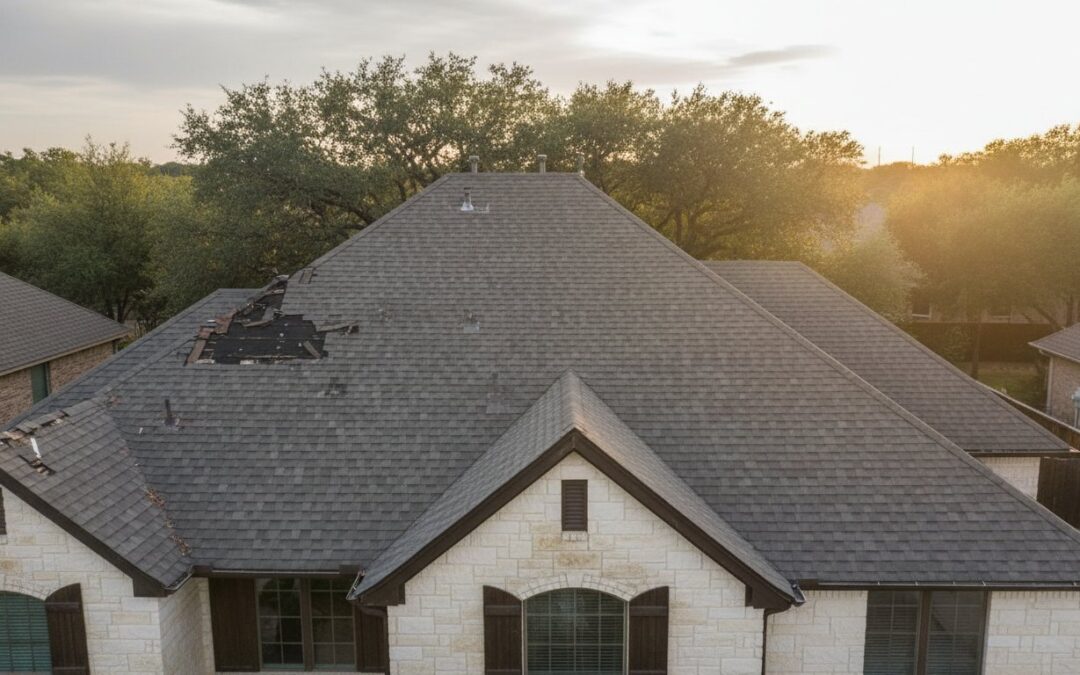
After the May 28, 2025 microburst brought 85 mph winds to Austin, many homeowners realized that “covered” doesn’t always mean “fully paid for.” It’s stressful to look at storm damage and worry about being lowballed by an adjuster who speaks in complex codes and math. You likely want to know: what will insurance actually pay full roof partial roof actual cash value or replacement cost? Dealing with insurance shouldn’t feel like a second job, especially when you’re just trying to keep your family dry and your property secure.
We understand the confusion because we’ve spent over 15 years helping Central Texas residents navigate these exact claims. You deserve a roof that matches your home and meets the 2024 Austin building codes, not a patchwork repair that lowers your property value. This guide breaks down how carriers calculate depreciation for roofs over 10 years old and explains the new 2026 Texas licensing mandates. You’ll learn the difference between ACV and RCV math, the truth about partial matching, and how to ensure your property is restored to total security without any surprises during the payout process.
Key Takeaways
- Understand the difference between getting a check for your roof’s current depreciated value versus the total cost to install a new shingle system.
- See the breakdown of what will insurance actually pay full roof partial roof actual cash value or replacement cost? based on your specific policy language and the age of your roof.
- Learn about the “hit count” method adjusters use in Austin to determine if you qualify for a full replacement or just a localized repair.
- Clarify your out-of-pocket costs and why Texas law makes paying your deductible a non-negotiable part of the restoration process.
- Discover how local storm history and professional representation during an adjuster’s inspection can help you secure a fair and accurate payout.
The Basics of Roof Insurance Payouts in Austin, TX
Insurance payouts in Central Texas are not random. They are determined by two primary factors: your specific policy type and the physical evidence of storm damage. In Austin, TX, our intense heat, which often stays above 100 degrees for weeks, accelerates shingle aging. Adjusters look closely at this “useful life” remaining when they inspect your property. If your shingles are brittle from UV exposure, it can complicate how damage is categorized. Replacement Cost Value (RCV) is the total amount needed to purchase and install a brand-new roof today without any deductions for the age or wear of your current shingles.
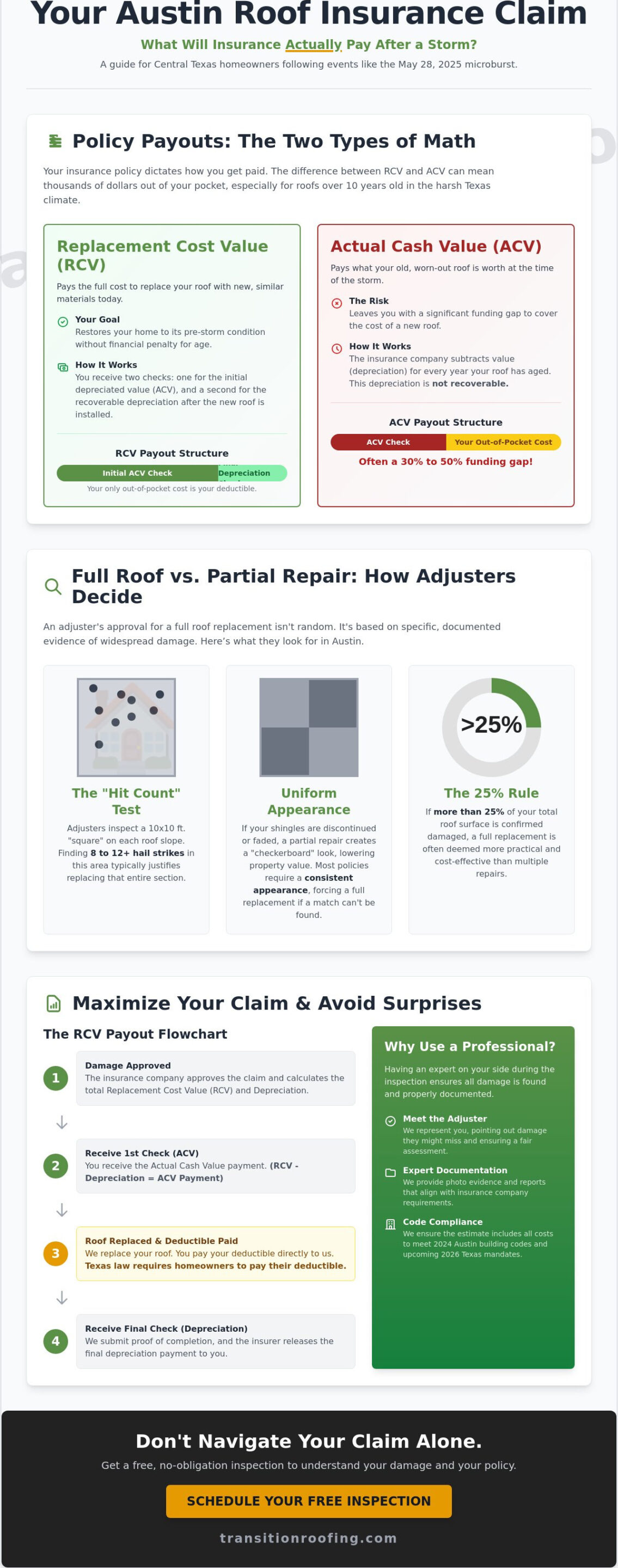
Homeowners often ask us, “What will insurance actually pay full roof partial roof actual cash value or replacement cost?” The answer starts with which of these two math equations is in your contract. Conversely, Actual Cash Value (ACV) only pays what your old, worn roof is worth at the time of the loss. This means the insurance company subtracts value for every year the roof has sat in the Texas sun.
To better understand how these values impact your checkbook, watch this helpful video:
RCV vs. ACV: Why the Difference Matters
The difference between these two policy types can mean thousands of dollars out of your own pocket. RCV policies cover the full cost of a new roof, minus your deductible, once the work is finished. You receive an initial check, and then a second “depreciation” check after we submit proof of completion. This allows you to choose premium residential roofing materials like GAF or Certainteed shingles without worrying about the price gap.
ACV policies are different. They are becoming more common in Austin for roofs older than 10 years. These policies often leave homeowners with a 30% to 50% gap in funding for a new roof. Because the depreciation is not recoverable, you’re responsible for the difference between the “used” value and the cost of new materials. This is usually when we recommend reviewing your policy’s declarations page to see if you have a “roof payment schedule” endorsement, which can further limit your payout based on the material’s age.
Full Roof vs. Partial Replacement: How Adjusters Decide in Austin, TX
Adjusters use a specific metric called a “hit count” to determine the extent of storm damage. They mark off a 10×10 foot area, known as a “square,” on each slope of your roof. If they find a certain number of hail strikes within that square, usually between 8 and 12 hits, it typically justifies a full replacement for that section. Homeowners often ask: what will insurance actually pay full roof partial roof actual cash value or replacement cost? The answer often hinges on “line of sight” and matching rules that protect your home’s value.
In Austin, TX, if your shingles are discontinued or the color has faded significantly, a partial repair might look like a checkerboard. Most insurance policies include a provision for a uniform appearance. If we cannot find a matching shingle that fits the existing layout, the carrier may be forced to pay for a full replacement to ensure your home maintains its integrity. Understanding Replacement Cost Vs. Actual Cash Value is vital here, as it dictates whether the carrier pays for the new materials or just the depreciated value of the old ones.
The 25% Rule and Texas Standards
Many adjusters follow a general guideline where if more than 25% of the roof surface is damaged, a full replacement becomes the most cost-effective path. In the Central Texas climate, hail rarely hits just one side of a house; it usually impacts multiple slopes. If you are seeing damage on more than two sides of your home, we can help you document the hit count to advocate for a complete system rather than a series of patches.
When a Patch Job Isn’t Enough
A partial repair on an older roof can sometimes cause more harm than good. As shingles age in the Texas sun, they become brittle. Lifting an old shingle to slide a new one underneath often causes the surrounding area to crack or lose granules. This creates new leak points that weren’t there before. If you’re concerned about whether a repair is viable, you can read our Austin roof repair guide. This is usually when we recommend having a professional assess shingle pliability before agreeing to a patch. Scheduling a professional inspection can clarify if your roof can actually withstand a repair.
Navigating Depreciation and Deductibles in Austin, TX
The payout process for a storm claim in Central Texas usually involves two separate checks. The first check covers the Actual Cash Value (ACV), which is the current value of your roof after the adjuster subtracts depreciation based on its age. If you have a Replacement Cost Value (RCV) policy, you can recover that depreciation once the project is finished. Many homeowners ask us, what will insurance actually pay full roof partial roof actual cash value or replacement cost? In Austin, TX, the answer depends on your policy math and your commitment to paying your legal deductible.
The second check, often called the “depreciation check,” is only released after we submit a certificate of completion. This check covers the gap between the initial ACV payment and the actual cost of the new roof. This is also where “Ordinance or Law” coverage comes into play. Since the City of Austin adopted the 2024 Technical Building Codes on July 10, 2025, your new roof must meet stricter fire-resistant standards. If your policy includes code coverage, insurance will pay for these mandatory upgrades in that final check.
Understanding Texas House Bill 2102
In 2019, Texas passed House Bill 2102 to eliminate deductible fraud. This law makes it illegal for any contractor to waive, rebate, or “absorb” your insurance deductible. We are required by law to include a bold-text warning in our contracts stating that the homeowner must pay this amount. Today, insurance carriers frequently ask for proof of payment, like a bank record or copy of a cleared check, before they release the final depreciation check. If a roofer offers to cover your deductible, they are asking you to participate in insurance fraud.
Recoverable vs. Non-Recoverable Depreciation
Non-recoverable depreciation in an ACV policy is money you will never get back from the carrier because it represents the “used up” value of your shingles. While RCV is standard, many insurers are adding ACV roof endorsements to policies for homes with shingles older than 15 years. This shift means the homeowner pays the difference between the old roof value and a new installation. If you are dealing with a complex claim, we can take a look and give you a clear plan for your restoration.
Maximizing Your Claim with an Austin, TX Roofing Expert
The most effective way to ensure a fair payout is to have an experienced contractor walk the roof alongside the insurance adjuster. Adjusters often have dozens of properties to inspect after a major event like the May 2025 microburst, and they can easily overlook subtle damage. We use our 15 years of local experience to point out specific issues like soft metal dents on vents, damaged peripheral flashing, and compromised ridge caps. When we represent your interests during the inspection, we provide the technical evidence needed to answer the question: what will insurance actually pay full roof partial roof actual cash value or replacement cost?
Local knowledge is your biggest asset during a claim. We track the exact hail dates and wind speeds that impacted specific neighborhoods in Austin, TX. This data allows us to provide the “contractor logic” that adjusters respect. Beyond the initial inspection, Transition Roofing assists with the detailed paperwork required for supplements. If the adjuster misses a line item required by the 2024 building codes, we submit the necessary documentation to ensure those costs are added to your final payout.
How to Start Your Claim the Right Way
- Step 1: Get a professional inspection before calling your insurance company. This verifies if the damage actually exceeds your deductible, preventing unnecessary claims on your record.
- Step 2: File the claim and request that your contractor be present for the adjuster meeting. This ensures a “level playing field” from the very first day.
- Step 3: Review the “Scope of Loss” estimate with your roofer. We check for missing essential items like starter shingles, drip edges, and proper ventilation components.
Why Transition Roofing is the Trusted Protector in Austin
We specialize in installing GAF and Certainteed shingle systems that are engineered to withstand the 85 mph wind gusts common in the Central Texas climate. Our goal is to move your home from a state of storm damage to one of total security. If you’re dealing with a confusing insurance estimate or a partial denial, we can take a look and give you a clear plan for your next steps. You don’t have to navigate this process alone. Schedule a roof inspection in Austin today to protect your property and ensure your claim is handled correctly.
Take Control of Your Austin Roof Restoration
Navigating the aftermath of a Central Texas storm is much easier when you understand the math behind your policy. You now know that factors like shingle hit counts, matching rules, and the age of your roof dictate your final payout. Whether you are dealing with a 15 year old shingle system or a complex metal roof, these details determine the success of your claim. Many residents start this journey wondering: what will insurance actually pay full roof partial roof actual cash value or replacement cost? The answer lies in professional documentation and an expert understanding of Texas House Bill 2102.
Transition Roofing brings over 15 years of local experience and GAF and Certainteed certifications to every project. We provide the expert insurance claim assistance needed to ensure your property meets the 2024 Austin building codes. If you are ready for a reliable partner to advocate for your home’s integrity, schedule a free, expert roof inspection in Austin today. We are committed to moving your roof from a state of damage to total security with honesty and quality craftsmanship.
Frequently Asked Questions
Can I get a full roof replacement if only one side is damaged by hail?
Yes, you can often secure a full replacement if the damaged slope cannot be matched with existing materials. Texas adjusters look at “line of sight” and uniformity rules. If your shingle is discontinued or significantly faded by the 100-degree Austin heat, a partial patch might be rejected. We document the hit count and material availability to advocate for a full system that protects your home’s resale value.
What is the difference between ACV and RCV for my roof insurance?
RCV pays for a new roof at today’s prices, while ACV only pays for what your old roof is worth now. When asking what will insurance actually pay full roof partial roof actual cash value or replacement cost?, check your declarations page for a “roof payment schedule.” RCV policies release a second check for depreciation once the work is done, ensuring your only cost is the deductible.
Is it legal for an Austin roofing contractor to waive my deductible?
No, it is strictly illegal for a contractor to waive your deductible in Texas under House Bill 2102. This law, enforced since 2019, classifies “eating” a deductible as insurance fraud. Carriers now require proof of payment before releasing the final depreciation check. Any contractor offering to ignore your deductible is putting you at legal risk and likely cutting corners on your installation.
How much will insurance actually pay for a 15-year-old roof in Texas?
For a 15-year-old roof, the payout depends entirely on whether you have an ACV endorsement. Many carriers are shifting older roofs to ACV, which might only cover 50% of the replacement cost after depreciation. If you have a standard RCV policy, you still get a full replacement, but the initial check will be smaller because the age-based depreciation is withheld until the project is finished.
What happens if the insurance estimate is lower than the contractor’s quote?
If the estimate is low, we submit a “supplement” request with photos and code requirements. This happens often because adjusters may miss items required by the 2024 Austin building codes, like specific flashing or ventilation. We use our 15 years of experience to justify these costs to the carrier. This ensures the final payout covers a high-quality GAF or Certainteed system without you paying extra out of pocket.