Did you know that nearly 50% of property claims in the Lone Star State end in a denial or a frustratingly low settlement? In 2025 alone, Texas led the nation with over 900 major hail events, leaving thousands of homeowners in Austin, TX struggling to get repairs. Avoiding common mistakes when filing a roof insurance claim in Texas is essential if you want to protect your home and your wallet. It’s stressful to deal with leaks while trying to decode complex policy jargon like depreciation and deductibles.
We believe you shouldn’t have to fight your insurance company just to get the coverage you’ve already paid for. With over 15 years of experience and certifications from GAF and Certainteed, we’ve seen how the right approach makes all the difference. This article provides a clear roadmap to help you secure a fully funded roof replacement without unnecessary out-of-pocket costs. We will break down the red flags of deductible fraud, explain the mandatory 2026 appraisal provisions, and show you how to find a contractor who truly understands the Central Texas climate.
Key Takeaways
- Learn why identifying the exact date of loss and documenting damage immediately is the most critical step for meeting strict Texas filing deadlines.
- Discover how to avoid common mistakes when filing a roof insurance claim in Texas, such as falling for illegal “free roof” offers that violate state law HB 2102.
- Understand the “invisible damage” trap and why a professional assessment is required to catch structural issues that are not visible from the ground.
- Gain clarity on your policy’s specific coverage, including the difference between Replacement Cost Value (RCV) and Actual Cash Value (ACV) for your settlement.
The High Stakes of Storm Damage Claims in Austin TX
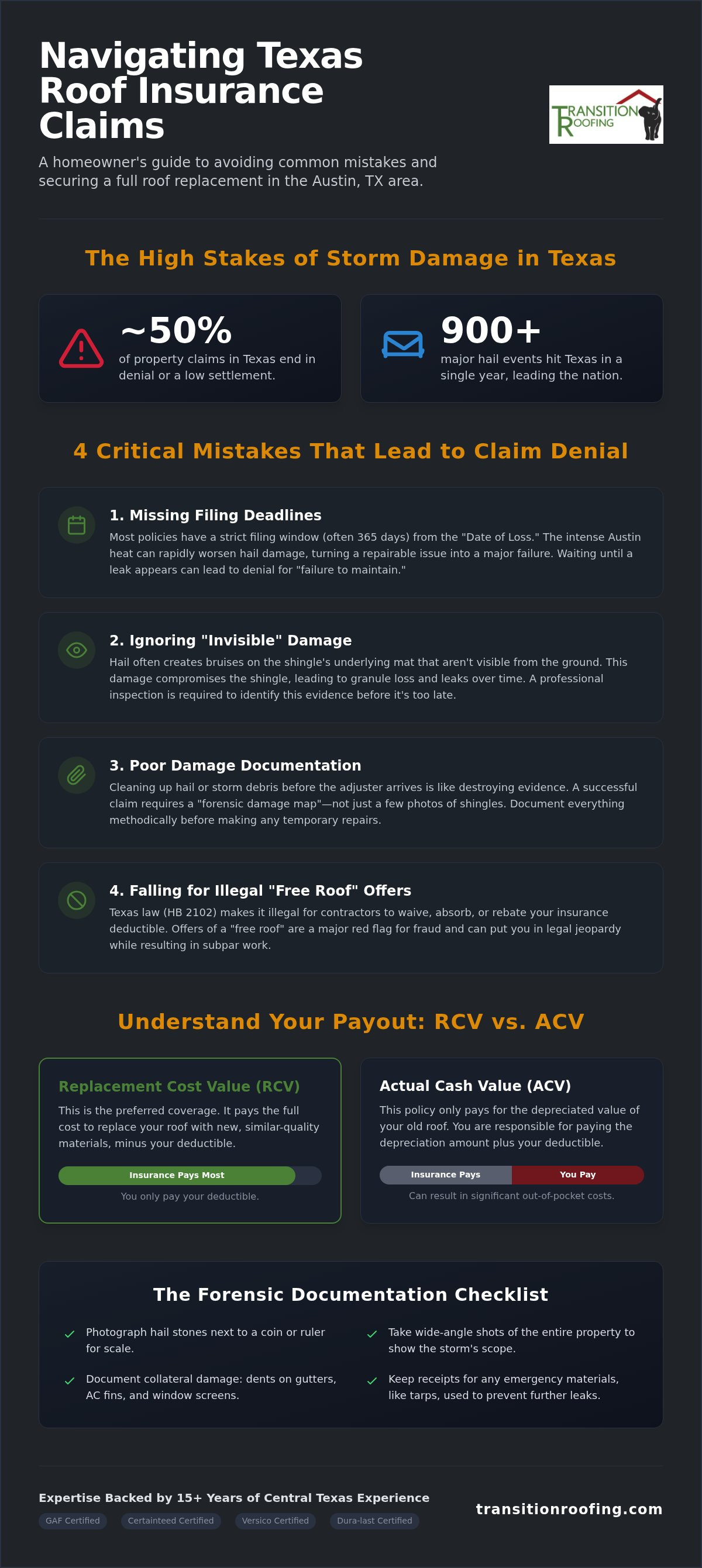
Texas is the hail capital of the U.S., making it the most difficult state for homeowners to navigate. One of the most common mistakes when filing a roof insurance claim in Texas is underestimating the complexity of the process. Currently, nearly half of all claims are denied. Most of these denials don’t happen because damage isn’t there; they happen because of procedural errors or poor documentation. Understanding property insurance basics is the first step toward protecting your investment and your home’s structural integrity.
To better understand how the process works in our state, watch this helpful guide:
Many homeowners assume their roof is fine if they don’t see missing shingles. This is the “invisible damage” trap. Hail impacts often bruise the fiberglass mat underneath the granules. This isn’t visible from the ground but leads to total failure over time. At Transition Roofing, we use our 15 years of local experience to identify these subtle signs that insurance adjusters often overlook. We’ve spent over a decade helping Austin residents secure residential roof replacement funding by providing the forensic evidence insurers require.
Why Austin Heat Makes Immediate Filing Critical
The 100-degree Austin sun is a roof’s worst enemy after a storm. When hail “bruises” a shingle, the intense Central Texas heat causes the asphalt to expand and contract rapidly. This causes the weakened granules to slough off, exposing the underlying layers to UV rays and water. If you wait until a leak appears in your living room, the insurance company will likely deny the claim. Their logic is simple: you failed to maintain the property. They’ll argue you allowed a small issue to become a major loss through neglect. Filing immediately after a storm ensures the damage is linked to the weather event, not a lack of maintenance.
Missing Deadlines and Poor Damage Documentation in Austin TX
Timing is everything in the Central Texas insurance landscape. One of the most common mistakes when filing a roof insurance claim in Texas is missing the strict filing window. While many policies provide 365 days from the storm event, some specialized carriers have much shorter windows. The “Date of Loss” acts as the foundation of your entire claim. Insurance companies cross-reference this date with local weather data to verify hail size and wind speed. If your reported date doesn’t match their records, your claim is often dead on arrival.
Another frequent error is cleaning up the yard or performing temporary repairs before the adjuster arrives. It’s natural to want to tidy up after a storm. However, you are essentially destroying the forensic evidence the adjuster needs to see. If you must make emergency repairs to prevent more damage, document everything with photos first. If you suspect damage, we recommend a professional inspection before you call your carrier to ensure you have a clear plan and the right data in hand.
The Forensic Documentation Checklist for Austin Homeowners
To build a strong case, you need more than just a few pictures of shingles. Our team at Transition Roofing uses over 15 years of experience to create a “damage map” that highlights structural vulnerabilities. This is far more effective than a generic repair estimate. Follow these steps to document damage correctly:
- Take date-stamped photos of hail stones next to a ruler or coin for scale.
- Photograph collateral damage on soft metals, such as dented gutters, downspouts, and AC unit fins.
- Capture wide-angle shots of the property to show the storm’s impact on the entire area.
- Keep all receipts for emergency materials like tarps used to stop active leaks.
A professional damage map provides the proof needed to secure a full residential roof replacement. For more details on the recovery process, check out our Austin Roof Repair Guide.
Hiring Unqualified Contractors and Accepting Lowballs in Austin TX
After an Austin hailstorm, neighborhoods are often flooded with “storm chasers.” These companies typically arrive with out-of-state license plates and use high-pressure door-knocking tactics to sign contracts quickly. One of the most dangerous common mistakes when filing a roof insurance claim in Texas is falling for “free roof” promises. Since September 2019, Texas House Bill 2102 has made it a Class B misdemeanor for a contractor to waive, pay, or absorb your deductible. If a company offers to “cover” this cost, they’re asking you to participate in insurance fraud. This can lead to heavy fines or even jail time for the homeowner.
Reputable restoration companies will always follow local laws and maintain high ethical standards; to see how a professional team operates in the Denver market, click here.
To avoid these legal pitfalls, homeowners should prioritize working with established, family-owned companies that value transparency; for more information on professional standards in Texas, you can visit Mike and Mike Roofing.
Beyond legal risks, many homeowners accept the insurance adjuster’s first estimate without question. In the Austin market, these initial offers are frequently 30-40% lower than actual local labor and material costs. Adjusters use national pricing software that doesn’t always reflect the high demand and specialized requirements of Central Texas. Accepting a lowball settlement forces you to hire cut-rate crews who use inferior materials. Our residential roofing services ensure your estimate reflects the true cost of a high-quality installation that meets local building codes.
The Importance of Manufacturer Certifications like GAF and Certainteed
Choosing a contractor with GAF or Certainteed certifications ensures your roof meets strict warranty standards. These manufacturers require specific installation methods that insurance companies must honor in their settlements. Contractor logic dictates that a cheap roof is the most expensive one you’ll ever buy. The Austin sun will bake low-grade shingles in just a few seasons, leading to premature failure and leaks. Certified installations provide long-term protection and ensure the manufacturer stands behind the product. If you want to avoid a lowball offer and ensure your home is protected, schedule a professional roof inspection in Austin today.
How to File a Successful Roof Insurance Claim in Austin TX
- Step 1: Get a professional inspection. Start with a local expert like Transition Roofing to confirm damage exists. This prevents you from filing an unnecessary claim that could impact your premiums without providing a payout.
- Step 2: Review your policy language. Check if your coverage is Replacement Cost Value (RCV) or Actual Cash Value (ACV). RCV pays to replace the roof at today’s prices. ACV only pays the depreciated value based on the roof’s age, which often leaves a large gap in funding.
- Step 3: File with forensic evidence. Submit your claim using your contractor’s detailed damage report. This sets a professional tone and forces the carrier to address specific structural issues from the start.
- Step 4: Have your contractor present for the adjustment. Ensure we are on the roof when the insurance adjuster arrives. We speak their technical language and point out subtle hail bruises that are often overlooked during a quick walk-through.
Working with Transition Roofing for a Smooth Claim Process
We provide transparent estimates that reflect the real-world costs of quality craftsmanship in Central Texas. Our team works directly with adjusters to ensure no damage is overlooked or minimized. We bring over 15 years of expertise to every project, whether you need Commercial Roofing in Austin or a residential shingle replacement. We focus on long-term protection rather than quick fixes, moving your structure from a state of vulnerability to total security.
If you’re dealing with storm damage in Central Texas, we can take a look and give you a clear plan. Schedule your inspection today.
Protect Your Austin TX Property with Expert Guidance
Navigating the insurance world after a major hailstorm is often overwhelming. By avoiding common mistakes when filing a roof insurance claim in Texas, you move your home from a state of vulnerability to total security. Success depends on immediate action, forensic documentation, and refusing to settle for lowball offers that don’t cover local labor rates. You don’t have to face the insurance adjusters alone.
At Transition Roofing, we bring over 15 years of Central Texas experience to every project. As a GAF and Certainteed Certified team, we specialize in storm damage recovery and complex insurance supplements. We ensure your claim reflects the true cost of quality craftsmanship and long-term protection. If you’re dealing with recent storm damage, we can take a look and give you a clear plan. Schedule a professional roof inspection in Austin today to get started. Your peace of mind is our priority, and we’re here to ensure your roof is restored to the highest industry standards.
Frequently Asked Questions
How long do I have to file a roof insurance claim in Texas after a storm?
Most Texas policies provide a one-year window from the date of the storm to file a claim. However, some specialized or surplus lines policies may have shorter deadlines. It’s critical to check your specific policy language immediately after a weather event. Confusing the filing deadline with the two-year legal statute of limitations is one of the common mistakes when filing a roof insurance claim in Texas.
Can my insurance company drop me for filing a hail damage claim in Austin?
Texas law generally prohibits insurance companies from non-renewing your policy solely for filing a single claim for weather-related damage. Since hail and wind are considered Acts of God, they are outside of your control. However, your premiums might increase if your entire zip code is re-rated due to frequent storms. Having a professional assessment first ensures you only file when legitimate structural damage exists to protect your claims history.
What is the difference between RCV and ACV on a Texas roof policy?
Replacement Cost Value (RCV) covers the full cost to replace your roof at today’s market rates once the work is completed. Actual Cash Value (ACV) only pays the depreciated value based on the roof’s age and condition. ACV policies often result in significant out-of-pocket expenses for homeowners. We recommend reviewing your policy with a local expert to understand if you’ll receive a full settlement or just a partial payment.
Is it illegal for a contractor to pay my deductible in Texas?
Yes, it’s a Class B misdemeanor under Texas House Bill 2102 for a contractor to waive, pay, or rebate any portion of a homeowner’s deductible. This law, effective since September 2019, applies to both the contractor and the homeowner. Any company offering to save your deductible is asking you to participate in insurance fraud. Reputable Austin contractors will always require proof that the deductible was paid before final project closeout.
What should I do if my roof insurance claim is denied in Austin TX?
If your claim is denied, you have several options including requesting a re-inspection with a different adjuster or invoking the mandatory appraisal provision. New Texas laws for 2026 require residential policies to include an appraisal process to settle disputes over damage amounts. We often help homeowners by providing a detailed forensic damage map that addresses the specific reasons for the initial denial. This documentation helps ensure no structural vulnerabilities are overlooked.