
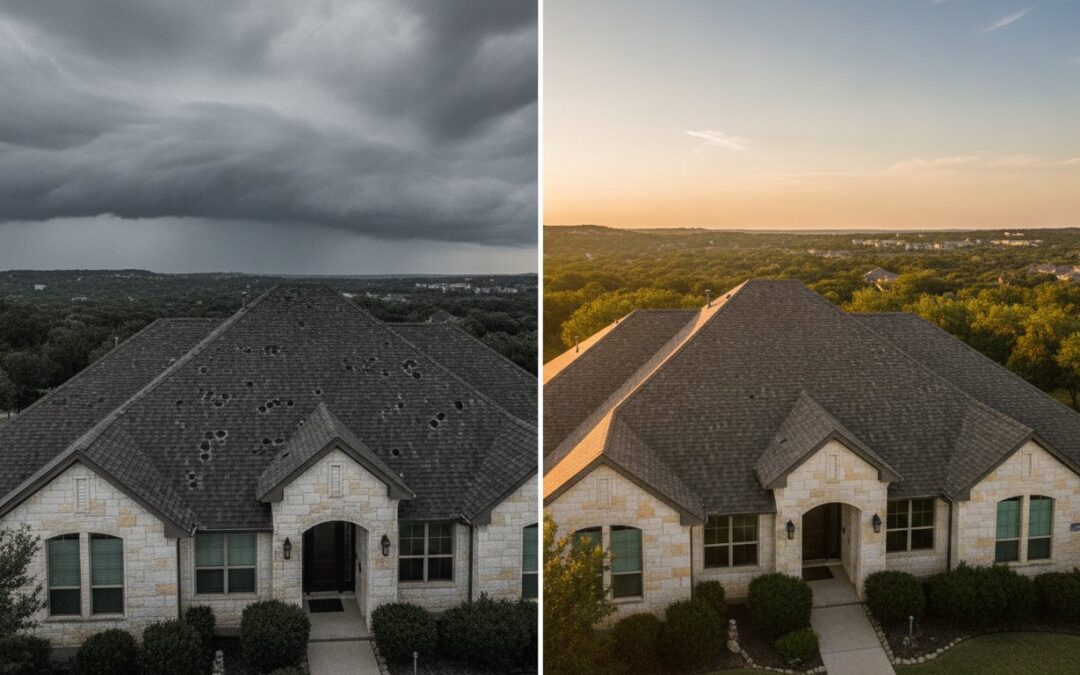
Imagine opening your insurance check after a heavy Austin hailstorm only to find it’s thousands of dollars short of what you actually need for a new roof. For many homeowners in Central Texas, this sticker shock is a harsh reality because of how modern policies are structured. You aren’t alone if you feel overwhelmed by the fine print or anxious about strict state laws. Navigating roof insurance deductibles in Texas has become more complex since the 2% deductible became the industry standard in 2026.
We understand that protecting your home shouldn’t feel like a legal gamble. This guide will help you understand the critical differences between Actual Cash Value (ACV) and Replacement Cost Value (RCV) so you can maximize your claim payout legally. We’ll also explain why recoverable depreciation appears on your statement and how to ensure your property gets the high-quality GAF or Certainteed materials it deserves. We’re going to break down the legal requirements and the math behind your out-of-pocket costs so you can move forward with confidence.
Key Takeaways
- Learn why Replacement Cost Value (RCV) is the standard for full restoration while Actual Cash Value (ACV) only pays for your roof’s depreciated worth.
- Understand the legal risks of “waiving” deductibles under Texas HB 2102 and how navigating roof insurance deductibles in Texas correctly protects your property.
- See how Austin’s intense UV exposure impacts depreciation math and how an RCV policy allows you to recover those held-back funds.
- Get a clear plan for reviewing adjuster summaries to ensure missing items like flashing and ridge vents are included in your final payout.
The Critical Difference Between ACV and RCV for Austin TX Roof Claims
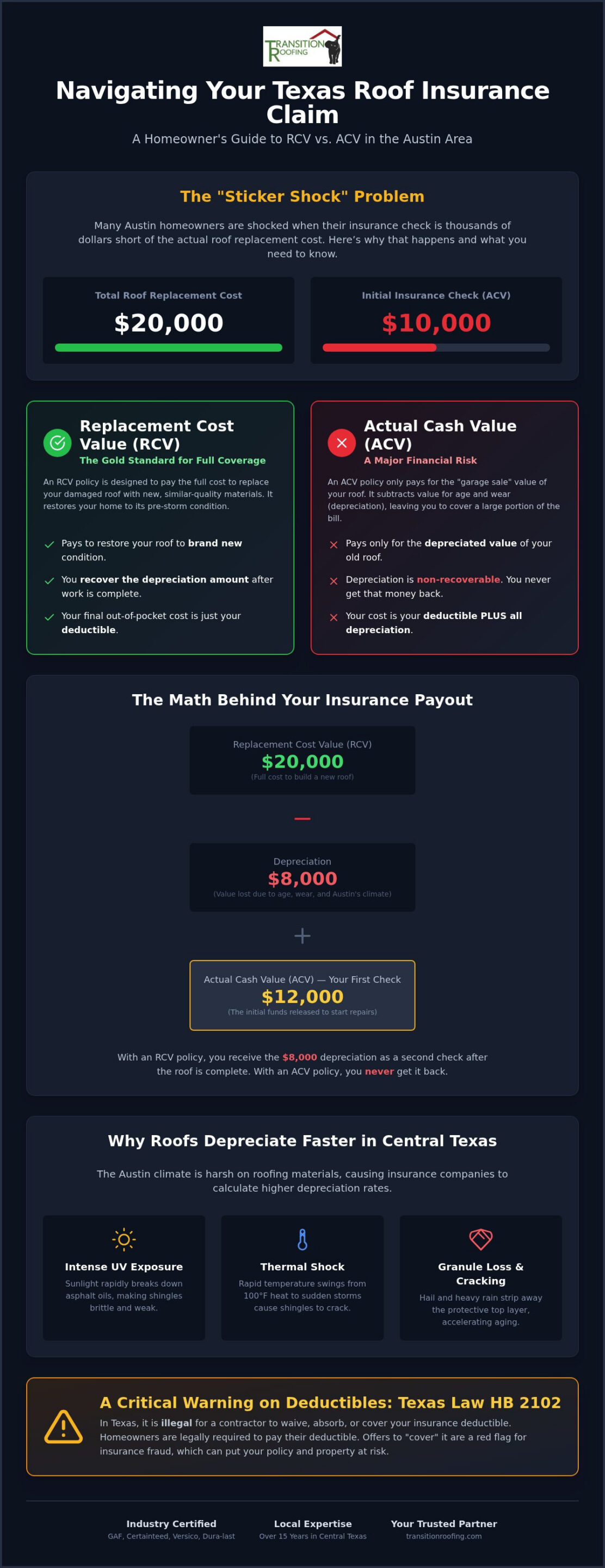
Understanding Property insurance basics is the first step in protecting your home. In Central Texas, most homeowners have either a Replacement Cost Value (RCV) or an Actual Cash Value (ACV) policy. RCV is the gold standard for residential roof replacement because it pays to restore the structure to its original condition. Conversely, ACV only pays the “garage sale” value of the roof, which means the insurance company subtracts for age and wear. Navigating roof insurance deductibles in Texas becomes much harder if you’re stuck with an ACV policy that doesn’t cover the full cost of new materials.
To better understand how these claims work, watch this helpful video:
Why Your Policy Choice Matters After an Austin Hail Storm
In hail-prone areas like Lakeway or Cedar Park, an ACV policy is a massive financial risk. If a storm hits a 15-year-old roof, the insurer might only pay out a fraction of the replacement cost. With an RCV policy, we can install high-quality GAF or Certainteed shingles while the insurance company covers the difference through recoverable depreciation. Recoverable depreciation refers to the specific funds an insurer holds back from the initial check until the contractor confirms the work is finished. This two-check process ensures the insurance company only pays for work that actually happens.
RCV vs ACV: A Quick Comparison for Central Texas
While ACV premiums are often lower, the out-of-pocket costs after a storm are significantly higher. In an ACV policy, the depreciation is “non-recoverable,” meaning you must pay that amount yourself. This hidden trap often leaves homeowners with thousands of dollars in unexpected debt. Navigating roof insurance deductibles in Texas requires knowing that RCV provides a predictable path to a secure home without the stress of “sticker shock” during the restoration process.
How Depreciation Calculations Work for Roof Replacement in Austin TX
Insurance adjusters use a specific formula to determine your payout: the total Replacement Cost Value minus Depreciation equals your Actual Cash Value (ACV) check. This “First Check” is the amount you receive to begin the restoration process. In an RCV policy, the “Second Check” represents the held-back depreciation that is released once the project is finished. Navigating roof insurance deductibles in Texas requires a clear understanding that your deductible is typically subtracted from that initial payout, which can create a significant gap in your starting budget.
A 10-year-old roof in Austin depreciates faster than the national average because our extreme heat and intense UV levels rapidly break down the asphalt oils that keep shingles flexible. This accelerated aging means your “garage sale value” drops quickly in the eyes of an insurance carrier.
Factors That Accelerate Roof Aging in Austin TX
Thermal shock is a constant threat in the Central Texas climate. When a 100-degree afternoon is followed by a sudden thunderstorm, shingles expand and contract with violent speed. This process causes granule loss and micro-cracking that weakens the entire system. While asphalt shingles are most vulnerable, metal roofing systems in Round Rock often hold their value better in insurance assessments because they resist this thermal cycling more effectively. If you’re noticing these signs of wear, we recommend exploring our residential roof replacement services to secure your home.
Recovering Your Depreciation: The Final Step
To trigger the release of the “Second Check,” you must provide a Proof of Loss or a final invoice showing the work is complete. This step confirms that you used the insurance funds for their intended purpose. You must complete the full scope of work outlined by the adjuster to receive the total RCV amount. If you skip specific repairs mentioned in the claim, the insurer may legally withhold a portion of those funds. If you’re seeing confusing line items on your claim summary, we can take a look and give you a clear plan for moving forward.
Navigating Roof Insurance Deductibles in Texas for Austin TX Homeowners
Since 2019, Texas HB 2102 has made it strictly illegal for roofing contractors to waive, absorb, or rebate any portion of a homeowner’s insurance deductible. This law ensures that repairs are performed to code and that the insurance system remains stable. Navigating roof insurance deductibles in Texas requires choosing a partner who values transparency over “too good to be true” deals. An honest estimate in Austin TX must always account for the full deductible. Ignoring this cost is considered a violation of state law and can lead to significant legal trouble for both parties.
Storm chasers often descend on areas like Pflugerville or Round Rock after a hail event, promising a “free roof” by covering the deductible. These temporary restoration specialists often vanish once the check clears, leaving homeowners with no warranty and potential legal exposure. For families with an ACV policy, paying the deductible is a larger hurdle because the insurance check is already reduced by depreciation. Choosing a contractor with over 15 years of local experience ensures you’re following the legal path for navigating roof insurance deductibles in Texas.
The Legal Risks of Deductible Scams in Austin TX
Your total out-of-pocket cost is the sum of your deductible, any chosen material upgrades, and depreciation if you hold an ACV policy. It’s vital to review our Austin Roof Repair Guide to see how these costs shift during storm recovery. If you’re dealing with a complex claim, schedule a roof inspection in Austin today so we can review your summary for accuracy and build a clear plan for your restoration.
Professional Steps to Securing a Full Roof Replacement in Austin TX
Successfully navigating roof insurance deductibles in Texas requires a methodical approach that starts well before you call your agent. First, schedule a professional inspection to document hail and wind damage. This documentation provides a baseline for your claim and prevents “thin” reporting. Once you receive the adjuster’s summary, review it for missing line items like flashing, drip edge, or ridge vents. These components are often overlooked in initial estimates but are vital for a durable, code-compliant system.
The next phase involves the supplement process. This is where we provide the technical justification for using high-quality Certainteed or GAF materials. We work directly with the carrier to ensure the scope of work covers the actual cost of a proper installation. Once the project is finalized, we submit a certificate of completion to your insurer. This document triggers the release of your recoverable depreciation, ensuring you receive the full value of your RCV policy.
Why Local Expertise Matters During the Supplement Phase
Having a contractor present during the adjuster’s meeting in Austin TX is one of the most important steps you can take. We use our industry certifications to prove the necessity of specific underlayments and ventilation systems. Because we understand the Central Texas climate, we can explain why standard generic estimates often fall short of providing total security. This level of detail helps prevent the “sticker shock” of unexpected out-of-pocket costs.
Commercial vs. Residential Claims in Central Texas
Special considerations apply to Commercial Roofing Austin projects involving TPO and flat roof systems. These claims often require more extensive documentation, such as core samples or thermal imaging, to verify damage to the insulation layers. Whether you’re managing a commercial facility or a family home, we apply the same “contractor logic” to ensure your claim is handled with integrity and technical precision.
Protecting Your Home and Your Investment in Austin
Successfully navigating roof insurance deductibles in Texas doesn’t have to be a source of stress. By understanding the critical gap between ACV and RCV policies and acknowledging the legal requirements of HB 2102, you’re already ahead of the curve. Remember that your deductible is a fixed responsibility; however, the quality of your restoration and the accuracy of your claim payout are variables we can help control. Our team brings over 15 years of local experience to every project, ensuring your roof is restored with GAF or Certainteed materials that can withstand the Central Texas climate.
We are experts in claim supplementing and hold the certifications necessary to justify code-compliant repairs to your insurer. Dealing with a confusing insurance estimate in Austin? Schedule a professional roof inspection today and let us give you a clear plan. We’re here to guide you from the initial damage assessment to the final certificate of completion. You deserve a roof that offers total security and a process that respects your time and budget. Let’s get your home back to its best condition together.
Frequently Asked Questions
Can I switch from an ACV to an RCV policy after a storm has occurred?
No, you cannot retroactively change your policy type to cover a past event. Insurance is a legal contract based on the specific conditions present at the exact time the damage occurred. If you had an ACV policy during the Austin storm, your claim will be processed under those depreciated terms. We recommend reviewing your policy immediately after repairs are complete to upgrade your coverage for future protection.
What happens if my Austin TX roof replacement costs more than the insurance estimate?
This is common and is addressed through the supplement process. If our inspection reveals hidden damage or code requirements like drip edge that the adjuster missed, we submit a supplement request to your carrier. As experts in navigating roof insurance deductibles in Texas, we provide the technical documentation needed to justify these costs. This ensures your Austin TX roof replacement is finished correctly without extra costs.
Is depreciation always recoverable in a Texas roof claim?
Depreciation is only recoverable if you have a Replacement Cost Value (RCV) policy. On an RCV claim, the insurer holds back a portion of the funds until the work is finished. Once we submit the certificate of completion, that money is released to you. If you have an Actual Cash Value (ACV) policy, the depreciation is considered “non-recoverable,” meaning you must cover that loss out of your own pocket.
How do I know if my current policy is ACV or RCV before a storm hits?
You can find this information on your policy’s “Declarations Page” under the “Loss Settlement” section. Look for terms like “Replacement Cost” or “Actual Cash Value.” If the language is unclear, call your agent and ask specifically if your roof is covered at RCV. Knowing this before a storm hits Austin is vital for budgeting, as it determines if you’ll face high out-of-pocket costs for depreciation.
What is the ‘deductible law’ in Texas and how does it affect my roof replacement?
The “deductible law,” known as HB 2102, makes it illegal for contractors to waive or “eat” your insurance deductible. You are legally required to pay the full deductible amount stated in your policy. This law protects homeowners from fraud and ensures contractors use high-quality materials. When navigating roof insurance deductibles in Texas, always work with a transparent company that includes your deductible in the final project cost.