
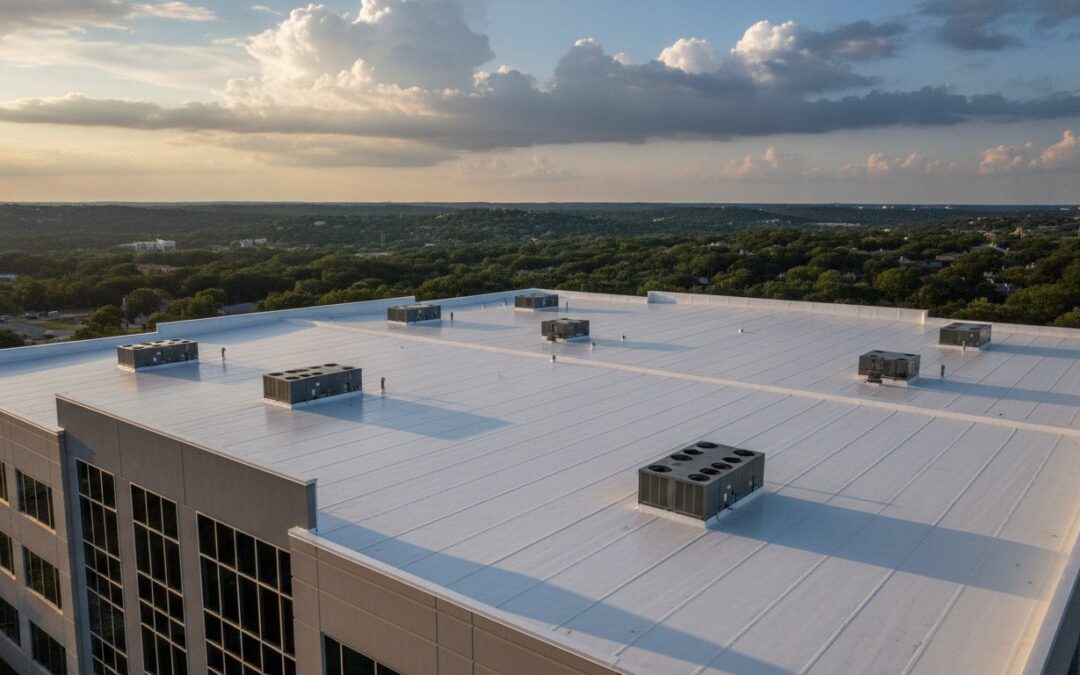
Your commercial roof in Central Texas faces a relentless battery of 110-degree summer days and sudden, destructive hailstorms. For property managers, a roof isn’t just a structural necessity; it’s a critical tool for controlling operational costs. You likely already feel the strain of rising cooling expenses and the frustration of chasing leaks through aging flat roof seams. It’s a stressful cycle that often leads to expensive, temporary fixes rather than long-term security.
This guide shows you why commercial TPO roofing Austin has become the gold standard for durability and energy efficiency in 2026. You’ll learn how to select a system that withstands the unique stressors of the Austin TX climate while securing a leak-free performance for over 20 years. With 15 years of local experience and certifications from industry leaders like GAF and Versico, we provide the technical clarity you need. We’ll preview the latest energy codes, current material lead times, and professional strategies for handling insurance claims after a storm.
Key Takeaways
- TPO’s high solar reflectance index (SRI) acts as a financial safeguard against Austin’s extreme heat by significantly reducing HVAC energy consumption.
- Selecting the right membrane thickness and utilizing heat-welded seams is the most reliable way to ensure your commercial TPO roofing Austin system stays leak-free.
- Property managers must identify the subtle differences between TPO surface fractures and deep punctures to prevent water from trapping under the membrane after hail storms.
- A consistent preventative maintenance program can extend a flat roof’s lifespan by 25% or more, turning a standard installation into a 20+ year asset.
Why TPO Roofing is the Standard for Commercial Buildings in Austin, TX
Thermoplastic Polyolefin, commonly known as TPO, is a single-ply reflective membrane that has transformed the local skyline. These TPO roofing systems are engineered from a blend of polypropylene and ethylene-propylene rubber. Unlike older built-up roofs (BUR) that rely on heavy layers of asphalt and gravel, TPO is lightweight and installs much faster. This efficiency reduces labor hours and minimizes disruptions to your daily operations. In a city where the summer sun can bake a standard dark roof to 150 degrees, TPO acts as a protective shield for your asset.
Energy Efficiency and Utility Savings in Central Texas
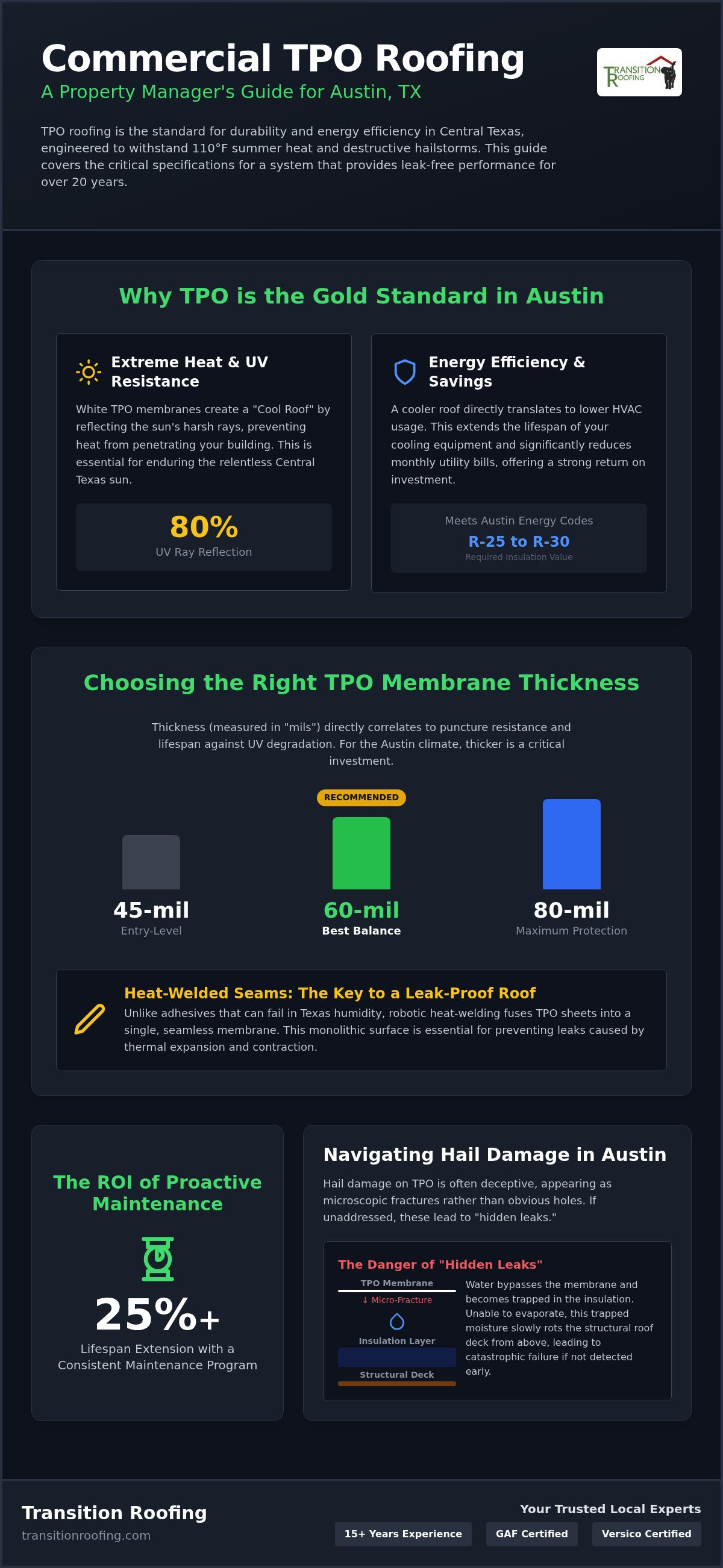
The primary reason for the dominance of TPO in Austin is its Solar Reflectance Index (SRI). High-quality white membranes reflect up to 80% of UV rays. This creates a “Cool Roof” effect that prevents heat from migrating into your building. There is a direct correlation here: a cooler roof means your HVAC units don’t have to work as hard. This extends the life of your cooling equipment and lowers monthly energy bills. To comply with energy standards, including the 2021 International Energy Conservation Code (IECC) enforced in Austin, new commercial TPO roofing Austin projects often require R-25 to R-30 continuous insulation.
Cost-Effectiveness vs. Longevity
TPO offers a superior balance of upfront investment and 20-year performance. While it is more affordable than some specialized metal systems, it provides better leak protection than traditional felt-and-tar options. The exact cost of a project depends on the building size and the condition of the existing substrate. If the current deck is saturated with moisture, we typically recommend a full tear-off. If the structure is sound, a recover might be possible. Regardless of the scope, TPO’s heat-welded seams provide a monolithic surface that handles the constant expansion and contraction caused by the Central Texas climate.
Technical Specs: Choosing the Right TPO Membrane for Austin’s Climate
TPO isn’t a one-size-fits-all product. For commercial TPO roofing Austin, the technical details determine if the system lasts 10 years or 25 years. We rely on industry leaders like GAF and Versico because their membranes are engineered specifically for extreme UV exposure. A critical component is the ‘scrim,’ a polyester reinforcement layer sandwiched between the TPO layers that prevents tearing during thermal expansion. We always use robotic heat-welding for seams. Unlike glue, which often degrades in high Texas humidity, heat-welding fuses the sheets into a single monolithic layer.
45-Mil vs. 60-mil vs. 80-mil: The Contractor’s Verdict
While 45-mil is the entry-level option, we typically recommend 60-mil or 80-mil for local commercial properties. Thicker membranes provide better puncture resistance against hail and more sacrificial material to withstand UV degradation over decades. Mil thickness represents the total thickness of the membrane in thousandths of an inch, which directly correlates to its ability to resist long-term UV weathering. In the harsh Central Texas climate, this extra thickness is a necessary investment for long-term protection.
Attachment Methods: Mechanically Fastened vs. Fully Adhered
Attachment choice depends on your building’s structure. Mechanically fastened systems are screwed into the deck, which works well for steel. Fully adhered systems are glued down and offer superior wind-uplift performance. This is vital since Austin building codes require roofs to withstand 110-115 mph winds. All professional installations must strictly follow OSHA fall protection standards to ensure job site safety. If you’re seeing signs of wear on your current system, we can provide a detailed roof assessment to help you choose the right specs for your commercial TPO roofing Austin project.
Navigating Hail Damage and TPO Roof Repairs in Austin, TX
Hail damage on TPO is uniquely deceptive. It doesn’t always present as a visible hole. Often, it appears as microscopic fractures in the top weathering layer that only a trained eye can spot. If these aren’t addressed, they lead to “hidden” leaks. Water becomes trapped between the membrane and the insulation. This moisture can’t evaporate, so it slowly rots the structural deck from the top down. Our team focuses on early detection to prevent this total structural failure. We provide immediate leak mitigation and emergency tarping to secure your building while we plan a permanent commercial TPO roofing Austin solution.
The Commercial Insurance Claim Process
Filing a claim for a large building is a complex task. We act as your technical advocate by providing adjusters with clear, documented evidence of hail impacts and seam failures. This professional documentation is the key to getting a fair settlement. Navigating an Austin roofing insurance claim requires a partner who understands both the building codes and the specific way TPO fails under stress. For a deeper look at the recovery process, see our Austin Roof Repair Guide.
Repair vs. Replacement: Making the Call
We use “contractor logic” to help you decide between a patch and a full replacement. If the damage is localized and the underlying insulation is dry, a professional repair is often the best move. However, if your roof is nearing the 15 to 20 year mark, the membrane may be too brittle for reliable heat-welding. In these cases, a full commercial TPO roofing Austin overlay or replacement provides better long-term ROI. If you suspect your building has storm damage, we can perform a thorough inspection to give you a clear, honest assessment.
Investing in Longevity: TPO Installation and Maintenance ROI in Austin, TX
A high-quality installation is only the first step for commercial TPO roofing Austin. To protect your investment, we recommend a preventative maintenance program. Bi-annual inspections allow us to catch small issues before they become catastrophic failures. Industry data indicates that consistent upkeep extends the lifespan of a flat roof by 25% or more. In the Central Texas climate, this often means the difference between a 20-year roof and one that fails prematurely at year 12.
Effective drainage is non-negotiable. We focus on keeping scuppers, gutters, and downspouts clear of debris. Austin’s heavy seasonal rains can quickly overwhelm a clogged system, leading to ponding water that stresses the seams. With over 15 years of experience, we’ve seen how a few hours of maintenance each year prevents thousands of dollars in structural repairs. Our team ensures that your system remains a protective asset rather than a liability.
Maximizing Your Manufacturer Warranty
Your warranty is a vital safety net, but it’s not automatic. A standard material warranty only covers defects in the TPO itself. We often recommend a No Dollar Limit (NDL) labor warranty for total peace of mind. This covers both the materials and the contractor’s labor for the duration of the term. Manufacturers like GAF and Versico typically require documented proof of regular maintenance to keep these warranties valid. Without a paper trail of inspections, a claim for a premature failure might be denied.
Selecting an Austin Commercial Roofing Expert
Choosing a contractor with deep roots in Austin and San Antonio ensures you have support when the next major storm hits. We understand the specific environmental stressors of the region and prioritize long-term relationships over quick transactions. This local expertise translates to better craftsmanship and reliable post-storm guidance. If you’re ready to secure your building’s future, schedule a professional TPO roof inspection in Austin today. We’ll provide a clear plan to keep your asset protected for decades.
Securing Your Commercial Asset for the Next Two Decades
Choosing the right roofing system is one of the most impactful decisions you’ll make for your property’s bottom line. By selecting high-performance commercial TPO roofing Austin, you’re investing in a system that directly reduces HVAC strain while providing a monolithic barrier against Central Texas storms. Success depends on more than just materials; it requires precise technical specs like 60-mil thickness and a proactive maintenance plan to keep your manufacturer warranty intact.
With 15+ years of experience in Central Texas, we understand the stress that hail and high heat place on your structure. As GAF and Versico certified installers, we provide the technical mastery and specialized insurance claim assistance needed to move your building from a state of vulnerability to total security. If you’re concerned about the current condition of your flat roof, we can take a look and give you a clear, honest plan. Schedule your free commercial TPO roof inspection in Austin today to ensure your property remains protected for years to come.
Frequently Asked Questions
How long does a commercial TPO roof last in the Austin heat?
A properly installed commercial TPO roofing Austin system typically lasts between 20 and 25 years. The extreme UV exposure in Central Texas can accelerate degradation if you choose a thin 45-mil membrane. We recommend 60-mil or 80-mil options to ensure the roof withstands the heat. Regular maintenance and keeping drainage systems clear are essential factors in reaching the full lifespan of the material.
What is the average cost per square foot for TPO roofing in Austin, TX?
The cost for commercial TPO roofing Austin varies based on several project-specific factors. These include the thickness of the membrane, the complexity of the roof’s penetrations, and whether you require a full tear-off or a recover. Labor demand in the Austin metropolitan area also influences the total investment. We provide transparent estimates based on current material lead times and the specific insulation requirements of the local energy code.
Can you install a new TPO roof over an existing flat roof?
Yes, you can often perform a recover by installing TPO over an existing roof, but it depends on the condition of the substrate. If the current roof has only one layer and the underlying insulation is dry, an overlay is a cost-effective solution. However, if there is trapped moisture or structural damage to the deck, a full tear-off is necessary to ensure long-term protection and warranty compliance.
Is TPO roofing hail resistant compared to other flat roof materials?
TPO is highly durable, but its hail resistance depends on the membrane thickness and the age of the system. Newer 60-mil or 80-mil TPO systems handle typical Central Texas hail well because the material remains flexible. Over time, UV exposure can make older membranes brittle, increasing the risk of fractures. Compared to asphalt-based systems, TPO’s reinforced scrim layer provides superior puncture resistance during severe storm events.
How often should I have my commercial TPO roof inspected in Central Texas?
We recommend scheduling professional inspections at least twice a year, typically in the spring and fall. In the Austin area, it’s also vital to request an assessment after any significant hailstorm or high-wind event. Regular checks help identify hidden leaks and ensure scuppers stay clear. Documented inspections are often a mandatory requirement to keep your GAF or Versico manufacturer warranties valid and enforceable.