

The most expensive roof on an Austin commercial property isn’t always the one with the highest installation cost. It’s the one that fails to deflect the Texas sun or buckles under the weight of a spring hailstorm. Choosing between TPO vs Metal Roofing for Commercial Buildings in Austin often feels like a gamble when you’re staring at conflicting quotes and rising energy bills. You want a solution that protects your assets without becoming a constant maintenance headache. We understand that your priority is a secure, leak-free structure that actually lowers your overhead.
In this guide, we compare these two dominant systems through the lens of the current 2021 IBC building codes. You’ll learn which material offers the best long-term ROI for your property and how to navigate Austin Energy rebates, such as the $1.00 per square foot credit for new roof insulation. We’ll examine durability against our local average of 6 to 8 annual hailstorms and identify which system keeps your cooling costs lowest. This clear breakdown ensures your next roofing decision is grounded in local expertise and technical facts.
Key Takeaways
- When evaluating TPO vs Metal Roofing for Commercial Buildings in Austin, consider how TPO’s reflective surface and metal’s longevity align with your specific property goals.
- Learn how Class 4 impact ratings protect your investment against Central Texas hailstorms and which system offers a potential 50 year lifespan.
- Discover how to reduce HVAC strain and capitalize on local energy rebates to maximize your commercial roofing ROI.
- Understand why working with certified installers for GAF or Versico systems ensures your new roof meets the latest 2026 building codes.
Understanding TPO and Metal Systems in the Austin TX Climate
Building owners in Central Texas face a unique set of environmental stressors. Our intense summer heat and sudden, violent spring storms require roofing that does more than just sit there. Choosing between TPO vs Metal Roofing for Commercial Buildings in Austin requires a deep look at two distinct technologies. TPO, or Thermoplastic Polyolefin, is a cost-effective, white single-ply membrane that excels on flat surfaces. Standing seam metal roofing provides a rigid, interlocking solution for low-slope buildings. Transition Roofing has spent over 15 years installing both systems, ensuring local businesses stay dry and energy-efficient.
The TPO Advantage for Austin Flat Roofs
TPO belongs to the category of Membrane roofing systems. It’s particularly effective for flat roofing in Austin because the seams are heat-welded. This creates a monolithic surface that won’t pull apart during the flash floods common in Central Texas. We often recommend GAF or Versico TPO membranes because they offer superior UV resistance. These systems reflect a massive amount of solar radiation, which is vital when the August sun beats down on your facility.
Why Metal Roofs Stand Up to Central Texas Storms
Standing seam metal roofing is the gold standard for structural integrity. The panels interlock with hidden fasteners, making them incredibly resistant to high winds and heavy rain. While many people associate metal with heat, modern “cool roof” coatings allow metal to rival TPO in reflectivity. These specialized finishes keep the building interior cooler; according to the U.S. Department of Energy, a reflective roof can stay over 50 degrees cooler than a traditional dark-colored roof in the summer. Comparing TPO vs Metal Roofing for Commercial Buildings in Austin reveals that metal is a heavy-duty choice for owners who prioritize long-term protection. It’s a reliable investment for any property.
Comparing Lifespan, Durability, and Maintenance in Austin TX
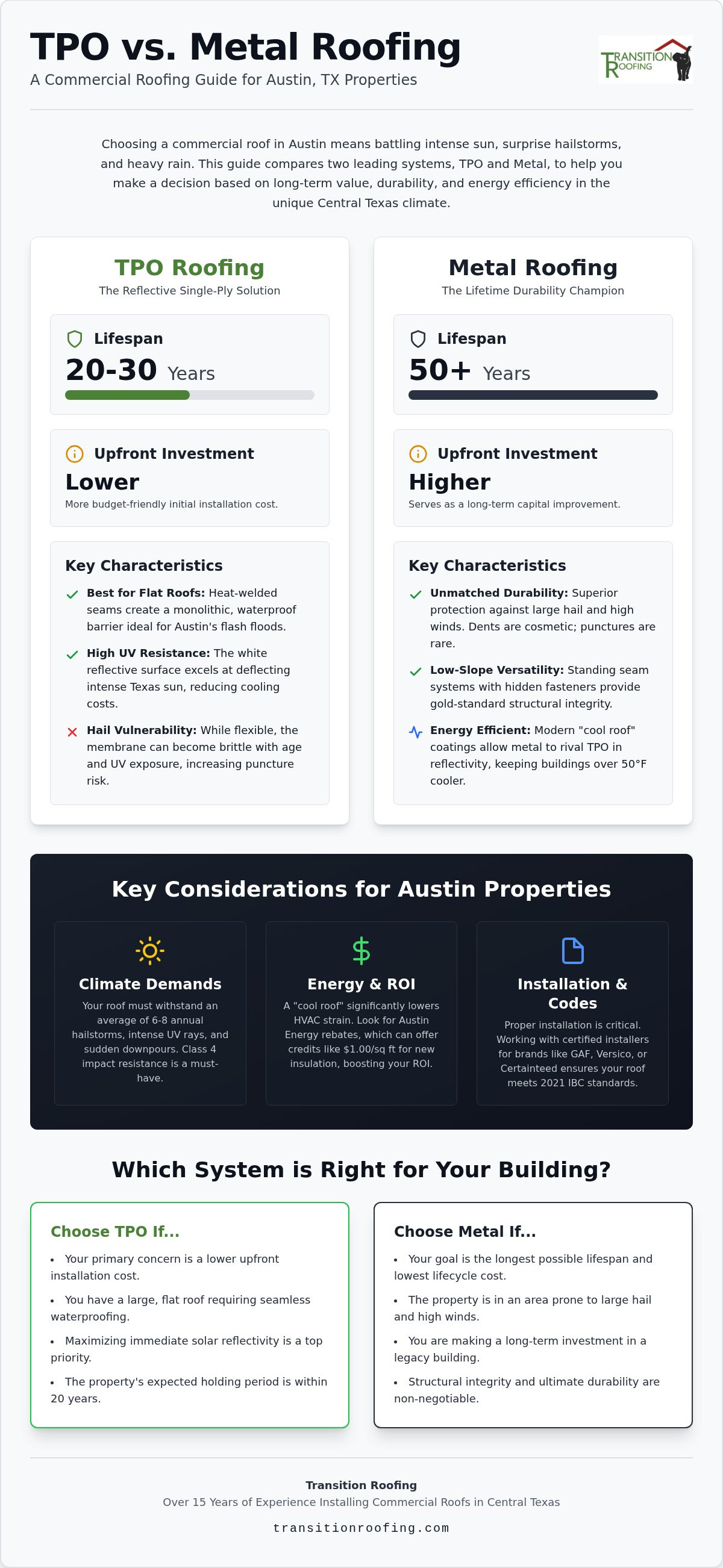
A commercial roof’s value is measured by how long it stays secure. When looking at TPO vs Metal Roofing for Commercial Buildings in Austin, lifespan is the most obvious differentiator. A well-installed TPO membrane typically lasts 20 to 30 years. In contrast, a standing seam metal roof can easily exceed 50 years with basic care. Both systems qualify as energy-efficient cool roof products, but their physical resilience varies as they age. Austin averages 6 to 8 significant hailstorms annually, making Class 4 impact resistance a standard requirement for local peace of mind.
Hail Resistance and Storm Recovery
Metal roofs generally offer superior protection against large hail. They rarely puncture, even if they sustain cosmetic denting. While new TPO is flexible, older membranes can become brittle under constant UV exposure, increasing the risk of cracks during a storm. If your property is hit, you can find detailed storm recovery insights in our guide to Austin roof repair. Transition Roofing provides dedicated insurance claim assistance to ensure your assets are fully restored after a disaster.
Maintenance Requirements for Long-Term Protection
Maintenance needs differ by system. TPO requires meticulous seam inspections to prevent water from creeping under the membrane. Metal systems focus on the integrity of fasteners and flashing. We recommend professional inspections twice a year to catch minor issues before they escalate into costly leaks. Our preventative maintenance programs are designed to extend the life of your commercial assets and guarantee total security. It’s a simple way to protect your bottom line while ensuring your roof remains in safe, capable hands.
Energy Efficiency and Cost-Benefit Analysis for Austin TX Businesses
Financial decisions for Austin property owners often boil down to immediate cash flow versus long-term asset value. When weighing TPO vs Metal Roofing for Commercial Buildings in Austin, you must account for the relentless August heatwaves that spike HVAC demand. TPO offers a lower entry point for businesses needing immediate budget relief. Metal requires a larger initial investment but serves as a permanent solution for legacy buildings intended to stay in a portfolio for decades. Our goal is to ensure your investment provides total security for your bottom line.
Beating the Austin Heat with Reflective Surfaces
Both materials can achieve high Solar Reflective Index (SRI) ratings. White TPO membranes are naturally reflective, while metal requires specialized cool roof coatings to reach similar performance. These surfaces prevent the building from absorbing thermal energy, which significantly reduces cooling costs. Austin Energy currently offers a rebate of $0.25 per square foot for reflective roof coatings, helping offset the cost of high-performance finishes. For those managing flat structures, our team at this flat roofing company in Austin can calculate the specific ROI based on your building’s footprint.
Total Cost of Ownership: TPO vs. Metal
The total cost involves more than just the material. TPO is generally the most affordable professional installation for low-slope roofs. Metal systems cost more upfront due to labor-intensive standing seam techniques and material prices. However, when you factor in that metal can last twice as long as TPO, the per year cost often favors metal for long-term holds. Other variables like your existing deck condition and the 2021 IECC insulation requirements will influence the final quote. For instance, Austin Energy provides a $1.00 per square foot rebate for new roof insulation, which applies regardless of the top layer you choose.
If you’re ready to lower your overhead with a high-performance system, contact our team for a commercial roof installation that prioritizes your long-term satisfaction and energy efficiency.
Professional Installation and Choosing Your System in Austin TX
Selecting the right material is only half the battle. The quality of the installation determines whether your investment reaches its full potential or fails prematurely. When deciding on TPO vs Metal Roofing for Commercial Buildings in Austin, you must partner with a team that understands local permitting and the 2021 IBC standards. The process begins with a comprehensive site assessment followed by securing municipal permits. We then manage the removal of the existing system, inspect the structural deck, and install the new material according to manufacturer specifications.
Expert Installation Standards in Central Texas
Transition Roofing utilizes specialized crews for each system. TPO heat-welding requires a different technical skill set than the precision fabrication needed for standing seam metal. We maintain certifications from GAF and Versico, which are essential for securing long-term manufacturer warranties. These certifications require us to provide documented reports and adhere to strict quality control. Choosing a contractor with a local Austin office is vital for future warranty support and emergency repairs. You need a partner who is physically present in the community when a storm hits.
Scheduling Your Commercial Roof Inspection in Austin
Your final choice often depends on your building’s specific use. TPO remains the standard for large warehouses and flat-roof retail centers due to its cost-efficiency and reflectivity. Standing seam metal is the superior choice for high-visibility office buildings or legacy assets where a 50 year lifespan is the priority. If you’re noticing leaks or high energy bills, a professional assessment is the first step toward total security. Schedule a commercial roof inspection in Austin today to ensure your property remains in safe, capable hands for decades to come.
Protecting Your Austin Commercial Investment
Deciding on TPO vs Metal Roofing for Commercial Buildings in Austin is a strategic move that impacts your operational costs for decades. Whether you prioritize the immediate reflectivity of a TPO membrane or the multi-generational durability of standing seam metal, your objective is total security. We’ve explored how Austin’s intense climate requires materials that not only meet current building codes but also maximize available energy rebates.
Transition Roofing brings over 15 years of local experience to every project. As a GAF and Versico certified installer, we apply every system with the technical precision required to safeguard your manufacturer warranty. Our specialized commercial maintenance programs offer the steady care needed to prevent leaks and extend your roof’s life. We’re committed to ensuring your assets remain in safe, capable hands.
Get a Transparent Estimate for Your Austin Commercial Roof today. Let’s build a solution that provides the long-term protection your property deserves.
Frequently Asked Questions
Is TPO or Metal better for a completely flat roof in Austin?
TPO is generally better for completely flat roofs because it is designed as a monolithic membrane that prevents ponding water from leaking. When evaluating TPO vs Metal Roofing for Commercial Buildings in Austin, metal requires a specific pitch to shed water effectively. TPO seams are heat-welded to create a watertight bond, making it the more reliable choice for zero-slope commercial structures in Central Texas.
How much does a commercial roof replacement cost in Austin TX?
The total cost of a replacement depends on your material choice, building height, and current insulation requirements under the 2021 IECC. TPO is typically the more budget-friendly option for large square footage, while standing seam metal involves higher labor costs. Factors like the condition of the existing deck and the need for structural repairs will also influence your final investment for a secure solution.
Can I install TPO over an existing metal roof?
Yes, you can often install TPO over an existing metal roof by using a flute-fill insulation system to create a flat surface. This recover process avoids the cost of a full tear-off while adding a reflective layer to lower cooling bills. When comparing TPO vs Metal Roofing for Commercial Buildings in Austin, this hybrid approach is a popular way to upgrade durability without a massive structural overhaul.
What is the typical lifespan of a TPO roof in the Texas heat?
A high-quality TPO roof typically lasts between 20 and 30 years in the intense Austin environment. The primary factor in its longevity is the thickness of the membrane and the quality of the heat-welded seams. Regular maintenance is essential to ensure the UV stabilizers in the material continue to protect the underlying structure from our local climate’s high heat and frequent temperature swings.
Does insurance cover hail damage for commercial metal roofs in Austin?
Most commercial insurance policies cover hail damage, but the extent depends on whether the damage is functional or merely cosmetic. Metal roofs often sustain dents that don’t compromise the system’s integrity, which some insurers may exclude. If the impact affects the roof’s ability to shed water, coverage typically applies. We recommend choosing a material with a Class 4 impact rating to maximize your protection and potential premium discounts.