
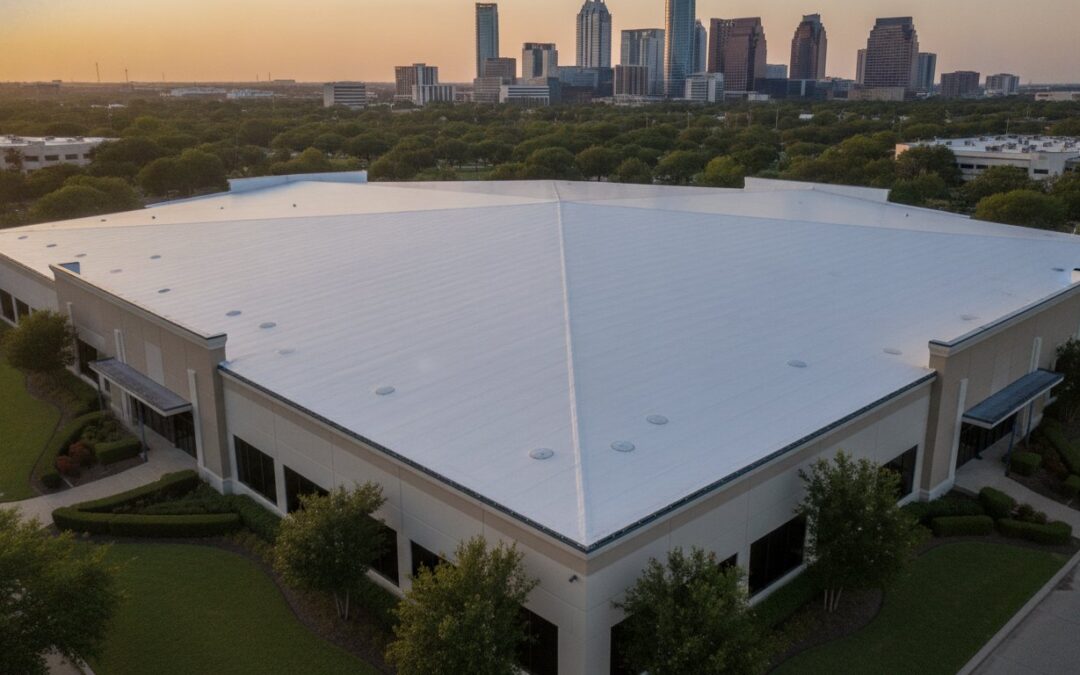
Austin ranks 9th among U.S. metros for hail damage risk, with the I-35 corridor facing up to eight significant storms every single year. If you manage a local facility, you know that a flat roof is more than just a structural necessity. It is a constant target for punishing UV rays and heavy ice. Keeping cooling costs down while preventing recurring leaks in those seams can feel like a full-time battle. Selecting the right commercial TPO roofing Austin system is the most effective way to protect your investment and your tenants.
We understand the stress of managing large-scale maintenance and the frustration of complex insurance claims. This guide shows you how to select a TPO system that provides a 20-year leak-free lifespan and slashes your HVAC energy consumption. We will walk through the 2026 industry standards, from choosing the right membrane thickness to meeting the latest Austin energy codes. You will gain the clarity needed to move your property from a state of vulnerability to total security under a roof built specifically for the Central Texas climate.
Key Takeaways
- Understand why commercial TPO roofing Austin is the industry standard for slashing cooling costs and meeting strict 2026 energy codes.
- Learn how to select the proper membrane thickness and why heat-welded seams are essential for lasting protection in high humidity.
- Identify the specific signs of hail damage to prevent “hidden leaks” from compromising your building’s structural integrity.
- See how a proactive maintenance plan can extend your roof’s life by 25% and simplify the commercial insurance claim process.
Why TPO Roofing is the Standard for Commercial Buildings in Austin, TX
Thermoplastic Polyolefin (TPO) is a single-ply, white reflective membrane that has revolutionized the local skyline. Unlike older built-up roofs (BUR) that rely on heavy layers of asphalt and gravel, TPO is lightweight and installs much faster. This speed is critical during our unpredictable Central Texas storm seasons. For property managers, commercial TPO roofing Austin provides a durable shield that handles thermal expansion better than rigid systems. Its flexibility allows the membrane to move with the building as temperatures fluctuate from freezing winters to scorching summers.
Energy Efficiency and Utility Savings in Central Texas
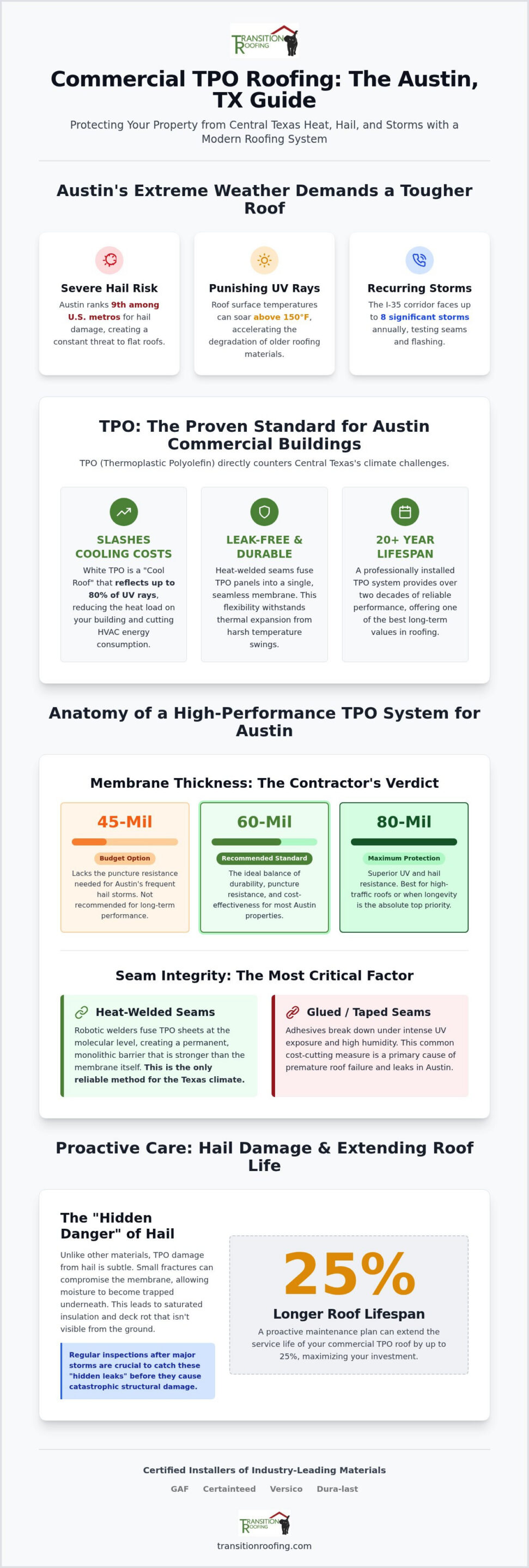
Austin’s urban heat island effect can push roof temperatures above 150 degrees. White TPO membranes reflect up to 80% of UV rays, earning them the “Cool Roof” designation. By keeping the roof surface cooler, you significantly reduce the heat transferred into your building. This creates a direct correlation to lower indoor cooling costs. It also reduces the strain on your HVAC units, extending their operational life by years. Current Austin energy standards, specifically the 2021 IECC, often require high Solar Reflectance Index (SRI) values that TPO membranes easily achieve.
Cost-Effectiveness vs. Longevity
Choosing commercial TPO roofing Austin offers a strong balance between initial investment and a 20-plus year performance life. While it is often the most cost-effective flat roof option, the final price depends on specific variables. It depends on the condition of your existing substrate and whether a full tear-off or a more affordable overlay is possible. We also look at building height and accessibility, which impact labor logistics. At Transition Roofing, we use our 15 years of local experience to determine the most reliable path for your specific building.
Technical Specs: Choosing the Right TPO Membrane for Austin’s Climate
To ensure long-term protection, your system must meet the ASTM D6878 standard for physical properties. We rely on industry leaders like GAF and Versico because their membranes include a robust internal “scrim.” This polyester reinforcement layer prevents the membrane from tearing under high tension. While some contractors cut costs with generic materials, we’ve seen how these fail during Central Texas hail events. Heat-welding is the only reliable way to secure a commercial TPO roofing Austin system. Robotic welders fuse the sheets together at the molecular level to create a single, monolithic waterproof layer. Glued seams often fail in Austin’s high humidity and heat, leading to premature leaks.
45-mil vs. 60-mil vs. 80-mil: The Contractor’s Verdict
A “mil” is a unit of measurement equal to one-thousandth of an inch, and thicker membranes provide more material to withstand decades of intense UV exposure. While 45-mil is the budget option, it lacks the puncture resistance needed for our frequent hail storms. We typically recommend 60-mil or 80-mil for Austin properties. These thicker options better withstand the constant expansion and contraction caused by our 40-degree temperature swings.
Attachment Methods: Mechanically Fastened vs. Fully Adhered
Wind uplift is a major concern during spring storms. Mechanically fastened systems use screws and plates to secure the membrane to a steel deck. Fully adhered systems use specialized adhesives to bond the TPO to the insulation. Adhered systems usually offer better wind performance and a smoother aesthetic on wood or concrete decks. If you aren’t sure which method fits your structure, we can evaluate your deck type to ensure a secure fit. This technical choice is the difference between a roof that stays put and one that peels during a high-wind event.
Navigating Hail Damage and TPO Roof Repairs in Austin, TX
Austin’s hail season often leaves property managers guessing. Unlike metal or shingles, commercial TPO roofing Austin systems show damage in subtle ways. You might see small fractures in the top polymer layer rather than clear punctures. According to NIST research on hail resistance, these impacts can weaken the membrane’s structural integrity even if no immediate leak appears.
The real danger is “hidden” water. When the membrane is breached, moisture traps between the TPO and the insulation. This leads to structural deck rot that isn’t visible from the ground. Transition Roofing prioritizes rapid leak mitigation and emergency tarping to stop the spread. If you suspect storm damage, schedule a professional inspection before minor fractures become a total loss.
The Commercial Insurance Claim Process
Navigating an Austin roofing insurance claim requires precise documentation. First, secure the site to prevent further damage. Next, we provide adjusters with high-resolution evidence of fractures and core samples showing moisture. This objective data is vital for a fair payout. For more on local recovery, see our Austin Roof Repair Guide.
Repair vs. Replacement: Making the Call
Contractor logic dictates when to patch and when to pivot. A few localized punctures on a young roof usually call for a simple heat-welded patch. However, if the system is approaching the 15 to 20-year mark, the membrane often becomes too brittle to weld. In these cases, a full TPO overlay or replacement is the only way to ensure long-term security. We evaluate the flexibility of your commercial TPO roofing Austin to give you an honest recommendation.
Investing in Longevity: TPO Installation and Maintenance ROI in Austin, TX
A commercial roof is a major asset that requires active management. Transition Roofing’s 15 years of experience has shown that a preventative maintenance program is the most effective way to protect that investment. In the Central Texas climate, bi-annual inspections can extend the functional lifespan of your flat roof by 25% or more. We focus on clearing drainage systems, such as scuppers and gutters, which frequently clog with debris during heavy Austin rainstorms. Clogged drains lead to ponding water, which adds immense weight and accelerates membrane degradation.
Maximizing Your Manufacturer Warranty
Understand the difference between a material-only warranty and a No Dollar Limit (NDL) labor warranty. An NDL warranty provides total security because it covers both the TPO membrane and the contractor’s installation labor. These warranties aren’t “set it and forget it” agreements. Manufacturers often require documented annual or bi-annual inspections to keep the coverage valid. If you can’t produce maintenance records after a leak, the manufacturer may deny your claim. We provide the detailed reporting you need to stay compliant.
Selecting an Austin Commercial Roofing Expert
Selecting a partner with deep roots in Austin, Round Rock, and Cedar Park ensures you have support when the next major hailstorm hits. Out-of-state “storm chasers” often disappear once the initial work is done, leaving you without recourse for warranty issues or minor repairs. We are certified with GAF and Versico, ensuring every commercial TPO roofing Austin project meets the highest technical standards. If you are dealing with recurring leaks or want to assess your current system’s health, schedule a professional TPO roof inspection in Austin today.
Securing Your Asset for the Next Decade of Austin Storms
Managing a commercial property in Central Texas requires a proactive approach to maintenance. By choosing a high-performance commercial TPO roofing Austin system, you aren’t just installing a membrane; you’re investing in long-term structural security. Selecting the right thickness and ensuring heat-welded seams are the only ways to survive our local hail and heat cycles. Regular maintenance isn’t optional; it’s the key to protecting your manufacturer warranty and extending your roof’s life by years.
Transition Roofing brings over 15 years of local experience to every project. As GAF and Versico Certified Installers, we provide the technical precision and specialized insurance claim assistance you need to navigate storm recovery with confidence. We focus on transparent communication and high-quality results so you can focus on your business. If you’re ready to move from vulnerability to total protection, schedule your free commercial TPO roof inspection in Austin today. We look forward to helping you protect your building for years to come.
Frequently Asked Questions about Commercial TPO Roofing in Austin
How long does a commercial TPO roof last in the Austin heat?
A professionally installed TPO roof typically lasts 20 to 25 years in Central Texas. The high solar reflectance helps the membrane resist UV degradation better than darker materials. However, lifespan depends on the thickness of the membrane and the quality of the heat-welded seams. Without regular maintenance to clear debris and check for storm damage, that timeframe can drop significantly due to the intense local thermal cycles.
What is the average cost per square foot for TPO roofing in Austin, TX?
The cost for commercial TPO roofing Austin depends on several structural factors rather than a single flat rate. We evaluate the total square footage, the height of the building, and the complexity of the roof’s penetrations. Another major factor is the current insulation thickness required by the 2021 energy codes. We provide transparent estimates after a physical inspection to ensure the quote reflects your building’s specific logistical needs.
Can you install a new TPO roof over an existing flat roof?
Yes, you can often perform a TPO overlay if the existing roof has only one layer and the underlying deck is structurally sound. This method saves on tear-off labor and disposal fees. However, if there is trapped moisture in the insulation or significant rot in the decking, a full replacement is necessary. We perform core samples to verify the condition of the substrate before recommending an overlay or a tear-off.
Is TPO roofing hail resistant compared to other flat roof materials?
TPO is highly hail resistant, especially when you choose a reinforced 60-mil or 80-mil membrane. The internal polyester scrim provides the tensile strength needed to absorb impacts that would puncture thinner materials. While no roof is entirely hail-proof in Central Texas, TPO performs better than older built-up asphalt roofs. It maintains its flexibility longer, which prevents the shattering or cracking often seen in aged, brittle roofing systems after a storm.
How often should I have my commercial TPO roof inspected in Central Texas?
We recommend a professional inspection at least twice a year, typically in the spring and fall. Austin’s heavy spring hail and intense summer heat create unique stressors that can weaken seams or clog drainage points. Frequent checks are also a requirement for most manufacturer NDL warranties. Documenting these inspections ensures you remain compliant with warranty terms and allows us to catch minor fractures before they turn into costly interior leaks.