In 2026, successfully filing commercial roof insurance claims Austin requires more than just showing an adjuster a few dented TPO seams. With the strict enforcement of Texas Insurance Code Chapter 707 and the recent updates to the International Building Code, the margin for error has vanished. You’re likely worried that a simple wear and tear clause will void your coverage or that the inspection process will shut down your operations for days. It’s a valid concern because a single documentation mistake can lead to a total denial and leave your asset vulnerable to the next Central Texas storm.
We know that managing a commercial property is stressful enough without the added weight of a complex insurance claim. You’ve paid your premiums for years and you deserve a roof that protects your tenants and your bottom line. This guide provides the exact steps to secure a fully funded replacement while staying compliant with Texas law. We’ll explain the legal boundaries between contractors and adjusters, detail the 2026 interest rates for late insurance payments, and provide a clear roadmap to move your structure from vulnerability to total security.
Key Takeaways
- Identify why the Austin heat turns hidden storm damage into total system failure and why immediate inspections are necessary for industrial properties.
- Navigate commercial roof insurance claims Austin legally by understanding the strict boundaries between roofers and adjusters under Texas Chapter 707.
- Learn to spot functional damage in TPO and metal systems that adjusters often mislabel as cosmetic to avoid claim denials.
- Ensure your restoration is fully funded by accounting for local Austin building ordinances and necessary code upgrades in your scope of work.
Navigating Commercial Roof Storm Damage in Austin, TX
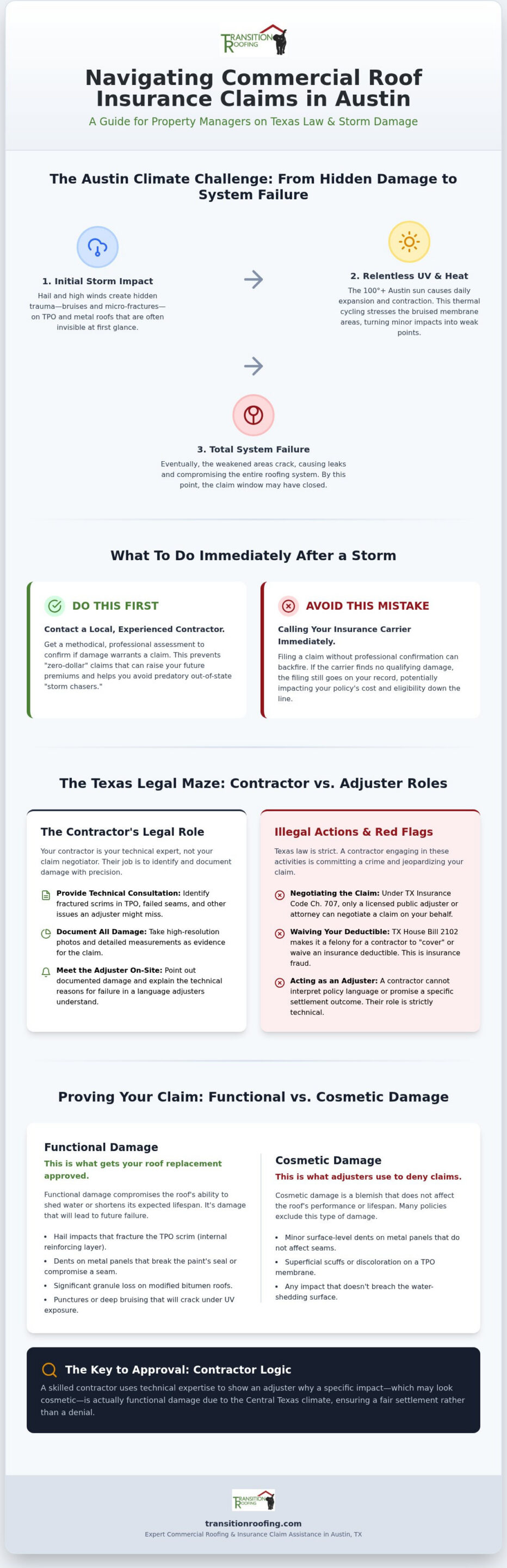
Severe weather in Central Texas rarely hits just once. High-wind events and hailstorms often leave industrial structures with hidden trauma that property managers overlook. If you’re managing commercial roofing in Austin, you must understand that “latent damage” is your biggest enemy. A hail strike might not cause a visible leak today, but the relentless 100-degree Austin sun causes the roof membrane to expand and contract daily. This thermal cycling pulls at those bruised areas until they eventually crack. By the time you see a ceiling stain, the window for successful commercial roof insurance claims Austin might have already closed.
Don’t call your carrier the second the clouds clear. Your first step should be contacting a local expert with over 15 years of Central Texas experience. We provide a methodical assessment to confirm if the damage actually warrants a filing. This prevents you from recording “zero-dollar” claims that can negatively impact your premiums. It is also the best way to avoid “storm chasers” who flock to the city after a major weather event. These out-of-state entities often lack a deep understanding of property insurance concepts like replacement cost versus actual cash value, which are vital for securing a fair settlement on commercial roof insurance claims Austin.
Common Storm Stressors for Austin Commercial Buildings
Extreme UV exposure in our region primes roofs for failure by making membranes brittle over time. When a flash flood occurs, low-slope and flat roof systems face immense pressure from water weight. If drainage points are even slightly restricted, the volume of a typical Austin downpour can compromise the structural deck. This vulnerability is why we recommend professional inspections after any wind event exceeding 50 mph. Catching these issues early ensures your asset moves from a state of vulnerability to total security before the next storm cycle begins.
The Legal Process for Commercial Roof Insurance Claims Austin, TX
Austin property managers must navigate a complex legal environment when filing commercial roof insurance claims Austin. In Texas, the line between a contractor and a public adjuster is strictly enforced. Under Chapter 707 of the Texas Insurance Code, a roofing contractor cannot negotiate a claim on behalf of a policyholder. This means your roofer shouldn’t ever offer to “handle everything” with the carrier. Doing so is illegal and puts your settlement at risk. We’ve seen many claims delayed because a contractor overstepped their legal role.
Texas House Bill 2102 also changed the landscape by making it a state jail felony for a contractor to waive a deductible. If a company offers to “cover your deductible,” they’re asking you to participate in insurance fraud. We maintain an integrity-first approach. We ensure all documentation is transparent and compliant with state law. To get your commercial roof insurance claims Austin approved, carriers require specific evidence:
- High-resolution photos of functional damage.
- Detailed measurements of the affected area.
- Proof of local Austin building code requirements.
- Manufacturer-specific data for systems like TPO or metal.
If you’re unsure about your policy’s specific requirements, we can provide a detailed assessment to get you started.
The Role of the Contractor vs. the Insurance Adjuster
A commercial roofing expert provides technical consultation, not legal negotiation. We identify the fractured scrim in a TPO membrane or the failed seams on a flat roof that an adjuster might miss. Having an experienced contractor present during the adjuster’s walk-through is vital. We speak the technical language adjusters understand. We point out structural vulnerabilities without overstepping our legal role. This collaborative approach ensures the adjuster has the full technical picture before they write their report.
Documenting Damage Across Different Commercial Systems in Austin
Successful commercial roof insurance claims Austin depend on technical proof that goes beyond a simple photo of a dent. Every roofing material reacts differently to the Central Texas climate. We use contractor logic to show adjusters why a specific impact is functional damage rather than just a cosmetic blemish. This distinction is vital for securing a full settlement rather than a partial repair.
In TPO and PVC systems, hail often creates microscopic impacts that adjusters miss. These impacts fracture the internal scrim, which is the reinforcing fabric of the membrane. Once the scrim is broken, the membrane loses its structural integrity. We look for these fractures during our inspections to ensure your claim covers a full system restoration. Without this evidence, you might be left with a leaking roof just months after a claim is closed.
Metal roofing in Austin presents a different challenge. Adjusters frequently label hail dents as cosmetic dimpling to avoid a payout. However, if those dents occur on a lap or a seam, they can lead to functional failure. We document how these impacts compromise the water-tight seal of your standing seam or R-panel system. For older built-up or modified bitumen roofs, we use drone thermography and moisture probes. These tools identify trapped water and sub-surface damage that isn’t visible to the naked eye. If you suspect your roof has hidden storm damage, schedule a professional inspection today to get a clear technical report.
Material-Specific Damage Indicators for Central Texas
Many flat roofing systems in Austin require specialized wind-uplift testing after a major storm. This test measures how well the roof is still attached to the building deck. If the attachment has been weakened by high winds, the entire system is at risk of blowing off during the next weather event. We include these test results in our reports to ensure your restoration is fully funded and compliant with safety standards.
Securing Your Restoration and Protecting Your Austin Asset
Once your carrier issues the initial payment, the focus shifts to execution. We carefully review the Scope of Work to ensure it aligns with the 2021 International Building Code and specific Austin local amendments. If your policy includes Ordinance and Law coverage, it should pay for these mandatory upgrades. We don’t just look at the visible damage; we look at what the City of Austin requires for a legal, permitted installation. This prevents you from being left with a roof that doesn’t meet current safety standards.
During the tear-off phase, hidden issues like saturated insulation or decking rot often surface. This is a critical moment for commercial roof insurance claims Austin. We immediately document these findings with photos and moisture readings to file supplemental claims. This ensures the carrier pays for the full cost of the restoration, not just the initial estimate. Our team has over 15 years of experience managing these mid-project adjustments, so your project doesn’t stall while waiting for approvals.
We finalize every project by registering high-level manufacturer warranties from leaders like GAF and Certainteed. This provides a layer of long-term protection that outlives the initial storm recovery. It moves your structure from a state of vulnerability to one of total security.
From Emergency Repair to Long-Term Security
Moving from a reactive Austin roof repair mindset to a proactive preventative maintenance program is the best way to protect your future insurability. Insurance carriers are increasingly scrutinizing maintenance records. If you can’t prove you’ve regularly inspected the roof, they may deny future claims by citing “neglect” or “wear and tear” clauses. Detailed records from a local expert make your next claim significantly easier to process.
Consistent documentation is also an investment in your building’s cap rate. A well-maintained, warrantied roof system makes the property more attractive to buyers and lenders. It shows that the asset is in safe, capable hands. If you’re dealing with storm damage now, we can take a look and give you a clear plan for both the restoration and the years of protection that follow.
Protect Your Commercial Asset with Expert Guidance
Successfully navigating commercial roof insurance claims Austin requires a mix of technical precision and strict legal compliance. You now understand that documenting fractured scrim in TPO or functional seam failure in metal is the only way to move from a state of vulnerability to total security. By following Texas Chapter 707 and avoiding illegal deductible waivers, you protect your professional integrity and your building’s long-term value. Our team brings over 15 years of Austin roofing experience and the expertise of a GAF Master Elite Contractor to every project. We maintain strict adherence to TDI compliance to ensure your restoration is handled properly from the first inspection to the final warranty registration.
If you suspect storm damage to your facility, schedule a professional commercial roof inspection in Austin today. We’ll provide a clear, data-driven plan to restore your roof and implement a maintenance strategy that keeps your property protected for years to come. Your asset is in safe, capable hands.
Frequently Asked Questions
Can an Austin roofing contractor pay my insurance deductible?
No, it is a state jail felony for a contractor to pay or waive your insurance deductible in Texas. Under HB 2102, contractors must include a notice in their contracts stating that the policyholder must pay the deductible. This law ensures transparency and prevents insurance fraud. We follow an integrity-first approach and never offer to cover these costs. Always choose a company that respects state regulations to protect your claim’s validity.
How long do I have to file a commercial roof claim in Texas after a storm?
Most Texas policies provide a one-year window to report storm damage, though the statute of limitations for lawsuits is generally two years. However, waiting too long allows the carrier to argue that the damage resulted from wear and tear. To secure successful commercial roof insurance claims Austin, we recommend reporting the loss immediately after a professional inspection confirms functional damage. Early filing prevents the “latent damage” arguments carriers often use.
What happens if the insurance adjuster misses damage that my roofer found?
You can file a supplemental claim if your contractor identifies damage the adjuster overlooked. This is a common part of the process when dealing with fractured scrim or hidden deck rot. We provide the technical documentation, including high-resolution photos and moisture readings, to prove the necessity of additional work. Your carrier will review this evidence and issue a revised scope of work. This ensures the full restoration is funded properly without cutting corners.
Does insurance cover a full commercial roof replacement or just repairs?
Insurance covers a full replacement if the cost to repair the damage exceeds a certain percentage of the roof’s value or if the system is no longer repairable. Carriers also look at whether the damaged materials can be matched. If a small repair won’t restore the roof to its pre-storm condition, we provide the technical data to justify a full replacement. This includes citing local Austin building codes that might mandate a total system upgrade.
Will filing a commercial roof claim in Austin cause my premiums to increase?
Filing a single weather-related claim typically won’t cause an immediate premium hike on an individual basis. However, insurance rates in Austin and Central Texas often rise for entire zip codes after widespread storm events. Carriers view these as “Acts of God” rather than negligence. When managing commercial roof insurance claims Austin, it is usually more expensive to pay for a total roof failure out of pocket than to manage a minor premium adjustment. For those interested in evaluating their current rates and coverage, Texas RIA offers expert guidance on commercial insurance policies.