
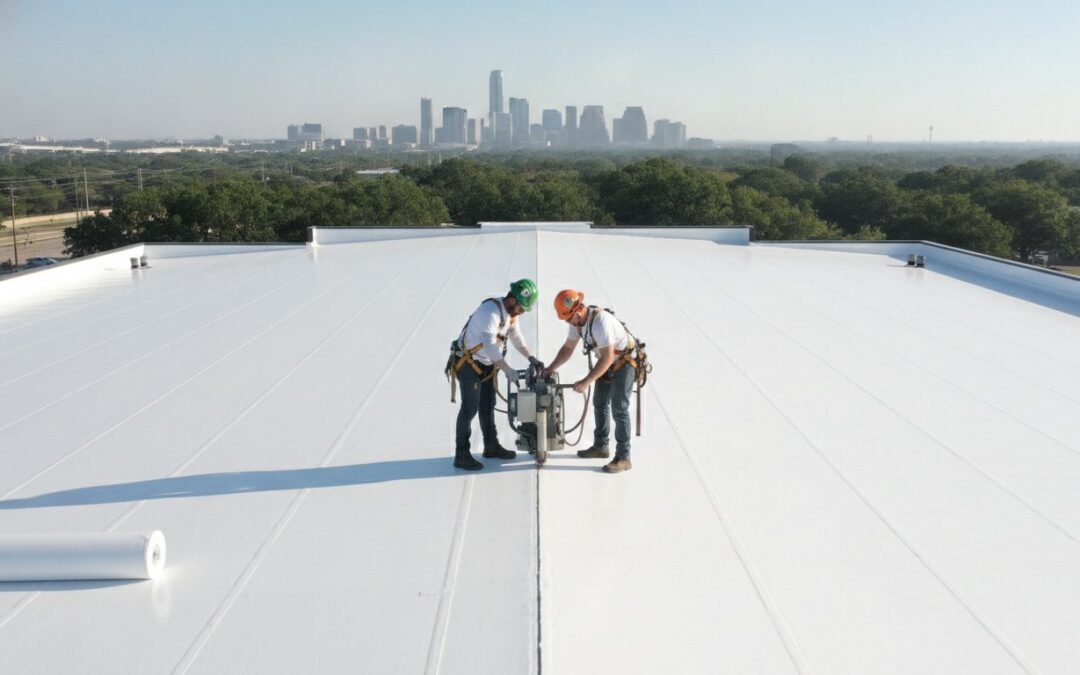
In the middle of an Austin August, your commercial roof isn’t just a structural necessity; it’s a thermal battlefield where 80% of the sun’s UV rays are either absorbed or reflected. As a property manager in Central Texas, you’re likely tired of watching utility bills climb every summer while worrying about whether those seams will hold during the next spring hail storm. It’s a common stressor, but it doesn’t have to be your reality. Choosing the right TPO roof installation strategy can transform your building’s efficiency and long term durability.
This guide provides the exact steps you need for a successful project on your commercial property. We’ll cut through the confusion regarding membrane thickness and explain how the 2026 local building codes impact your investment. You’ll learn how to move your structure from a state of vulnerability to total security with a system designed for the specific stressors of the Austin climate. We will cover everything from robotic heat-welding techniques to realistic cost factors, ensuring you find a solution that keeps your tenants dry and your overhead low for the next 20 years.
Key Takeaways
- Understand why white TPO membranes are the standard for Austin commercial properties to reflect UV rays and lower summer cooling costs.
- Learn the exact steps of a professional TPO roof installation, from structural deck inspection to precision robotic heat-welding.
- Identify how the 2021 International Building Code and local Austin amendments affect your insulation requirements and project scope.
- Compare the long term value of TPO against other materials to see why it remains the most cost-effective choice for Central Texas flat roofs.
- Discover how to avoid common seam failures and ensure your warranty stays intact by hiring a contractor with over 15 years of local experience.
TPO Roofing: The Standard for Austin, TX Commercial Buildings
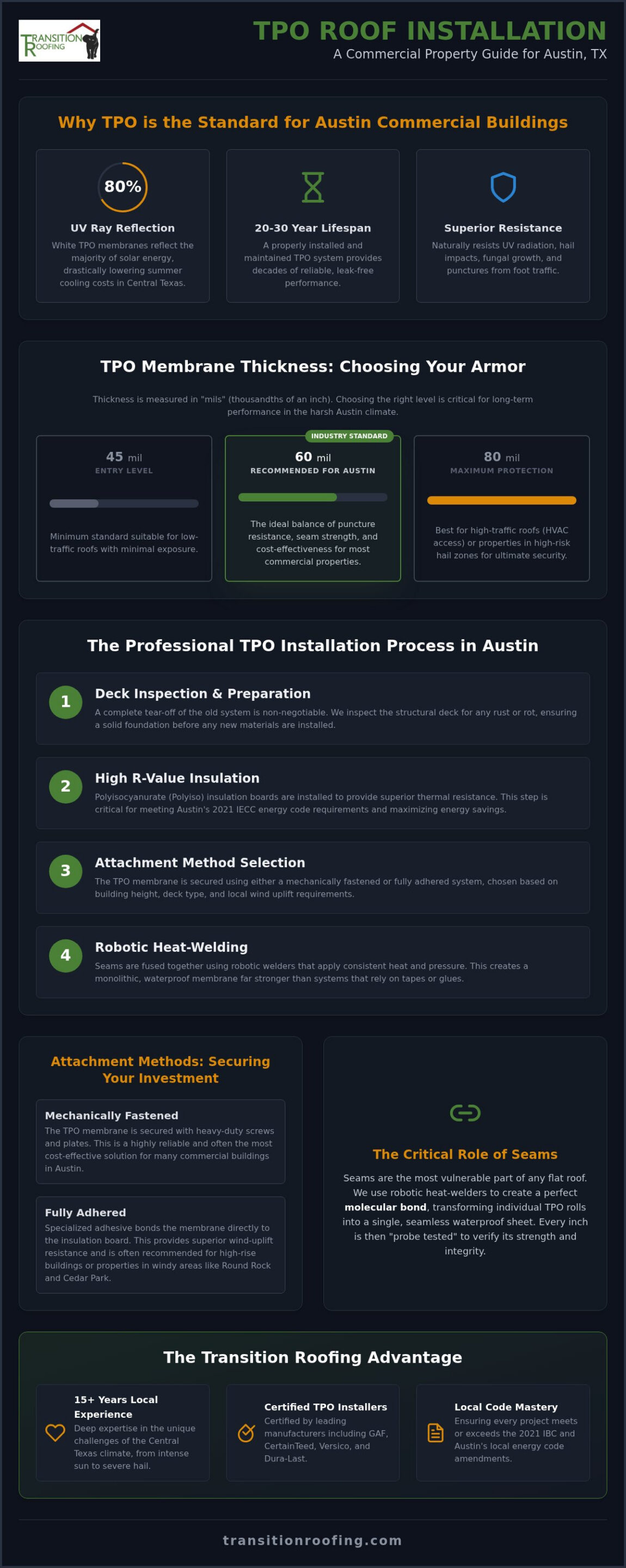
TPO, or Thermoplastic Polyolefin (TPO), is a single-ply membrane that’s become the dominant choice for flat roofs across Central Texas. Unlike older dark materials that soak up solar heat, TPO is naturally reflective. This bright white surface acts as a shield against the intense Austin summer. It keeps your building interior cooler and significantly lowers monthly utility bills. When handled by a professional contractor, a high-quality TPO roof installation provides several long term benefits:
- An expected lifespan of 20 to 30 years when properly maintained.
- Natural resistance to UV radiation and fungal growth.
- Significant reduction in the “heat island” effect for urban properties.
- Lower strain on commercial HVAC systems during peak summer months.
Understanding TPO Membrane Thickness: 45 mil vs. 60 mil vs. 80 mil
Membrane thickness is measured in “mils,” which are thousandths of an inch. While 45 mil is the entry-level option, we rarely suggest it for long-term commercial assets in Austin. A 60-mil membrane is the industry standard for our climate. It offers a better balance of puncture resistance and seam strength. If your property has heavy foot traffic from HVAC crews or is in a high-risk hail zone, upgrading to 80 mil provides the extra security needed to prevent micro-fractures during a storm. This thicker layer is often the difference between a leak-free roof and costly interior damage after a major weather event.
The Energy Efficiency Factor in Central Texas
The “heat island” effect in downtown Austin can make temperatures feel much higher than the official forecast. TPO helps combat this by reflecting up to 80% of solar energy back into the atmosphere. To maximize these savings, we install polyisocyanurate (polyiso) insulation boards directly beneath the membrane. These boards provide a high R-value, which is a measurement of the material’s ability to resist heat flow. A higher R-value means better thermal resistance. In Austin, the 2021 IECC requires specific insulation levels that we strictly follow during every project. If you’re looking for a flat roofing company in Austin that understands these thermal dynamics, choosing a team with local expertise is vital for long-term performance.
The TPO Roof Installation Process: From Deck Prep to Heat-Welded Seams in Austin, TX
A successful TPO roof installation starts with a clean slate. We perform a complete tear-off of the old system to inspect the structural deck for rust or rot. This step is non-negotiable; covering up a damaged deck only hides a problem that will eventually lead to failure. Once the deck is secured, we install polyisocyanurate (polyiso) insulation boards. These boards provide the thermal protection required by the 2021 International Energy Conservation Code now enforced in the Austin area. This solid foundation is what allows the membrane to perform at its peak for decades.
Attachment Methods: Mechanically Fastened vs. Fully Adhered
Choosing the right attachment method depends on your building’s height and local wind exposure. Mechanically fastened systems use heavy-duty screws and plates to secure the membrane. It’s often the most cost-effective choice for many properties. Fully adhered systems use specialized adhesives to bond the membrane to the insulation. This creates a smoother look and offers superior wind-uplift resistance. For commercial buildings in Round Rock and Cedar Park where wind gusts can be unpredictable, we often recommend a fully adhered system to provide better long-term security.
The Critical Role of Robotic Heat-Welding
Seams are the most vulnerable part of any flat roof. While hand-welding is necessary for corners and flashings, we use robotic heat-welders for the long field seams. These machines ensure consistent temperature and pressure. They create a molecular bond that turns individual rolls into a single, waterproof sheet. Following The TPO Roof Installation Process standards, we use a “probe test” on every inch of the seam to verify its strength. If you’re noticing water pooling or suspect seam failure, we can inspect your current roof and give you a clear plan for total security.
Calculating TPO Roof Installation Costs and Lifespan in Austin, TX
TPO is the most cost-effective choice for large-scale commercial projects in Central Texas. It typically beats PVC on price and significantly outperforms EPDM in thermal reflection. However, the final estimate for a TPO roof installation depends on more than just square footage. The condition of your structural deck is the biggest variable. If we discover rusted metal or rotted wood during the tear-off process, those sections must be replaced to ensure the new system has a stable foundation. This is a critical step in moving your building from a state of vulnerability to total security.
Rooftop penetrations also influence your labor costs. Every HVAC curb, vent pipe, and skylight requires meticulous hand-welding to create a watertight seal. Contractor logic suggests that if an estimate seems too good to be true, the crew is likely rushing these details. Poorly welded seams are the leading cause of premature failure in Austin’s high-heat environment. Investing in quality craftsmanship upfront prevents the stress of emergency repairs five years down the road.
Navigating Insurance Claims for Storm and Hail Damage
Austin hail storms are notorious for damaging commercial membranes. While TPO is durable, large hailstones can cause micro-fractures that compromise the system’s integrity. If your property was recently in the path of a storm, you may qualify for a replacement through insurance. You can find more detail on this process in our guide to Austin roof repair and storm recovery. We work directly with property managers to document damage for adjusters, using our 15 plus years of experience to ensure no detail is overlooked.
Maintenance Programs to Extend TPO Lifespan
Most manufacturers require twice-yearly inspections to keep their long-term warranties valid. Transition Roofing provides preventative maintenance programs that focus on clearing drainage systems and checking seam integrity. These proactive steps can extend the life of your roof to 30 years or more. If you’re dealing with a recurring leak or just want to verify your roof’s current condition, we can provide a thorough inspection and a clear plan for your property.
Why Transition Roofing is the Preferred TPO Installer in Austin, TX
Choosing a contractor for your TPO roof installation involves more than just comparing bids. It’s about finding a partner who understands the specific environmental stressors of Central Texas. Transition Roofing brings over 15 years of local experience to every project. We don’t believe in high-pressure sales. Instead, we focus on transparent estimates and high-quality craftsmanship that protects your investment for the long haul. Our team provides the steady, reliable service property managers need to feel confident that their assets are in safe hands.
We act as a neighborly expert for businesses across the region. We’ve built our reputation on integrity and a deep understanding of how the Austin heat affects commercial membranes. By maintaining certifications from industry leaders like Versico and GAF, we ensure your warranty remains valid and your roof stays leak-free. This commitment to professional standards is what allows us to move your structure from a state of vulnerability to one of total security.
Expertise in Flat and Low-Slope Systems
As a specialized flat roofing company in Austin, we know the local landscape better than anyone. We ensure every project complies with the latest Austin building codes regarding insulation R-values and drainage requirements. Proper slope and drainage are vital to prevent ponding water, which is the leading cause of seam failure on flat systems. We handle these technical details with precision, ensuring your roof survives the next major storm without a drop of water entering the building.
Schedule Your Professional TPO Roof Inspection Today
If you’re dealing with a recurring leak or need a comprehensive plan for a full TPO roof installation, we can take a look and give you a clear plan. We provide thorough inspections that identify hidden storm damage before it becomes a major liability for your business. Our goal is to provide a long-term solution that lowers your utility bills and provides lasting peace of mind. Schedule a roof inspection in Austin today to secure your building’s future with a contractor you can trust.
Protect Your Austin, TX Commercial Investment with Confidence
Protecting your commercial asset in the Central Texas climate requires more than just a standard roof; it requires a specialized thermal strategy. By choosing a high-quality TPO roof installation, you’re investing in a system that stabilizes your building’s environment and secures your budget against rising energy costs. We’ve spent over 15 years helping local property managers move from the stress of recurring leaks to the peace of mind that comes with total structural security.
Our team is proud to be certified by major manufacturers like GAF and Versico, ensuring your project meets the highest industry standards for warranty compliance. We also understand the complexities of insurance claim documentation after the severe hail storms that frequently hit our area. If you’re dealing with a problematic roof or planning a replacement, we’re here to provide a transparent plan based on honest, contractor logic.
Schedule your commercial TPO roof inspection in Austin today to ensure your property is ready for whatever the next season brings. We’re committed to quality craftsmanship and the long term well-being of our Austin, TX community.
Frequently Asked Questions About TPO Roofing in Austin, TX
How long does a TPO roof installation take for a commercial building?
Most commercial projects in Central Texas take between one and three weeks to complete. The exact timeline depends on the building’s total square footage, current weather patterns, and the number of rooftop penetrations like HVAC units or vents. A straightforward warehouse project moves quickly, while a complex retail center requires more time for detailed hand-welding. We plan every phase of the TPO roof installation to minimize disruption to your daily business operations.
Is TPO roofing puncture-resistant against Central Texas hail?
TPO provides high-level protection against hail, but its performance depends on the membrane thickness you select. While a standard 60-mil membrane handles typical storms well, we suggest an 80-mil membrane for properties in high-risk hail zones. This thicker layer offers superior puncture resistance. It acts as a reinforced shield that protects your structural deck and interior assets during the severe weather common in the Austin area.
Can TPO roofing be installed over an existing roof?
A TPO recover is possible if your building currently has only one layer of roofing. Austin building codes generally prohibit having more than two layers of roofing on any structure. If your building already has two layers, a full tear-off is required by law. We always perform a thorough moisture scan to ensure the existing insulation isn’t holding water, as trapping moisture between layers will lead to deck rot and structural failure.
What is the difference between TPO and PVC roofing for Austin businesses?
TPO and PVC are both white, heat-reflective membranes, but they serve different specific needs. TPO is typically more cost-effective and offers excellent UV resistance for standard commercial buildings. PVC is often preferred for restaurants because it resists damage from animal fats and grease vents. For most office or retail TPO roof installation projects in Austin, TPO provides the best balance of long-term durability and upfront value.
Does a white TPO roof really lower my electricity bill?
A white TPO membrane reflects up to 80% of the sun’s UV rays, which significantly reduces the heat absorbed by your building. This “cool roof” effect lowers the workload on your HVAC system during brutal 100-degree Austin afternoons. Many property managers report a significant decrease in monthly cooling costs immediately following their installation. It’s a practical investment that directly improves your building’s energy efficiency and bottom line.