The cheapest flat roof quote you get in Cedar Park might end up costing you the most. That’s not a scare tactic; it’s a pattern we’ve seen play out for over 15 years working on flat roofs across Central Texas. A budget membrane that can’t hold up against relentless UV exposure and 100-degree summers won’t last long enough to justify the savings.
If you’re researching flat roof replacement cost in Cedar Park right now, you already know the frustration. You want a real number, not a vague range that shifts the moment a contractor shows up and spots a drainage problem. You want to know whether TPO or PVC is worth the price difference, and whether the material you choose will still be performing a decade from now under the Central Texas heat.
This guide gives you exactly that. You’ll get a transparent breakdown of what drives flat roof replacement pricing in Cedar Park for 2026, a clear comparison of the most heat-resistant membrane options available, and the local labor context you need to budget with confidence and choose a contractor you can trust.
Key Takeaways
- Understanding flat roof replacement cost in Cedar Park requires more than a per-square-foot number — substrate condition, slope corrections, and hidden deck damage can significantly shift your final budget.
- Material choice matters more in Central Texas than most markets; TPO and PVC membranes perform very differently under prolonged UV exposure and 100-degree summers, and the price gap between them reflects real long-term value differences.
- Labor remains a major cost driver in Cedar Park for 2026, and a low bid that skips a proper inspection often leads to expensive surprises once the old membrane comes off.
- A detailed, line-item proposal is the clearest sign of a contractor you can trust — vague estimates are a red flag, not a starting point for negotiation.
- Local expertise in Cedar Park’s storm patterns and insurance claim process can directly affect how much of your replacement cost gets covered, making contractor selection a financial decision, not just a quality one.
Factors Influencing Flat Roof Replacement Cost in Cedar Park, TX
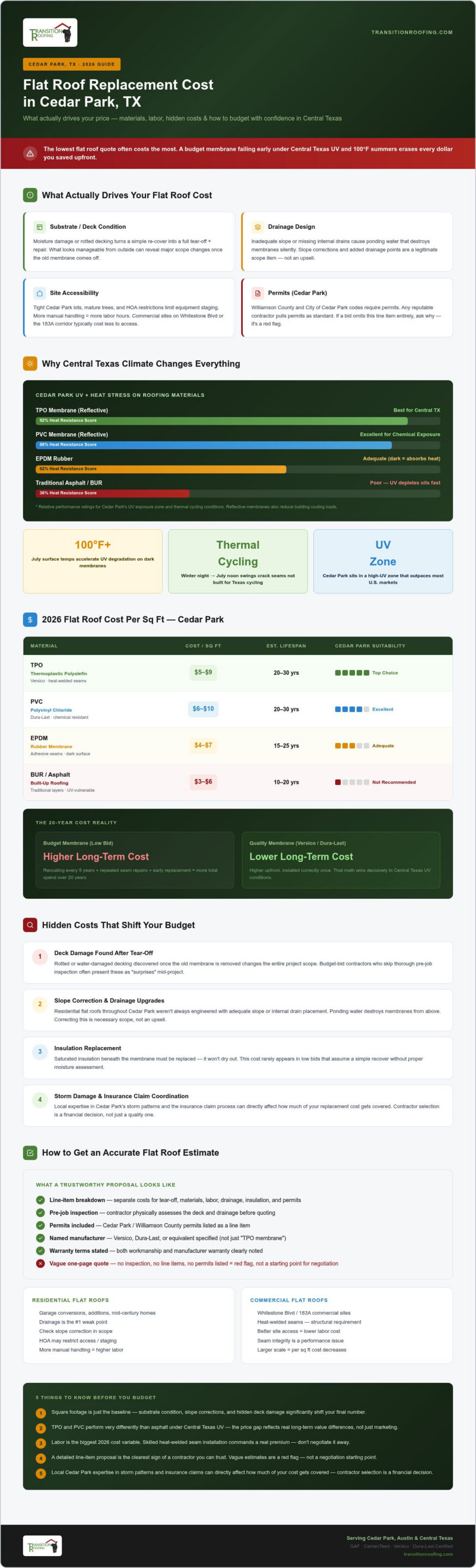
Square footage sets the baseline, but it rarely tells the full story. When we assess flat roof replacement cost in Cedar Park, the variables that actually move the number are substrate condition, drainage design, equipment access, and what the local permit office requires before work can begin.
Start with the deck beneath the membrane. If moisture has been sitting against the substrate, you’re not looking at a simple recover. You’re looking at a tear-off, deck repair, and then a new system on top. That sequence changes the project scope entirely. A roof that looks manageable from the outside can reveal rotted decking or compromised insulation once the old membrane comes off. This is exactly why low bids built on assumptions tend to fall apart mid-project.
Accessibility is another factor that gets underestimated in Cedar Park’s residential neighborhoods. Tight lots, mature trees, and HOA restrictions can limit where equipment parks and how materials get staged. Commercial properties along Whitestone Boulevard or in the 183A corridor typically have better site access, which keeps labor hours down. Residential jobs in tighter subdivisions require more manual handling, and that cost shows up in your quote.
Permit requirements in Cedar Park follow Williamson County and City of Cedar Park building codes, and for 2026, you should verify current fee schedules directly with the city’s Development Services department, as fees are subject to change. Any reputable contractor will pull permits as a standard part of the job. If a bid skips this line item, ask why.
The Impact of the Central Texas Climate on Flat Roofs
Cedar Park sits in a UV exposure zone that accelerates the breakdown of traditional asphalt-based flat roofing faster than most other U.S. markets. Asphalt loses its flexibility as UV radiation depletes the oils that keep it pliable. Once that brittleness sets in, cracking and seam separation follow quickly.
Thermal expansion and contraction during Texas temperature swings, where surface temps can shift dramatically between a winter night and a July afternoon, places repeated mechanical stress on seams that weren’t designed for that kind of cycling. Reflective membranes like TPO and PVC directly address this by reducing surface temperatures and cutting cooling loads for the building below. For Cedar Park property owners, that reflectivity isn’t a bonus feature; it’s a practical operating cost decision.
Residential vs. Commercial Flat Roof Requirements
Scale and drainage complexity separate these two categories more than most people expect. Commercial flat roofs typically require heat-welded TPO or PVC seams installed by trained technicians using specialized equipment. The seam integrity on a 20,000-square-foot commercial membrane is a structural performance issue, not just a cosmetic one.
Residential flat roofs, common on garage conversions, modern home additions, and mid-century designs throughout Cedar Park, face different challenges. Drainage is often the weak point. Residential systems weren’t always engineered with adequate slope or internal drain placement, which leads to ponding water that quietly destroys the membrane from above. Addressing flat roof replacement cost in Cedar Park on a residential property means factoring in whether slope correction or additional drainage is part of the scope, not an afterthought.
2026 Flat Roofing Cost Per Sq Ft in Cedar Park
Material costs have largely stabilized heading into 2026 after the supply chain volatility of previous years. That’s good news for Cedar Park property owners planning a replacement. The variable that continues to drive budget uncertainty isn’t materials — it’s labor. Skilled membrane installation, especially heat-welded seams on commercial-grade TPO and PVC systems, requires trained technicians and specialized equipment. That expertise commands a real premium, and it’s one you shouldn’t try to negotiate away.
When evaluating flat roof replacement cost in Cedar Park, the most useful framework isn’t just the upfront installation number. It’s the 20-year cost picture. A lower-cost system that requires recoating every five years, repeated seam repairs, or early replacement will outspend a quality membrane installed correctly the first time. That math becomes even more pronounced in Central Texas, where UV degradation and thermal cycling accelerate wear on inferior materials.
For high-heat environments like Cedar Park, we consistently recommend membranes from manufacturers like Versico and Dura-Last. Both produce systems engineered specifically for prolonged UV exposure and extreme temperature cycling. Their factory-reinforced seam specifications and membrane consistency give installers less room for error and give property owners a more predictable performance timeline.
TPO and PVC: The Energy-Efficient Choice for Cedar Park Heat
TPO is currently the most widely specified single-ply membrane in Central Texas, and the pricing reflects both its availability and its performance profile. Thickness matters significantly here. A 60-mil TPO sheet costs less upfront but offers less puncture resistance and a shorter weld life under repeated thermal stress. An 80-mil system costs more per square foot but holds up meaningfully better over a decade of Cedar Park summers. For most commercial applications, the 80-mil spec is the right starting point, not an upgrade.
PVC carries a higher price point, and the premium is justified in specific situations. Its chemical resistance makes it the correct choice for commercial kitchen exhaust areas, restaurant rooftops, or any industrial setting where grease or chemical exposure is a factor. For a standard commercial or residential flat roof without those conditions, the cost difference between PVC and a quality 80-mil TPO doesn’t always translate into a proportional performance gain in this climate.
- TPO (60-mil): Lower entry cost, adequate for low-traffic residential applications with proper installation
- TPO (80-mil): The standard we recommend for commercial roofs and high-UV residential exposure in Cedar Park
- PVC: Higher cost per square foot, best justified where chemical or grease resistance is a functional requirement
Modified Bitumen and Built-Up Roofing (BUR)
Multi-ply systems like built-up roofing have been the industry standard for decades, but their dark surface color is a liability in Cedar Park’s climate. They absorb heat rather than reflect it, which drives up cooling costs and accelerates the breakdown of the bitumen itself. For large commercial roofs, this makes BUR a difficult recommendation in 2026 when reflective single-ply options are readily available at competitive prices.
Modified bitumen still has a legitimate place for small residential applications — a covered balcony, a porch extension, or a low-slope garage roof where the surface area is modest and foot traffic is occasional. In those contexts, the material’s durability makes it a practical choice, though specialized GRP fiberglass systems—such as those installed by Resin Roofing Company—can offer an even more robust, seamless solution for long-term protection. It’s not obsolete; it’s just context-dependent.
If you’re weighing these options for a specific property, learn more about our flat roofing services in Austin and Cedar Park to get a clearer sense of which system fits your building’s actual conditions and long-term budget.
Beyond the Surface: Hidden Costs of Cedar Park Flat Roof Projects
The line item that surprises most Cedar Park property owners isn’t the membrane. It’s everything underneath it. A flat roof replacement isn’t just a material swap; it’s a full structural assessment that can uncover problems the original installation never addressed. Budgeting only for the membrane and labor is how projects run over.
Slope is the clearest example. Despite the name, a functional flat roof needs a minimum slope to move water toward drains or scuppers. Many older Cedar Park properties, particularly mid-century residential builds and early commercial construction, were built without adequate pitch. Correcting that during replacement means adding tapered insulation or building up the substrate, which adds both material cost and installation time. Skip it, and you’re reinstalling a new membrane over the same drainage problem that degraded the last one.
Deck condition is the other variable that can’t be priced until the old membrane comes off. Moisture trapped between layers causes wood decking to rot and rigid insulation board to compress and lose structural integrity. A professional inspection before the project starts narrows that uncertainty significantly. Schedule a professional roof inspection in Austin before finalizing any budget, especially if the existing roof has visible ponding or is more than 15 years old.
Disposal fees are another line item that often gets buried in vague estimates. Tear-off costs increase with every layer of existing roofing material. A single-layer membrane removal is straightforward. A built-up roof with three or four plies of bitumen and gravel is a different job entirely, requiring more labor hours and higher disposal fees at the landfill.
Tapered Insulation Upgrades and R-Value Compliance
Tapered insulation solves two problems at once: it creates positive drainage slope and brings the roof assembly into compliance with current energy code R-value requirements for Central Texas. Ponding water is the single most destructive force on a flat roof membrane, and tapered insulation is the most reliable structural fix. The upfront cost is real, but it directly extends membrane lifespan and reduces the risk of the deck damage that makes flat roof replacement cost in Cedar Park spike unexpectedly. Verify current R-value minimums with Cedar Park’s Development Services, as energy code requirements are updated periodically.
Drainage Systems: Scuppers, Gutters, and Drains
Central Texas storms deliver high-volume rainfall in short windows. A drainage system that works adequately in a light rain can fail completely under a two-inch-per-hour downpour. Evaluating your existing drainage is a non-negotiable part of any honest flat roof assessment. Key considerations include:
- Internal drains: More effective for large commercial roofs but require penetrations through the membrane and regular maintenance to prevent debris clogs
- Scuppers: Common on commercial parapets; often undersized on older buildings and worth upgrading to handle peak storm flow
- Perimeter gutters: Lower installation cost but less effective on roofs with significant surface area; adequate for smaller residential applications
- Overflow drains: A code requirement in many applications and a practical safeguard against catastrophic ponding if primary drains clog
Choosing the right system depends on roof size, parapet configuration, and how the building was originally engineered. If you’re unsure what your current setup can handle, that’s exactly the kind of question a thorough inspection answers before the project starts, not after.
Understanding the full scope of flat roof replacement cost in Cedar Park means accounting for these hidden variables upfront. If you want a clear picture of what your specific property actually needs, talk to our flat roofing team before committing to any bid.
How to Secure an Accurate Flat Roof Estimate in Cedar Park, TX
A vague estimate isn’t a starting point. It’s a warning sign. When a contractor hands you a single-line quote with no breakdown, you have no way to know what’s included, what’s excluded, or what will get added to the invoice once the old membrane comes off. Insist on a line-item proposal that separates tear-off, deck inspection, insulation, membrane material, drainage work, permits, and labor. If a contractor won’t provide that level of detail before you sign, find one who will.
Manufacturer warranties are another area where the details matter more than the headline number. A 20-year warranty sounds strong until you read the fine print and realize it only covers material defects, not installation failures. The warranties that actually protect you are system warranties issued by manufacturers like Versico or Dura-Last, which cover both the membrane and the installation when the work is performed by a certified contractor. A basic labor warranty from a contractor with no manufacturer backing is a much thinner layer of protection. Ask specifically which warranty type you’re getting before you commit.
Local expertise also directly affects your flat roof replacement cost in Cedar Park when storm damage is involved. A contractor who understands Central Texas hail and wind patterns knows how to document damage in the format your insurance adjuster needs. That documentation quality can be the difference between a claim that covers most of your replacement and one that covers a fraction of it.
Vetting Local Cedar Park Roofing Contractors
Certifications from Versico or Dura-Last aren’t just credentials on a wall. They confirm the contractor has been trained specifically in heat-welded membrane installation, which is the technical skill that determines whether your seams hold up through a decade of Cedar Park summers. Ask for references on Cedar Park or Austin projects that are at least five years old. A seam that looks clean on day one tells you nothing. A seam that’s still watertight after five cycles of Texas heat tells you everything.
The Transition Roofing Process
Our assessments start with infrared moisture detection, which identifies trapped moisture beneath the existing membrane before a single layer comes off. That step eliminates the guesswork that causes budgets to blow up mid-project. From there, every scope item gets documented clearly: deck condition, drainage adequacy, insulation requirements, and membrane specification. When storm damage is part of the picture, we assist with insurance claim documentation from the initial assessment through final adjuster review, so nothing gets missed and nothing gets undervalued.
If you’re dealing with a failing flat roof in Cedar Park, Transition Roofing can give you a clear scope, an honest estimate, and a system built to last in this climate. Reach out and let’s take a look at what your roof actually needs.
Make Your Next Flat Roof Decision a Confident One
Flat roof replacement cost in Cedar Park comes down to three things: the right material for this climate, an honest assessment of what’s underneath your existing membrane, and a contractor who won’t hand you surprises once the job is underway. TPO remains the strongest value for most Cedar Park properties, hidden costs like deck repair and drainage corrections deserve a real line item in your budget, and a detailed proposal is the only estimate worth trusting.
With 15+ years of Central Texas experience, GAF and CertainTeed certifications, and specialized TPO installation teams who work in this heat every day, Transition Roofing brings the kind of local knowledge that generic roofing companies simply can’t replicate. We know what Cedar Park roofs face, and we build systems that hold up against it.
If you’re ready to move forward with a clear scope and an honest number, get a professional flat roof estimate from Transition Roofing today. You’ll know exactly what your roof needs and what it will cost before any work begins.
Frequently Asked Questions About Flat Roof Replacement Cost in Cedar Park
How much does a flat roof replacement cost per square foot in Cedar Park?
The honest answer is that per-square-foot pricing varies based on material choice, deck condition, drainage requirements, and site accessibility. A basic membrane replacement on a structurally sound deck costs less than a full tear-off with deck repairs and tapered insulation added to the scope. That’s why we don’t publish a single number: a figure quoted without a proper inspection is a guess, not an estimate.
What you can control is how you evaluate bids. A line-item proposal that separates material, labor, disposal, and drainage work gives you a real basis for comparison. A single-line quote does not. Always ask for the breakdown before you agree to anything.
How long does a TPO flat roof last in the Central Texas heat?
A properly installed 80-mil TPO system from a quality manufacturer like Versico or Dura-Last can realistically perform for 20 to 30 years in Central Texas conditions. The key variables are membrane thickness, seam quality, and whether the drainage underneath was correctly addressed at installation. A 60-mil system installed over a drainage problem won’t come close to that lifespan regardless of the brand name on the membrane.
Reflectivity is what makes TPO particularly well-suited to Cedar Park’s climate. By reducing surface temperatures significantly compared to dark membranes, it experiences less thermal cycling stress over time, which directly protects seam integrity through years of temperature swings.
This focus on material suitability is a hallmark of professional contractors; for instance, the team at I R. Wilson Roofing emphasizes tailoring solutions to specific environmental demands, whether dealing with heat or high-moisture conditions.
Can I install a new flat roof over my old one to save money?
In some cases, yes, but only if the existing membrane is dry, structurally sound, and the deck beneath it is undamaged. Installing over a compromised substrate traps moisture and accelerates failure in the new membrane. In Cedar Park’s climate, where heat drives moisture deeper into roofing assemblies, skipping a proper deck inspection before a recover is a short-term savings that often becomes a long-term expense.
Infrared moisture scanning is the most reliable way to determine whether a recover is appropriate or whether a full tear-off is the only responsible path forward. Don’t make that call based on a visual inspection alone.
What is the best flat roofing material for a commercial building in Cedar Park?
For most commercial applications in Cedar Park, 80-mil heat-welded TPO is the strongest combination of performance, longevity, and cost-effectiveness. Its reflective surface directly reduces cooling loads, which matters on large commercial footprints where HVAC costs are significant. Flat roof replacement cost in Cedar Park for commercial properties is most predictable with TPO because the material is widely available and the installation process is well-established among certified contractors.
PVC becomes the right answer when chemical or grease resistance is a functional requirement, such as on restaurant rooftops or buildings with industrial exhaust systems. For standard commercial construction without those conditions, the price premium over quality TPO rarely translates into proportional performance gains in this climate.
Does insurance cover flat roof replacement after a Cedar Park hail storm?
It depends on your policy type and how the damage is documented. Most standard commercial and residential property policies cover sudden storm damage, including hail impact that compromises membrane integrity or causes seam failure. What determines how much gets covered is the quality of the damage documentation submitted to your adjuster. Vague photos and a generic repair estimate rarely result in full replacement coverage.
A contractor with experience in Central Texas storm claims knows what adjusters look for and how to document hail strike patterns, membrane punctures, and drainage damage in a format that supports a complete claim. That expertise directly affects your out-of-pocket cost, which is why contractor selection matters beyond just the installation itself.