Did you know that a 2% wind and hail deductible on your Austin home could leave you paying $10,000 or more out of pocket for a new roof? It’s a frustrating reality for many in Central Texas, especially when you’re already stressed about storm damage and pushy “storm chaser” contractors. You deserve a roof that keeps your family safe without a surprise bill that drains your savings.
Understanding your homeowners insurance for roof replacement is the key to making sure your carrier pays what they actually owe. We’ve spent over 15 years helping neighbors navigate the complexities of Texas insurance claims using expert contractor logic. This guide will show you how to secure a fully funded, high-quality roof using materials like GAF or Certainteed shingles while staying compliant with state law.
We’ll explain the critical difference between ACV and RCV payouts, how to handle the 2026 shift toward percentage-based deductibles, and exactly what to expect during the 15-day claim acknowledgment window. By the end, you’ll have a clear plan to move your home from a state of vulnerability to total security with confidence.
Key Takeaways
- Learn how to distinguish between covered storm damage and general wear to ensure your claim isn’t denied by the adjuster.
- Gain a clear understanding your homeowners insurance for roof replacement by comparing RCV and ACV policies to avoid massive out-of-pocket expenses.
- Follow a proven timeline that starts with a professional contractor inspection before you ever pick up the phone to call your insurance company.
- Protect yourself from legal trouble by understanding Texas HB 2102 and why “waiving deductibles” is a red flag for insurance fraud.
- Discover how using GAF or Certainteed materials can secure your home’s long-term protection and potentially lower your future premiums in Austin, TX.
What Does Homeowners Insurance Actually Cover for Roof Replacement in Austin, TX?
Understanding your homeowners insurance for roof replacement starts with identifying “covered perils.” In the Austin area, these usually include windstorms and hailstorms that cause immediate damage. A covered loss is damage caused by a specific, verifiable weather event like an Austin hail storm. Most standard homeowners insurance policies are designed to protect you from these sudden, accidental events rather than predictable aging or lack of care.
To better understand this concept, watch this helpful video:
Adjusters look for “un-repairable” damage when deciding if a full replacement is necessary. This often happens when hail strikes cause significant granule loss or “bruising” to asphalt shingles. When the protective surface is gone, the shingle loses its ability to shed water or resist UV rays. This compromises the entire structure, making a simple repair impossible.
Covered Perils vs. General Maintenance
Insurance companies are clear that they aren’t a maintenance plan for an aging 30-year-old roof. They cover “sudden accidental damage” like a tree falling or a 110-mph wind gust ripping off tabs. They don’t cover “gradual wear and tear” like rotting wood or shingles that have simply reached the end of their life. In Austin, extreme UV rays can bake shingles until they become brittle. This heat damage can sometimes mask storm damage, which is why having an expert contractor check your residential roof is vital before you file.
The “Matching” Rule in Austin, TX
Texas Department of Insurance (TDI) guidelines generally support the principle of a “uniform and consistent appearance.” If a storm damages one slope and the original shingles are no longer manufactured, the carrier may be required to replace the entire roof to ensure it matches. This is a common point of negotiation in Central Texas. We recommend keeping documented inspections to prove your roof’s pre-storm condition, making it much harder for an insurer to claim the damage was pre-existing or purely cosmetic.
Understanding Your Homeowners Insurance for Roof Replacement Payouts: ACV vs. RCV in Austin, TX
Not all insurance checks are written for the same amount. When you are understanding your homeowners insurance for roof replacement, the most critical factor is whether you have a Replacement Cost Value (RCV) or Actual Cash Value (ACV) policy. This distinction determines if you receive enough money to actually build a new roof or just a fraction of the cost. You can find more details on these coverage types in this Home insurance guide from the Texas Department of Insurance.
Actual Cash Value (ACV) Explained
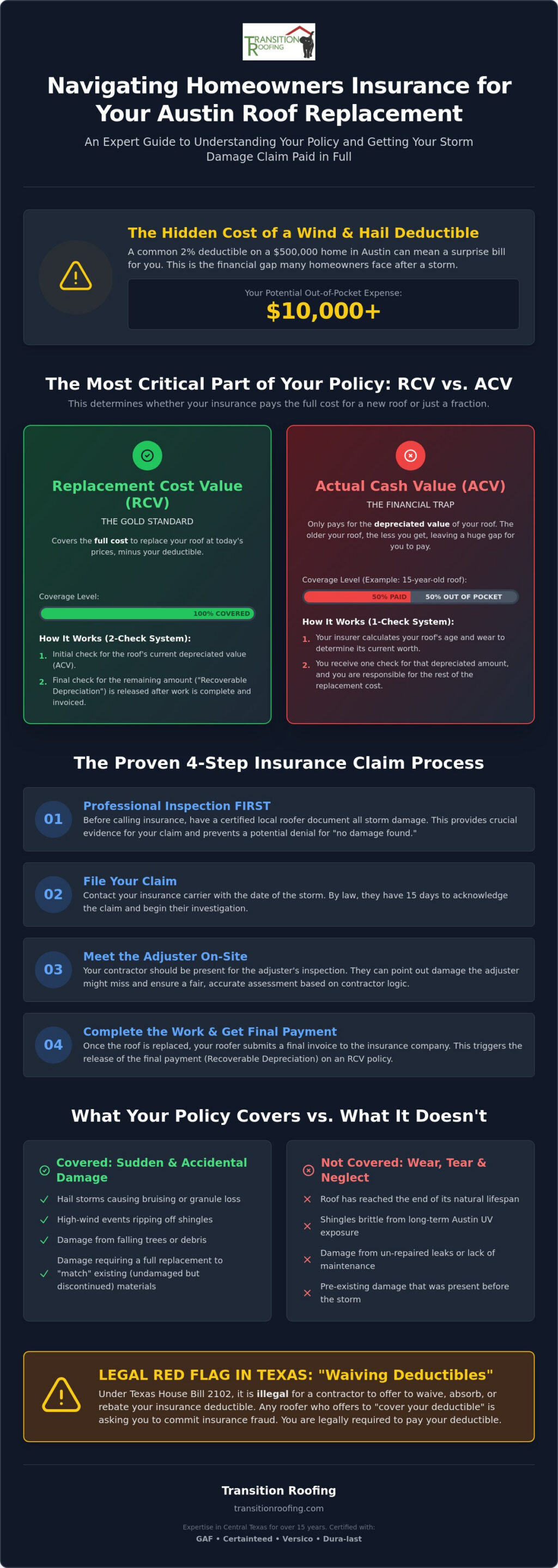
ACV is essentially the depreciated value of your roof. Insurers calculate how much life is “used up” based on the age of your shingles. If your 15-year-old roof is damaged by hail, the carrier subtracts 15 years of wear from the payout. This often leaves Austin homeowners with a massive financial gap between the insurance check and the actual cost of a Residential Roof Replacement. We are seeing a trend where “ACV-only” policies are becoming more common in high-risk Texas zones. These policies can be a financial trap because they shift the majority of the replacement cost onto the property owner.
Replacement Cost Value (RCV) Benefits
RCV is the gold standard for property protection. It covers the full cost to replace your roof at today’s market prices, minus your deductible. This process typically involves a two-check system. The first check covers the ACV of the damage. The second check, known as “Recoverable Depreciation,” is held back until the project is complete. Transition Roofing helps homeowners by providing the detailed final invoices and proof of completion that adjusters require to release those final funds. This ensures you aren’t left footing the bill for the depreciation yourself.
If you’re looking at your policy’s declarations page and aren’t sure which coverage you have, we can take a look and give you a clear plan for your specific situation.
The Step-by-Step Insurance Claim Process for Austin, TX Storm Damage
Filing a claim is a methodical process that requires accuracy from the very first day. Understanding your homeowners insurance for roof replacement means knowing that the timeline doesn’t start with a phone call to your agent. It starts on your roof. Many homeowners make the mistake of calling their insurance company immediately after a storm, which can lead to a “zero-dollar” claim if the damage doesn’t exceed your deductible. These claims stay on your record and can impact your future premiums without providing any benefit.
Why the Initial Inspection Matters
You should always have a trusted contractor perform a thorough assessment before involving your carrier. Professional Austin roof repair experts look for hidden leaks and subtle hail bruising that an untrained eye might miss. We use this data to confirm you have a legitimate “date of loss” that matches local weather reports. This preparation ensures you are following the Texas Department of Insurance guide on roof coverage by providing clear, verifiable evidence of a covered peril.
Navigating the Adjuster Meeting
When the insurance adjuster arrives, your roofing contractor should be there to meet them. We speak “adjuster language” to ensure the scope of work is fair and complete. Adjusters are often handling dozens of claims after a Central Texas storm and can easily miss damage to gutters, window screens, or siding. Having a local expert on-site prevents these omissions from stalling your project. If you haven’t scheduled an adjuster meeting yet, schedule a professional inspection with us first to ensure your home is fully protected.
Supplementing and Construction
The final stage is “supplementing,” which is how we handle items the adjuster may have missed or new code requirements. In Austin, TX, building codes often change, and your policy’s “Ordinance or Law” coverage should pay for these upgrades. We submit photos and documentation directly to the carrier to cover items like drip edge or specific flashing. This ensures your new roof is built to the highest standards without you paying for these necessary safety upgrades out of pocket. We’ve spent over 15 years perfecting this process so our neighbors can focus on getting back to normal.
Avoiding Common Claim Pitfalls with an Austin, TX Roofing Expert
Understanding your homeowners insurance for roof replacement requires staying alert to local laws and quality standards. One of the biggest risks involves the Texas HB 2102 law. This statute makes it a felony for contractors to waive or absorb your deductible. If a roofer offers to cover your out-of-pocket costs, they’re asking you to participate in insurance fraud. It’s better to work with a team that values integrity and follows the law to the letter.
Another pitfall is ignoring “Code Upgrades.” Austin building codes require roofs to handle 110 mph winds. If your current roof is older, it likely doesn’t meet this standard. Most policies include “Ordinance or Law” coverage that pays for these necessary safety improvements. We verify these codes on every project so you don’t get stuck with a roof that isn’t up to par with current city requirements.
The Truth About Your Deductible
A “free roof” isn’t just a red flag; it’s a legal liability. You should plan for your deductible payment as a standard part of your project budget. Legitimate contractors will always provide a clear invoice showing that the deductible was paid. This documentation protects you during the final stages of the claim when the insurance company asks for proof of payment before releasing the depreciation check.
Maximizing Your New Roof with Quality Materials
Using high-quality materials like GAF or Certainteed shingles provides more than just durability. These high-wind rated products can sometimes lead to lower annual insurance premiums. Our 15 years of experience in both residential and commercial roofing in Austin allows us to spot quality issues that “storm chasers” often overlook. When searching for a roofer near me, prioritize local experts who offer long-term warranties and certified installation.
Homeowners who value this level of craftsmanship and durability often extend that same standard to their backyard features, seeking out specialists like Marlin Exteriors, Inc. for custom pool design and construction.
If you’re dealing with a denied claim or confusing insurance paperwork, we can take a look and give you a clear plan. Schedule a roof inspection in Austin today.
Secure Your Home with Expert Austin Insurance Guidance
Understanding your homeowners insurance for roof replacement is the first step toward a successful recovery after a Central Texas storm. You now have the tools to navigate the “two-check” RCV system and avoid the legal pitfalls of deductible fraud. Remember that your insurance policy is a contract; ensuring it is honored requires documented proof and a deep knowledge of current Austin building codes.
At Transition Roofing, we leverage over 15 years of local experience to advocate for our neighbors. As GAF Master Elite and Certainteed Certified contractors, we maintain an A+ rating by prioritizing integrity and long-term protection. We know how to speak the adjuster’s language to ensure every detail, from drip edges to ventilation upgrades, is fully funded and built to withstand the next round of Texas weather.
If you’re seeing signs of damage or just finished a stressful hailstorm, don’t wait for a leak to appear. Schedule a professional storm damage inspection in Austin today. We’ll provide the steady, expert guidance you need to restore your home with total confidence.
Common Questions About Understanding Your Homeowners Insurance for Roof Replacement in Austin, TX
Does homeowners insurance cover a 20-year-old roof replacement?
Yes, insurance can cover an older roof if the damage is caused by a specific storm event rather than general aging. However, the payout depends heavily on your policy type. Many Texas carriers in 2026 now use a sliding scale for roofs over 15 years old, often providing only Actual Cash Value (ACV) coverage. This means the insurer subtracts depreciation based on the roof’s age, which can leave you with higher out-of-pocket costs compared to a newer roof.
What is the “Deductible Law” in Texas (HB 2102)?
Texas HB 2102 is a state law that makes it a felony for a roofing contractor to pay, waive, or “absorb” a homeowner’s insurance deductible. This law was designed to prevent insurance fraud and protect homeowners from predatory “storm chaser” practices. You are legally required to pay your full deductible, and your contractor must be able to provide proof of that payment to the insurance company if requested. Avoiding this requirement puts both the homeowner and the contractor at legal risk.
Can I choose my own roofing contractor for an insurance claim in Austin?
You have the absolute legal right to choose any roofing contractor you trust for your project. While some insurance companies might provide a list of “preferred” contractors, you are not obligated to use them. We recommend selecting a local expert with GAF or Certainteed certifications who has a deep understanding of Austin building codes. A local contractor will act as your advocate during the adjuster meeting to ensure the scope of work is accurate and fair.
How long do I have to file a roof claim after a storm in Texas?
Homeowners generally have one year from the date of loss to file a roof damage claim under Texas Insurance Code §16.005. While some specific policies might offer a longer window, one year is the legal minimum required by the state. Waiting too long can make it difficult to prove the damage was caused by a specific storm. Understanding your homeowners insurance for roof replacement means acting quickly to get a professional inspection and document the damage while the evidence is fresh.
What happens if my insurance company’s estimate is lower than my contractor’s bid?
It is very common for an adjuster’s initial estimate to be lower than a contractor’s bid because they often miss specific line items or local code requirements. This is where the “supplementing” process comes into play. Your contractor will submit detailed photos and documentation to the carrier to justify the additional costs for items like permit fees or specialized flashing. This is a standard part of understanding your homeowners insurance for roof replacement and ensures your new roof is built to the highest safety standards without you footing the extra bill.