
A “no” from your insurance adjuster isn’t always the final word; often, it’s just a sign that the right evidence hasn’t been presented yet. If you’ve recently weathered a Central Texas storm, the stress of potential leaks is enough to deal with without the added fear of a claim denial. Understanding exactly what insurance adjusters look for on a roof is the first step toward securing the repairs your home needs. At Transition Roofing, we’ve spent over 15 years helping Austin, TX homeowners navigate these inspections with clarity and confidence.
You’re likely worried about technical jargon or the recent 2026 shift toward Actual Cash Value (ACV) policies that can leave you paying more out of pocket. We agree that the process often feels designed to be confusing, but it doesn’t have to be. This guide explains how adjusters evaluate hail hits, wind uplift, and structural integrity according to current HAAG standards. We’ll show you how to prepare for an inspection so you can get a fair assessment and the peace of mind that your property is fully protected.
Key Takeaways
- Learn how adjusters use a “test square” to measure damage density and determine if your roof meets the threshold for a valid claim.
- Understand exactly what insurance adjusters look for on a roof, including subtle hail bruises and wind-creased shingles that often go unnoticed by homeowners.
- Discover how Austin building codes and the “25% Rule” can turn a partial repair into a full roof replacement if the damage is widespread enough.
- See how the shift toward Actual Cash Value (ACV) policies in 2026 makes professional documentation more critical than ever for a fair payout.
The Inspection Framework: How Adjusters Start in Austin, TX
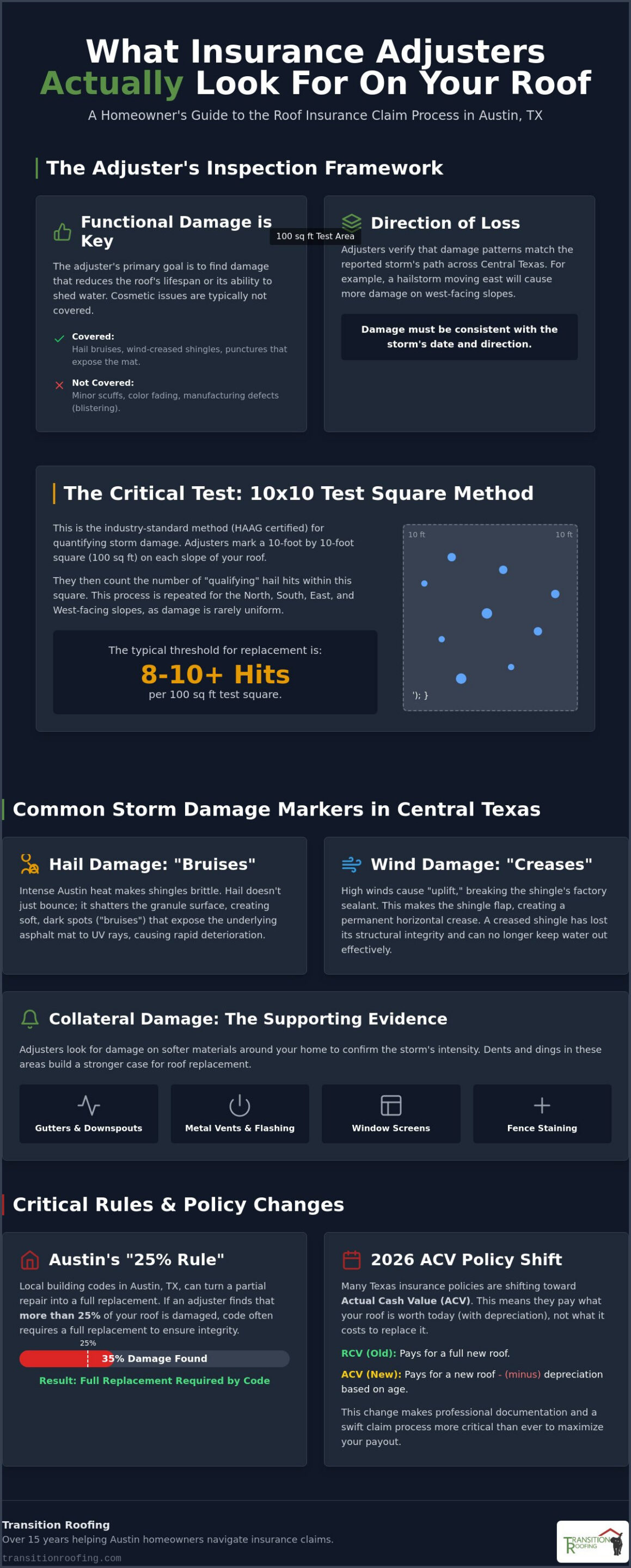
When an adjuster arrives at your home in Austin, they don’t just glance at the shingles and write a check. They follow a strict protocol designed to separate real storm damage from standard aging. Understanding what insurance adjusters look for on a roof starts with knowing their “functional damage” standard. This means the damage must actually reduce the roof’s lifespan or its ability to keep water out. Cosmetic issues, like minor fading or small scuffs that don’t break the asphalt mat, usually won’t lead to a payout.
Adjusters also track the “Direction of Loss” by looking at local storm paths across Central Texas. If a hailstorm moved from West Lake Hills toward downtown, they expect to see more impact on the western and northern slopes of your home. They use this data to verify that the damage matches the date of the storm you reported. Clear documentation, including photos of the yard immediately after a storm, helps prove your case and keeps the process transparent.
To see how this framework looks in practice, watch this helpful video:
The 10×10 Test Square Method
The most critical part of understanding what insurance adjusters look for on a roof is the “test square” method. An adjuster marks off a 10-foot by 10-foot area on each slope of your roof. They count the number of qualifying hits within that 100-square-foot space. If the count meets the insurance company’s threshold, typically 8 to 10 hits per square, that slope qualifies for replacement. They repeat this for the North, South, East, and West sides because wind and hail rarely hit every side with the same intensity. Our team at Transition Roofing has spent over 15 years witnessing how these counts determine the fate of a claim.
Collateral Damage: Looking Beyond the Shingles
Adjusters look for “collateral damage” on softer materials to confirm the storm’s severity. If they find deep dents in your gutters, attic vents, or flashing, it’s a strong indicator that the shingles also took a beating. They will even check your window screens and fence staining for Storm Damage Markers. These signs provide the supporting evidence needed to justify a full residential roof replacement. If you’re seeing dents on your downspouts or metal vents, it’s a clear sign you need a professional to take a look.
Storm Damage Markers: What Adjusters Hunt for in Central Texas
Austin’s summer sun regularly hits triple digits, and this extreme heat plays a major role in how damage develops. Intense UV exposure bakes shingles over time, making them brittle and less flexible. When hail hits a sun-baked roof, it doesn’t just bounce; it often shatters the granule bond. This “Heat Factor” is a primary element in what insurance adjusters look for on a roof during a Central Texas inspection. They aren’t just looking for obvious holes. They’re looking for “bruises.” A bruise is a dark, soft spot where granules have been knocked away, exposing the fragile asphalt mat underneath to the elements.
Wind damage is equally subtle but just as dangerous. High winds in the Austin area often cause “uplift.” This happens when the wind gets under the shingle and breaks the factory sealant bond. Once that seal is broken, the shingle flaps in the wind, creating a permanent crease across the top. Adjusters hunt for these creases because they signal that the shingle’s structural integrity is gone. If you’re noticing shingles that look slightly lifted or “tabbed up,” it’s a sign that your home’s first line of defense is compromised.
Adjusters are also trained to spot “mechanical damage.” This is damage caused by humans or standard wear and tear, such as foot traffic or manufacturing defects like “blistering.” They often use these findings to deny claims as maintenance issues. Having a local expert who understands contractor logic present during the inspection ensures these distinctions are made fairly and accurately.
Residential Shingle Damage Markers
On Asphalt Shingle Roofing, damage presents differently depending on the quality of the material. Premium shingles like GAF and Certainteed are engineered for high impact resistance, but even they show signs of “scabbing” after a major storm. Adjusters look for circular impact patterns in the granule layer and fractures in the fiberglass matting. They also check for missing shingles or exposed nail heads that indicate wind stripping.
Commercial and Flat Roof Markers
For business owners, TPO and Flat Roof Systems require a different set of eyes. What insurance adjusters look for on a roof with a flat surface includes membrane punctures and seam failures. Hail can create microscopic “star cracks” in TPO membranes. These aren’t always visible from a distance, but they will lead to major leaks during the next heavy Austin rain if they aren’t documented and repaired quickly.
Repair vs. Full Replacement: The Adjuster’s Decision in Austin, TX
The final decision on your claim often comes down to local building codes and the specific language in your policy. In Austin, TX, the “25% Rule” is a major factor in what insurance adjusters look for on a roof. If the storm damage covers more than a quarter of the total roof area, city codes often mandate a full replacement rather than a patch. This ensures the entire system remains structurally sound and meets modern safety standards. Adjusters must weigh the cost of a repair against these legal requirements before making their final call.
Matching issues also play a huge role in the replacement decision. If your current shingles are no longer manufactured, an adjuster might approve a full replacement because a mismatched patch would compromise the home’s curb appeal and resale value. It’s also vital to check if you have an Actual Cash Value (ACV) or Replacement Cost Value (RCV) policy. With the 2026 shift toward ACV policies in Texas, your payout might be lower based on the roof’s age, even if a full replacement is approved. Understanding these financial nuances is key to managing your expectations.
When Repair is the Logical Choice
Sometimes, a full replacement isn’t necessary. If the damage is limited to a small area or a single pipe boot, a targeted fix is the most efficient path. We specialize in emergency roof leak repair to stop active water intrusion before it damages your ceilings. These smaller projects are ideal when the overall integrity of the shingles remains high and the damage density is low.
When Replacement is Unavoidable
Widespread granule loss is a different story. When an adjuster sees hundreds of hits across every slope, they know the roof’s lifespan is effectively over. Insurers prefer a full replacement in these cases to avoid the high costs of future interior restoration claims. If your roof decking is soft or rotting, a patch won’t hold; a complete overhaul becomes the only safe option. If you’re dealing with extensive storm damage, schedule a thorough inspection to get a clear plan for your property.
Maximizing Your Claim: Working with Austin, TX Roofing Experts
Don’t leave the outcome of your claim to chance. When you understand what insurance adjusters look for on a roof, you realize how easy it is for a busy inspector to miss a single creased shingle or a subtle hail bruise. Having an experienced contractor on the ladder with the adjuster ensures every square foot gets a fair look. We speak the same technical language as insurance professionals. This allows us to point out damage density that might otherwise be dismissed as standard wear and tear.
Professional estimates from Transition Roofing act as a vital second set of eyes for your property. We provide high-resolution photo reports that document every finding with precision. If an adjuster denies a claim, these photos serve as the primary evidence needed to request a re-inspection or enter the 2026 standardized appraisal process. After the adjuster leaves, your next step is reviewing the “scope of loss” document. We help you compare this report against our findings to ensure every necessary repair is covered.
The Advantage of Local Expertise
We have over 15 years of experience navigating the unique insurance landscape in Austin, TX. Our team holds high-level certifications from GAF, Certainteed, Versico, and Dura-last. These credentials prove we understand the manufacturer’s requirements for a valid warranty. When we validate what insurance adjusters look for on a roof, we use these industry standards to advocate for the long-term protection of your home or business. Local knowledge matters when you’re defending the integrity of your structure.
Schedule Your Professional Inspection
Waiting for the insurance company to find damage is a reactive approach that can lead to smaller payouts or missed leaks. Be proactive by getting a professional assessment before the adjuster arrives. If you’re seeing signs of storm damage or just want the peace of mind that comes with an expert’s opinion, we are here to help. We can take a look and give you a clear, honest plan for your next steps. Schedule a roof inspection in Austin today to ensure your property remains safe and secure.
Secure Your Property with Professional Advocacy
Handling an insurance claim in Central Texas doesn’t have to be a source of stress. By understanding what insurance adjusters look for on a roof, you can manage the inspection process with the confidence of an expert. Remember that the “test square” density and local Austin building codes are the primary drivers behind a replacement approval. Having the right documentation, from high-resolution photos to proof of collateral damage, ensures that no legitimate storm impact is overlooked or dismissed as simple wear and tear.
At Transition Roofing, we bring over 15 years of Central Texas experience and GAF and Certainteed certifications to every project. We don’t just fix leaks; we provide expert insurance claim assistance to make sure your home returns to a state of total security. Our team understands the 2026 regulatory shifts and knows how to present the facts clearly to your carrier. If you’re dealing with storm damage, we can take a look and give you a clear plan. Schedule a professional roof inspection in Austin today and let our experts handle the technical details for you. Your peace of mind is our highest priority.
Common Questions About Roof Insurance Claims in Austin, TX
Can I challenge an adjuster’s decision if my claim is denied?
Yes, you have the legal right to dispute a denial or an underpaid claim. As of January 2026, Texas SB 458 requires all residential policies to include a standardized, binding appraisal provision for resolving these disputes. You can also request a re-inspection with a different adjuster. Having a contractor present for the second visit often helps clarify the damage density that was initially overlooked or misidentified as wear and tear.
Does the age of my roof affect what the insurance adjuster looks for?
Yes, age is a primary factor in what insurance adjusters look for on a roof during an inspection. Older shingles are more brittle and prone to “mechanical damage” or heat blistering, which adjusters may categorize as maintenance issues rather than storm damage. Additionally, if you have an Actual Cash Value (ACV) policy, the age of the roof will significantly reduce your final payout based on the depreciated value of the old materials.
Will my insurance rates go up if the adjuster finds storm damage?
Not usually for an individual claim. Texas law generally prevents insurance companies from raising your specific rates due to a weather-related claim that you didn’t cause. However, premiums often rise for an entire zip code or neighborhood after a major hailstorm or wind event hits the area. Filing a claim for legitimate damage is usually the best financial move to protect your home’s structural integrity and overall market value.
What happens if the adjuster misses damage that my roofer found?
You should submit a supplemental claim for the missing items immediately. This is a standard part of the process where your contractor provides high-resolution photo evidence or local Austin building code requirements that the adjuster didn’t include in the initial scope of loss. This is exactly why we recommend having a professional on-site to discuss what insurance adjusters look for on a roof while the inspection is actually happening.
Do I have to use the roofing company the insurance adjuster recommends?
No, you have the absolute right to choose your own contractor. In fact, as of June 2026, Texas HB 3344 requires all roofing contractors to be state-licensed by the TDLR. You should always hire a local expert who prioritizes your long-term protection over the insurance company’s bottom line. A “preferred” contractor from an insurance list may feel pressured to minimize repair costs rather than ensuring a high-quality, durable solution.