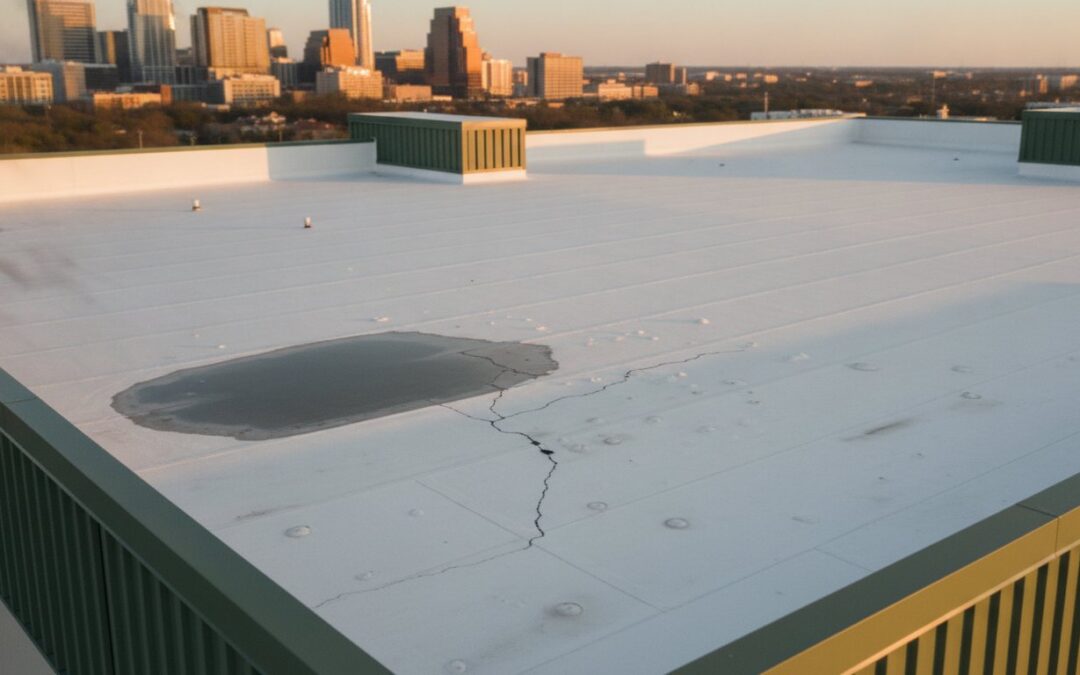
The most expensive commercial roof failure in Austin isn’t usually caused by a single storm. It’s often caused by ignoring the small warnings that appear months before a total collapse. You might think your building is secure, but the intense Central Texas sun and rapid temperature swings create invisible fractures in your TPO or metal system. Identifying the early signs of commercial roof damage is the only way to protect your investment and avoid the massive disruption of a total tear-off.
We understand that a roof replacement is a major capital expense that you want to delay as long as possible. It’s often stressful to navigate changing 2026 Texas licensing mandates and new energy codes while keeping your tenants happy. This guide provides the clarity you need to evaluate your property’s health with the perspective of a seasoned expert. We’ll walk through ten critical red flags to watch for, explain the difference between a simple repair and a total failure, and show you how to find a reliable Austin contractor for an honest assessment.
Key Takeaways
- Identify the early signs of commercial roof damage to stop minor leaks from becoming expensive capital expenditures for your business.
- Learn how the Austin heat and sudden rain cycles create thermal shock, putting immense pressure on your TPO or metal roofing system.
- Recognize the difference between simple surface wear and critical failures like membrane bruising or wind uplift after a Central Texas storm.
- Master the 48-hour rule for ponding water to ensure your drainage systems are protecting your building’s structural integrity.
- Understand why working with contractors certified by GAF, Certainteed, or Versico is essential for maintaining your commercial roof warranty.
Understanding the Early Signs of Commercial Roof Damage in Austin, TX
Commercial roof damage isn’t always as obvious as a gaping hole or a fallen tree. It is technically defined as any breach in your waterproofing membrane or structural decking that allows moisture to enter. In our Central Texas climate, this damage often happens silently. After 15 years of inspecting properties in the area, we’ve seen that simple neglect is the primary reason roofs fail before their time. If you don’t catch the small issues, the building’s structural integrity is eventually compromised.
To better understand this concept, watch this helpful video:
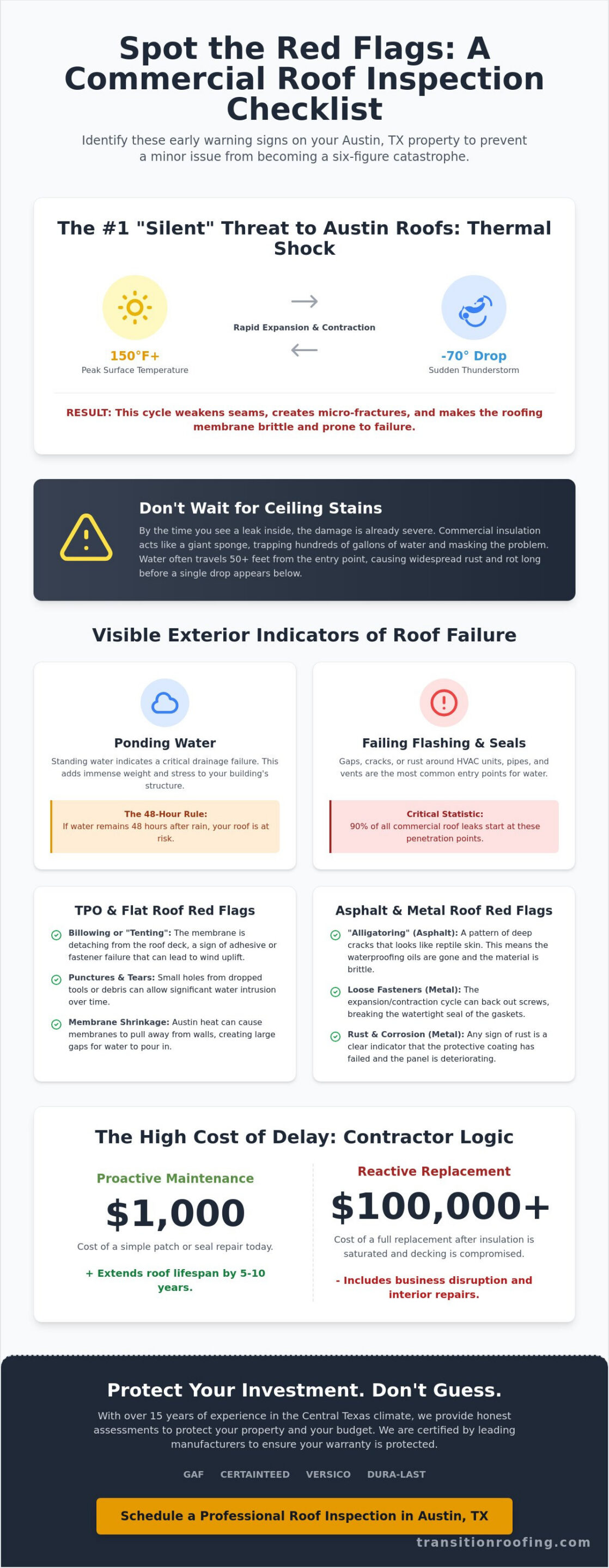
One of the biggest threats to an Austin, TX commercial roof is thermal shock. On a typical 100-degree summer day, your roof surface can easily reach 150 degrees. When a sudden afternoon thunderstorm hits, that temperature can drop 70 degrees in minutes. This causes the roof membrane to contract violently. Over time, this rapid expansion and contraction creates cracks and splits that are clear signs of commercial roof damage. Constant UV exposure also “bakes” your roof, making membranes brittle and prone to shattering under stress.
Why Interior Leaks are Often the Last Sign of Trouble
By the time you see a brown spot on your ceiling tiles, the damage is already advanced. Commercial insulation acts like a giant sponge. It can hold hundreds of gallons of water before a single drop hits the floor. Water often enters in one spot and travels along steel beams for 50 feet before dripping. This is why Austin roof repair experts use thermal imaging cameras. We can find trapped moisture and “hidden leaks” while the interior of your building still looks perfectly dry.
The High Cost of Neglecting Small Red Flags
Contractor logic is simple: a $1,000 patch today stops the rot. If you wait until the insulation is saturated and the decking is rusted, you’re looking at a $100,000 replacement next year. Small red flags like clogged drains or loose flashing are easy to fix. Enrolling in preventative maintenance programs can extend your roof’s lifespan by 5 to 10 years. It’s the most effective way to keep your capital in the bank rather than spending it on a premature total roof failure.
Visible Exterior Indicators of Roof Failure on Austin, TX Properties
Detecting the early signs of commercial roof damage often requires a simple walk across the surface. One of the most common issues we see in Central Texas is ponding water. If you notice standing water that remains for more than 48 hours after an Austin rain, your drainage system is failing. This isn’t just a nuisance. Water weighs about 8.3 pounds per gallon. Large pools can add thousands of pounds of unexpected stress to your building’s structure, eventually leading to a collapse.
You should also pay close attention to the roof’s perimeter and any penetrations. Statistics show that 90% of all commercial leaks occur at the flashing or seals around HVAC units, vents, and pipes. In asphalt-based roofs, look for “alligatoring.” This is a pattern of deep cracks that looks like reptile skin. It indicates that the bitumen has lost its oils and is no longer waterproof. If you’re seeing these visible changes, it’s time to have a professional evaluate your commercial roof before the next storm hits.
TPO and Flat Roof Membrane Red Flags
On flat roofing systems, keep an eye out for billowing. This happens when the membrane detaches from the substrate and “tents” up during high winds. It means the adhesive or mechanical fasteners have failed. You should also check for small punctures. These are often caused by dropped tools from maintenance crews or wind-blown debris. Finally, watch for membrane shrinkage. In the Austin heat, TPO and EPDM can pull away from the walls, tearing the flashing and creating direct paths for water to enter.
Metal Roofing Warning Signs in Central Texas
Metal roofs are durable, but they aren’t invincible. The extreme heat causes metal panels to expand and contract constantly. This often results in “oil canning,” which looks like wavy distortion on the flat areas of the panels. More importantly, this movement can cause fasteners to back out over time. If a screw is loose, water will follow the threads directly into your decking. Always check for rust at the seams and around the base of rooftop equipment. Inspecting your metal roofing in Austin after a high-wind event is critical to ensure no panels have been caught by the wind and bent upward.
Detecting Storm and Hail Damage on Commercial Roofs in Austin, TX
Austin storms often leave behind subtle but devastating signs of commercial roof damage. When large hail hits a TPO or modified bitumen membrane, it creates a “bruise” on the underside. You won’t see a hole from the ground, but the internal reinforcement is shattered. This creates a weak point that will eventually split during the next temperature swing. Even if your ceiling is dry today, the waterproofing integrity of your building has been compromised.
High winds in Central Texas create a vacuum effect known as wind uplift. This pressure is strongest at the corners and edges of your property. It can peel back the membrane or loosen the perimeter flashing without making a sound. You should also check your “soft metals” like gutters, downspouts, and vents. If these are dented, it serves as a reliable proxy for the force that hit your roof. If the metal is damaged, the membrane likely took a significant hit as well.
If you suspect your building was in the path of a storm, we can provide a thorough commercial roof inspection in Austin to give you a clear path forward.
Navigating the Insurance Claim Process
Property managers must document damage immediately after a storm passes. In 2026, many Texas insurance carriers have shifted toward percentage-based deductibles, making the accuracy of your claim more critical than ever. It’s important to understand the difference between “cosmetic” damage, like small dents, and “functional” damage that actually stops the roof from shedding water. We provide expert insurance claim assistance to ensure your adjuster sees the full scope of the structural impact.
Common Post-Storm Equipment Failures
Don’t forget to inspect your rooftop equipment. Severe wind can shift heavy HVAC units, tearing the curb flashing and creating massive leak points. You should also look for “scouring” on shingle or cap sheet roofs. This happens when hail or high-speed rain strips away the protective granules. Without these granules, the underlying asphalt is exposed to the sun and will degrade rapidly. Check your skylights for cracks as well, as even a hairline fracture will eventually fail under the weight of the next Austin rainstorm.
Taking Action: Professional Inspections and Repair in Austin, TX
When you spot signs of commercial roof damage, the next step is a methodical evaluation to determine the best path forward. We’ve spent over 15 years refining a 5-step professional assessment process to ensure your building remains secure. Our team starts with a visual perimeter walk, followed by a drainage evaluation and a membrane health check. We then perform core sampling to check for moisture trapped deep within the assembly. Finally, we provide a detailed report with clear repair or replacement options.
Core sampling is a critical part of this process. It involves taking a small cross-section of the roof to see if the insulation is saturated. If the insulation is wet, simply patching the top layer won’t stop the rot. Local expertise in commercial roofing in Austin is vital because we understand the specific building codes. For instance, as of September 2026, Austin has increased the minimum roof insulation value for commercial buildings to R-30. We ensure your project stays compliant with these new standards while protecting your investment.
Choosing a contractor with the right credentials is just as important as the inspection itself. Certifications from major manufacturers like GAF, Certainteed, Versico, and Dura-last are essential. These certifications mean the manufacturer trusts the contractor to install their products correctly, which is the only way to keep your long-term warranty valid.
When to Repair vs. When to Replace
Deciding between a patch and a full replacement often comes down to contractor logic and the “25% rule.” The 25% rule is a standard industry guideline where we recommend a total replacement if more than a quarter of the roof area is compromised. If the damage is localized and the underlying insulation is dry, we might recommend a high-quality roof coating. These coatings can often save a failing roof and extend its life for a fraction of the cost of a full tear-off.
Schedule Your Austin Roof Inspection Today
We take a neighborly, expert approach to every property we visit. You can expect transparent estimates and no-nonsense advice based on the actual condition of your structure. If you’re seeing any of these signs on your building, it’s time to have a professional take a look before the next Central Texas storm season arrives. Contact Transition Roofing for a comprehensive commercial roof evaluation in Central Texas today.
Protecting Your Austin Asset for the Long Term
Identifying the signs of commercial roof damage early is the difference between a simple repair and a budget-breaking replacement. Whether it’s the subtle bruising from a Central Texas hailstorm or the gradual wear caused by thermal shock, being proactive ensures your business operations continue without interruption. With the updated 2026 building codes and shifting insurance policies, having a clear understanding of your roof’s health is essential for protecting your capital and your tenants.
We bring over 15 years of local experience to every project. Our team is certified by GAF, Certainteed, Versico, and Dura-last, ensuring your TPO, metal, or flat roof system is handled by professionals who prioritize long-term durability over a quick fix. If you suspect your property has sustained damage, don’t wait for the next storm to test your building’s integrity. We provide the honest, expert assessment you need to move from a state of vulnerability to total security. Schedule a Professional Commercial Roof Inspection in Austin Today and get a clear plan for your property’s protection.
Frequently Asked Questions
How do I know if my commercial roof leak is an emergency?
A commercial roof leak becomes an emergency if water is entering electrical rooms, computer server areas, or causing visible sagging in the structural decking. If the leak is large enough to create a slip hazard for your employees or customers, it requires immediate attention to prevent liability and structural failure. It’s best to shut off power to affected areas and call for professional help to prevent a total business interruption.
What does hail damage look like on a flat TPO roof?
Hail damage on a TPO membrane often appears as “bruising” or small fractures in the internal scrim layer. These signs of commercial roof damage might not look like holes from a distance, but they create soft spots that will eventually leak. A professional inspector identifies these by feeling for indentations or using thermal imaging to see if moisture has already started to seep through the bruised area.
Can a commercial roof be repaired, or does it always need a full replacement?
Many commercial roofs can be repaired if the damage is caught early and the underlying insulation is still dry. We use the “25% rule” to decide; if more than a quarter of the roof is failing, a replacement is usually more cost-effective over time. If the structural core is sound, a high-quality roof coating can often restore the waterproofing membrane without the need for a full tear-off.
How often should I have my commercial roof inspected in Austin, TX?
You should schedule a commercial roof inspection in Austin, TX at least twice a year, ideally in the spring and fall. The extreme Central Texas heat and sudden hailstorms put immense stress on your building’s exterior. Regular checks allow you to clear debris from drains and fix small membrane splits before they turn into major structural problems or expensive interior leaks.
Will my insurance cover commercial roof damage from a Central Texas wind storm?
Most commercial policies cover wind and hail damage, but coverage depends on whether the damage is “functional” or “cosmetic.” In 2026, many Texas carriers have moved to percentage-based deductibles, which can change your out-of-pocket costs. Documenting the signs of commercial roof damage immediately after a storm is the best way to ensure your claim is processed accurately and your building is restored to a state of total security.