

Your commercial roof shouldn’t be a liability that bleeds money every time the Texas sun hits its peak. Most property managers accept high cooling bills as an unavoidable cost of doing business, but an aging flat roof is often the real culprit. Finding a reliable TPO roofing contractor Round Rock is the first step toward stopping recurring leaks and finally stabilizing your overhead. You’ve likely dealt with contractors who lack specific heat-welding expertise, leaving your building’s interior vulnerable to the next heavy Central Texas downpour.
We understand that protecting your assets requires more than just a quick patch; it requires a long-term strategy. This guide will show you why TPO is the most efficient choice for local businesses and how to select an installer who guarantees a leak-free, energy-saving result. We’ll preview the 2024 building code requirements in Round Rock, the benefits of high-density 80-mil membranes, and how to secure a documented warranty. You’ll finish this article with a clear plan to achieve a 20 plus year roof lifespan while significantly cutting your monthly cooling costs.
Key Takeaways
- Learn why TPO membranes are the most cost-effective way to lower cooling bills and mitigate the heat island effect during harsh Central Texas summers.
- Discover why choosing an experienced TPO roofing contractor Round Rock is essential for ensuring proper heat-welded seams and precise substrate preparation.
- Compare TPO against PVC and metal systems to find the best balance of chemical resistance and long-term durability for your specific commercial property.
- Identify the early warning signs of membrane degradation and the maintenance steps needed to extend your roof’s life beyond 20 years.
Why TPO is the Top Choice for a TPO Roofing Contractor Round Rock and Austin, TX
Round Rock’s commercial landscape is expanding quickly, and property owners need materials that can keep up with the local climate. Thermoplastic Polyolefin (TPO) is a single-ply, white reflective membrane that has become the standard for flat and low-slope roofs. It’s designed to resist grease, chemicals, and punctures, which makes it a perfect fit for the industrial warehouses and restaurants common in our area. Working with a specialized Expert Roofing Contractor in Austin, TX ensures these properties are maximized through professional installation.
To better understand how these systems are layered and secured, watch this helpful video:
In Central Texas, the “heat island effect” can cause commercial buildings to absorb massive amounts of thermal energy. TPO acts as a shield, reflecting heat away from the structure rather than soaking it in. This protective quality is vital for maintaining structural integrity and preventing the premature aging of your roofing system. It’s a strategic cooling asset for any facility in the Austin TX area.
Energy Efficiency in the Central Texas Climate
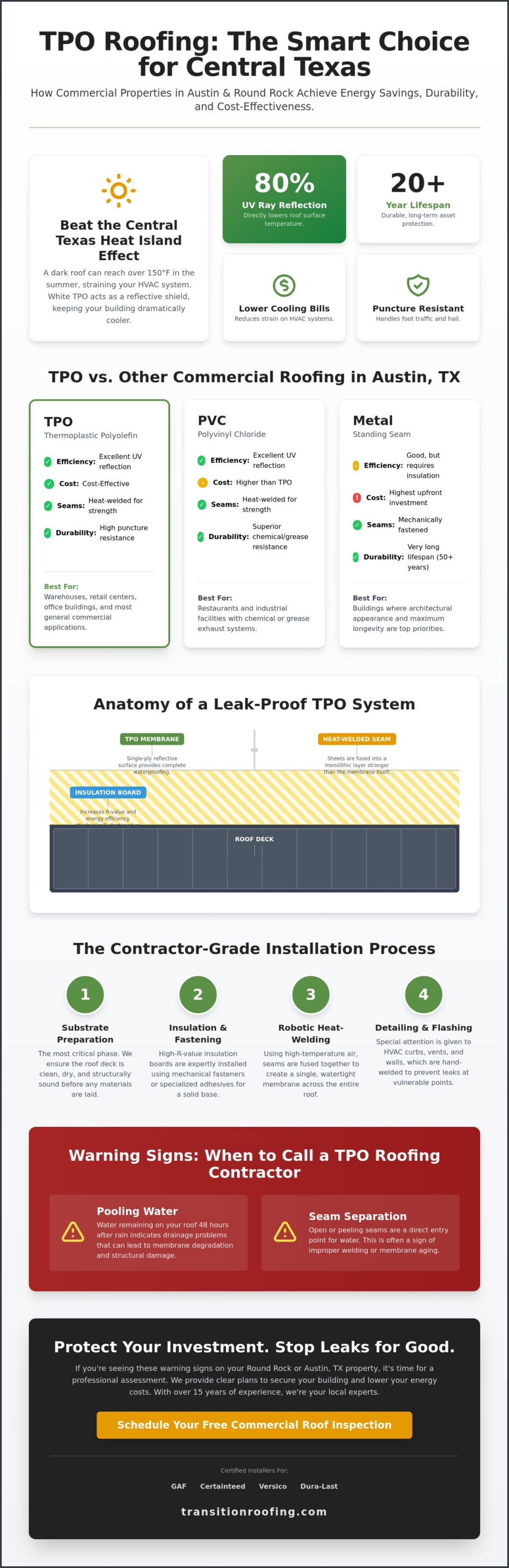
White TPO membranes are engineered to reflect up to 80% of UV rays. During a typical 100-degree summer in Round Rock, a dark-colored roof can reach temperatures over 150 degrees. TPO keeps the surface much cooler, which directly reduces the strain on your HVAC systems. This leads to lower monthly utility bills and fewer mechanical repairs for your cooling units. These systems are also compliant with the 2024 International Energy Conservation Code (IECC) adopted by the City of Round Rock.
Cost-Effectiveness for Large Round Rock Footprints
Speed of installation is a major advantage for local businesses. Unlike traditional built-up roofs (BUR) that require multiple layers and hot asphalt, TPO is installed in large, lightweight sheets. This efficiency allows a TPO roofing contractor Round Rock to complete projects faster, minimizing disruptions to your daily operations. It offers the best balance of low upfront investment and high durability, providing a reliable solution that doesn’t break the budget.
The Installation Process: What to Expect from a TPO Roofing Contractor in Round Rock and Austin, TX
Success begins long before the first roll of membrane is laid out. A qualified TPO roofing contractor Round Rock knows that substrate preparation is the most critical phase of the project. We start by ensuring the roof deck is clean, dry, and structurally sound. Next, we install insulation boards using either mechanical fasteners or specialized adhesives. Mechanical fastening is often preferred for steel decks, while adhesives are used when the deck shouldn’t be penetrated. This foundation is what allows energy-saving cool roofs to perform reliably for decades.
The actual waterproofing happens through robotic heat-welding. This process uses high-temperature air to fuse the sheets together, creating a monolithic bond that is stronger than the membrane itself. To verify the quality of these welds, we perform a “peel test” by physically pulling a sample weld apart to confirm the material tears before the seam separates. If you’re seeing water pooling or seam separation on your current roof, this is usually when we recommend a professional assessment to prevent structural damage.
Seam Strength and Leak Prevention in Austin TX
Seams are the most common point of failure on flat roofs, but they don’t have to be. Beyond the main runs, our team pays close attention to detailing around penetrations, HVAC curbs, and parapet walls. These areas require hand-welding and reinforced flashing to handle the expansion and contraction caused by the volatile Central Texas climate. We ensure every corner is watertight so your inventory and equipment stay dry during heavy storms.
Choosing Membrane Thickness: 60-mil vs. 80-mil
While 60-mil TPO is the industry standard, we often recommend 80-mil for Round Rock properties. Contractor logic is simple here: thicker membranes provide significantly better resistance to punctures and hail damage. An 80-mil system also qualifies for longer documented warranties from manufacturers like Versico, GAF, or Certainteed. Investing in a thicker membrane now can easily add five to ten years to the total lifespan of your commercial roofing system.
Evaluating TPO vs. PVC and Metal for Austin TX Area Properties
Choosing the right material for your commercial property often comes down to the specific use of the building. While TPO is a versatile solution, an experienced TPO roofing contractor Round Rock will tell you that the final decision depends on your building’s specific slope and the density of rooftop equipment. For instance, low-slope roofs with complex HVAC layouts require the flexibility of a membrane that’s easy to flash and seal. These reflective systems do more than just protect your inventory; they help reduce urban heat islands across the growing Central Texas region.
If you need a more granular look at how these materials perform under different environmental stressors, our Flat Roofing Company in Austin provides detailed breakdowns for specialized systems. We focus on matching the material to the actual demands of your facility to ensure long-term protection.
When PVC is the Better Alternative
PVC (Polyvinyl Chloride) is often confused with TPO, but it has distinct advantages for specific Austin TX area properties. We recommend PVC for restaurants or industrial facilities where the roof is exposed to high levels of grease, fats, or harsh chemicals. TPO can degrade when in constant contact with these substances. While PVC comes with a price premium, its superior chemical resistance prevents premature failure in these demanding environments. For most standard warehouses or retail centers, however, TPO remains the more cost-effective choice.
Metal Roofing for Long-Term Assets
For owners who plan to hold a property for 40 years or more, standing seam metal is a powerful alternative. You can find specific durability stats in our guide to Metal Roofing Austin. However, TPO is often preferred for large commercial retrofits in Round Rock. It’s lighter, faster to install, and significantly more budget-friendly than metal when covering massive square footage. TPO also offers superior reflectivity, which is a major factor in our 100-degree summers.
If you’re trying to decide between these materials for your next project, we can help you weigh the ROI of each system based on your specific building goals.
Maximizing Your Roof’s Lifespan with a Trusted TPO Roofing Contractor in Round Rock and Austin, TX
A commercial roof is a major investment that requires proactive care to reach its full potential. At Transition Roofing, we bring over 15 years of experience to every project, backed by industry certifications from leading manufacturers like Versico and GAF. As a dedicated TPO roofing contractor Round Rock, we’ve seen how the intense Central Texas sun can impact even the best systems if they aren’t maintained. Our goal is to move your property from a state of vulnerability to one of total security through steady, reliable craftsmanship.
Bi-annual inspections are the most effective way to protect your warranty and extend your roof’s life. These visits focus on clearing drainage systems of Texas debris like oak tassels, cedar pollen, and windblown dust. If water can’t flow off the roof, it adds unnecessary weight and stress to the heat-welded seams. We also look for early signs of UV degradation, often called “alligatoring,” where the membrane develops small cracks that look like reptile skin. If you haven’t had your seams inspected since the last Round Rock hail storm, we can provide a clear plan to ensure your building remains watertight.
Commercial Maintenance Programs in Austin TX
Consistent upkeep is often a requirement for keeping your manufacturer warranty valid. A professional maintenance report should include detailed photos of all penetrations, drainage points, and seam conditions. This documentation is essential for insurance compliance if you ever need to file a claim. You can explore our Commercial Roof Installation services to see how we build these systems for long-term durability from day one.
Navigating Storm Damage and Insurance Claims in Austin TX
When hail hits Round Rock, TPO membranes can suffer “bruising” or fractures that aren’t always visible from the ground. We use specialized techniques to document these impacts, providing the proof needed for a successful insurance claim. For more detailed recovery steps, refer to our guide on Austin Roof Repair. If you’re dealing with recurring leaks or suspected storm damage, we can take a look and give you a clear plan for your commercial property. Schedule a roof inspection in Austin today.
Securing Your Commercial Investment for the Long Term
Protecting your building from the Central Texas climate requires more than just a standard roof; it requires a strategic cooling asset. TPO membranes offer the perfect balance of UV reflection and puncture resistance, provided they’re installed with technical precision. By choosing high-density 80-mil membranes and prioritizing robotic heat-welded seams, you can effectively lower your operational costs while gaining peace of mind during storm season.
Transition Roofing brings over 15 years of local experience and manufacturer certifications from GAF, Versico, and Dura-last to every project. We specialize in maintaining the integrity of your roof through professional installation and proactive maintenance. Partnering with an expert TPO roofing contractor Round Rock ensures your facility remains secure and efficient for decades. We focus on moving your structure from a state of vulnerability to one of total security.
If you’re seeing signs of wear or want to verify your roof’s condition after a storm, we can take a look and provide a clear plan. Schedule a professional TPO roof inspection in Round Rock today and let our team provide the protection your assets deserve. We look forward to helping you stabilize your property’s future.
Frequently Asked Questions About Commercial Roofing in Austin TX
How long does a TPO roof typically last in Round Rock, TX?
A TPO roof typically lasts between 15 and 25 years in the Central Texas climate. The actual lifespan depends on the thickness of the membrane you choose and how well you maintain the drainage system. Thicker 80-mil membranes generally last longer because they resist UV degradation and punctures more effectively than thinner options. Regular bi-annual inspections help prevent small issues from turning into premature failures.
Is TPO roofing more expensive than asphalt shingles for commercial buildings?
TPO roofing is generally more expensive upfront than asphalt shingles; however, shingles are rarely suitable for the low-slope or flat surfaces found on commercial buildings. TPO provides superior energy efficiency and waterproofing that shingles cannot match on a large footprint. When you factor in the reduction in cooling costs and the long-term durability, TPO often provides a better return on investment for local businesses.
Can you install a new TPO roof over an existing flat roof system?
You can often install a new TPO membrane over an existing flat roof, a process known as a roof recovery. Whether this is possible depends on the moisture levels in your current insulation and the total weight of the existing layers. We always perform a core sample test first to ensure the substrate is dry. If the existing system is saturated or already has two layers, a full tear-off is necessary to meet local building codes.
How does a TPO roofing contractor in Round Rock handle hail damage repairs?
A TPO roofing contractor Round Rock handles hail damage by performing a detailed physical inspection to find fractures or “bruising” in the membrane. If the damage is localized, we can perform a permanent repair using heat-welded patches that fuse with the original material. If the hail has compromised the entire surface, we provide documented evidence for insurance claims to ensure the replacement meets current 2024 building standards.
What is the difference between mechanically attached and fully adhered TPO?
Mechanically attached systems use screws and plates to secure the membrane to the roof deck, making them faster and more affordable to install. Fully adhered systems use specialized adhesives to bond the membrane to the insulation, providing a smoother look and better wind uplift resistance. The best choice for your building depends on the height of the structure, local wind patterns, and the specific type of roof deck you have.