

A single hail storm in Central Texas can wipe out an entire year’s maintenance budget in less than ten minutes. You likely already know that reacting to leaks is the most expensive way to manage a building. It’s frustrating to stand before a board with a massive repair bill you didn’t see coming, especially when they demand data you don’t have. Developing a proactive commercial roofing capital expenditure plan Austin allows you to stop playing defense against the weather and start managing your asset with confidence.
I’ll show you how to build a strategic 5 to 10 year budget that eliminates financial surprises and protects your property from the intense heat. We’ll look at the 2024 building codes recently adopted in Austin, TX, and how to maximize Section 179 tax deductions for the 2026 tax year. You’ll learn how to choose the right materials to reduce emergency calls and keep your property’s value high for the long haul. This guide provides the clear financial roadmap you need to turn your roof from a liability into a stable business asset.
Key Takeaways
- Differentiate between reactive repair costs and a strategic commercial roofing capital expenditure plan Austin to provide your board with predictable, data-driven financial roadmaps.
- Use advanced assessment tools like moisture mapping and infrared technology to pinpoint hidden leaks and accurately inventory the condition of every roof section.
- Maximize your property’s ROI by leveraging updated Section 179 tax deductions and energy-efficient TPO systems specifically designed for the Central Texas heat.
- Implement a proactive maintenance program to extend the lifespan of your existing roof, potentially delaying a full replacement by three to five years.
Why Your Property Needs a Commercial Roofing Capital Expenditure Plan in Austin, TX
Managing a commercial property in Central Texas requires a clear distinction between daily operating expenses and long-term investments. While OpEx covers routine commercial roof repair to stop active leaks, understanding what is a capital expenditure is vital for major projects like full replacements or restorations. A commercial roofing capital expenditure plan Austin is a proactive strategy to stabilize property value by forecasting roof life and funding requirements years in advance.
To better understand how these plans work in a real-world setting, watch this helpful overview:
The 2026 Central Texas climate presents unique stressors that make this planning essential. Extreme UV radiation and the increasing frequency of hail storms significantly shorten the traditional lifecycle of many roofing systems. Without a plan, you’re essentially waiting for a disaster to dictate your budget and your building’s safety.
The Cost of Deferred Maintenance in Central Texas
Choosing to “patch as you go” often feels like a cost-saving measure, but it usually backfires. Industry data shows that deferred maintenance leads to costs that are often twice as high over a ten-year period compared to proactive care. Emergency leaks don’t just damage the structure; they threaten tenant retention and disrupt daily operations. When a business has to shut down because of a failed roof, the loss of income far outweighs the cost of a scheduled replacement. A structured commercial roofing capital expenditure plan Austin ensures you replace the roof on your terms, not the weather’s.
Building Your 5-Year Commercial Roofing Capital Expenditure Plan in Austin, TX
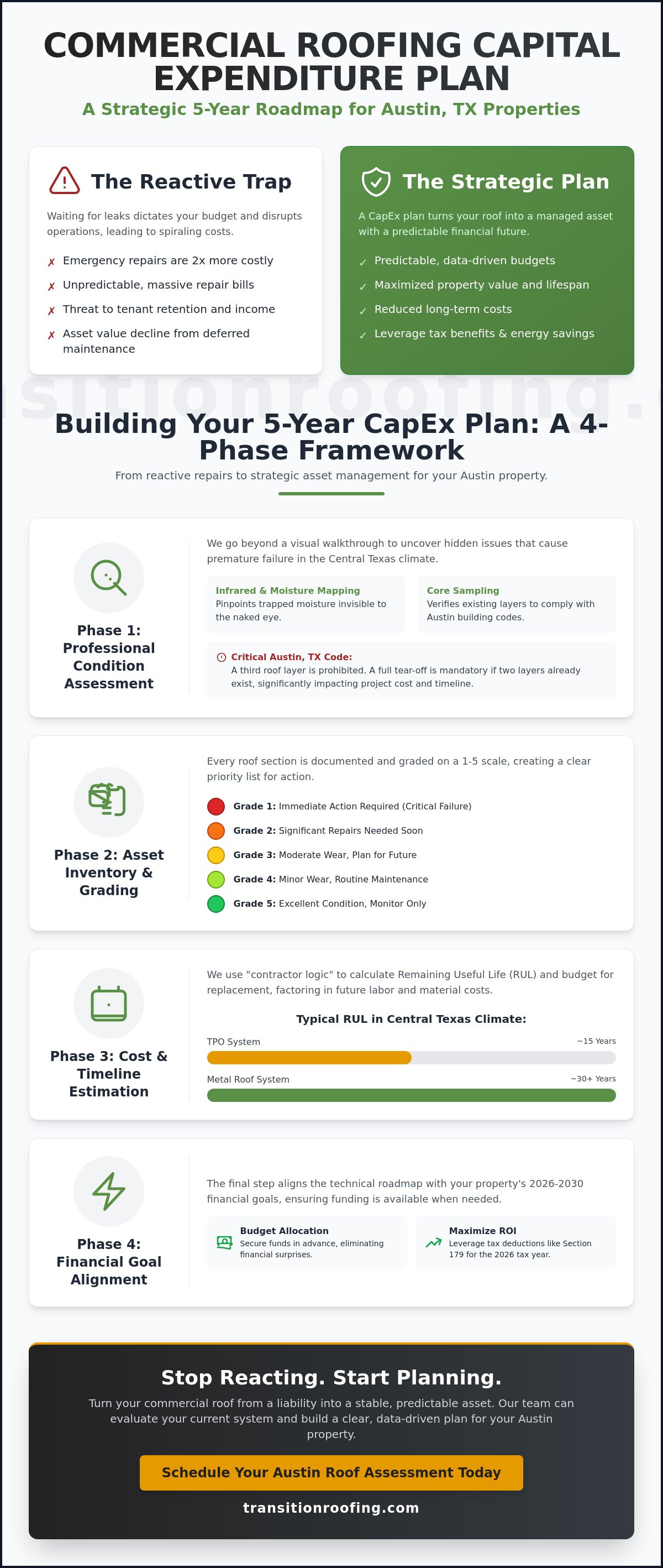
Creating a reliable commercial roofing capital expenditure plan Austin involves more than just guessing at a replacement date. It requires a disciplined, four-step framework to move from reactive repairs to strategic management. First, we conduct a technical assessment using moisture mapping. Second, we inventory every asset, documenting the age and material, such as TPO or metal. Third, we grade each section on a 1-5 scale, where 1 requires immediate action and 5 is monitor-only. Finally, we align this roadmap with your property’s 2026-2030 financial goals to ensure funding is available when needed.
Phase 1: Professional Condition Assessment
A visual walk-through isn’t enough to secure a multi-million dollar asset. We use infrared technology to find trapped moisture that remains hidden to the naked eye. In Austin, TX, we also perform core sampling to verify the number of existing roof layers. This is critical because the City of Austin building code generally prohibits a third roof layer, meaning a full tear-off is required if two layers already exist. We also look for “invisible” hail damage. These micro-fractures in the membrane don’t leak immediately but will cause premature failure during the next heat wave.
Phase 2: Estimating Replacement Costs and Timelines
Accurate budgeting depends on calculating the Remaining Useful Life (RUL) of your system. While a well-maintained metal roof might last 30 years, a TPO system in the intense Central Texas sun usually requires closer attention after year 15. We use “contractor logic” to build your budget, factoring in 2026 labor rates and material inflation rather than relying on outdated numbers. This planning also helps you navigate IRS rules on depreciating property, allowing you to maximize tax benefits as you replace aging assets. If you’re unsure where your roof stands, we can evaluate your current system to jumpstart your planning.
Maximizing ROI and Tax Benefits for Austin, TX Commercial Roofs
Investing in a commercial roofing capital expenditure plan Austin isn’t just about stopping leaks; it’s a strategic tax move. For the 2026 tax year, the Section 179 deduction limit has reached $2,560,000. This allows most property owners to expense the full cost of a roof replacement in a single year instead of depreciating it over 39 years. If your total equipment purchases stay below the $4,090,000 phase-out threshold, the tax savings can significantly offset your initial capital outlay. A well-crafted commercial roofing capital expenditure plan Austin turns a necessary expense into a predictable, tax-advantaged asset.
In the Austin heat, energy efficiency is a direct contributor to your bottom line. A white TPO (Thermoplastic Olefin) membrane reflects a massive amount of UV radiation. This reduces the load on your HVAC systems and lowers monthly cooling costs. If you’re seeing rising energy bills, a white TPO overlay might be the best CapEx move to stabilize your operating budget.
TPO vs. Metal: Which Fits Your 10-Year Plan?
Choosing between systems depends on your hold period. TPO offers a lower entry cost and reliable performance for 15 to 20 years. However, for a 30-year lifecycle value, metal roofing Austin often provides a better long-term return. As a specialized flat roofing company Austin with over 15 years of experience, we weigh these upfront costs against maintenance needs. Metal systems are nearly impervious to the hail storms common in Central Texas, preventing frequent insurance claims.
If you want to see how these tax benefits apply to your specific building, we can help you run the numbers.
Executing Your Plan with a Local Austin, TX Commercial Partner
Bidding out every small commercial roof repair might seem like a way to save money, but it lacks the continuity needed for a successful commercial roofing capital expenditure plan Austin. A multi-year partnership allows a contractor to learn the history of your building’s roof sections. We track every patch and every storm impact over time. This data is what makes your 5-year budget accurate. It’s the difference between guessing and knowing when a large replacement is actually required.
Our team brings over 15 years of local experience to every project in Austin, TX. We understand the specific requirements of manufacturers like GAF and Certainteed. These warranties often require documented proof of maintenance to remain valid. If you don’t have those records, you could lose your coverage after a major hail event. We manage that documentation for you, ensuring your investment stays protected under warranty terms.
Preventative Maintenance: The CapEx ‘Secret Weapon’
A solid maintenance program is the most effective way to push back a full replacement by three to five years. We recommend bi-annual inspections in the Spring and Fall. These visits focus on clearing drains and checking seams before the heavy Central Texas storm seasons hit. Documented maintenance reports are also vital when you need to file a claim for hail damage repair. They prove the roof was in good condition before the storm arrived, which makes the insurance process much smoother.
- Clear debris from drainage systems to prevent ponding water and structural stress.
- Inspect flashings and seams for damage caused by extreme thermal movement in the Texas heat.
- Provide detailed photo reports to satisfy GAF and Certainteed warranty requirements.
- Identify minor membrane tears before they turn into costly interior leaks.
If you’re ready to stop reacting to emergencies and start planning for the future, we can help you build a reliable commercial roofing capital expenditure plan Austin. Schedule a roof inspection in Austin today to start your 5-year plan.
Secure Your Building’s Future with a Strategic Roadmap
A successful commercial roofing capital expenditure plan Austin allows you to stop reacting to unpredictable Central Texas weather and start making data-driven decisions. By leveraging updated tax codes and implementing a proactive maintenance schedule, you can significantly extend the life of your asset while stabilizing your annual budget. We have spent over 15 years helping Austin property managers navigate the complexities of TPO and metal lifecycle management. As GAF, Certainteed, and Versico certified contractors, we focus on providing the technical clarity you need to present a professional roadmap to your board.
If you are ready to eliminate financial surprises and protect your structure from the next hail season, we are here to help. Our team provides the local expertise required to turn a vulnerable roof into a secure business asset. Schedule your comprehensive commercial roof assessment in Austin today.
You don’t have to manage these structural challenges alone. With a clear plan in place, you can move forward with the confidence that your property is secure and your financial future is protected.
Frequently Asked Questions
How much does a commercial roof condition assessment cost in Austin?
The cost of a professional assessment depends on the square footage of your building and the specific technology required, such as infrared moisture mapping or core sampling. While we don’t provide flat-rate pricing here, these assessments are a vital part of a commercial roofing capital expenditure plan Austin. They provide the data needed to justify budget requests to board members and identify hidden damage before it becomes a structural emergency.
Can I deduct the full cost of a new commercial roof in one year?
Yes, many property owners can deduct the entire cost of a roof replacement in a single year using the Section 179 deduction. For the 2026 tax year, the maximum deduction limit is $2,560,000. This tax benefit applies to qualified improvement property, making it much easier to fund a full system replacement rather than relying on a 39-year depreciation schedule. You should always consult with a tax professional to confirm your specific eligibility.
How long does a TPO roof typically last in the Austin heat?
A TPO roofing system typically lasts between 15 and 20 years in the Central Texas climate. The intense UV radiation in Austin can accelerate the aging of lower-quality membranes, so choosing a 60-mil or 80-mil thickness is often a better long-term move. Regular preventative maintenance, especially clearing drains and checking seams after summer heat waves, is the most effective way to ensure your TPO system reaches its maximum expected lifespan.
What is the difference between a roof repair and a capital improvement for taxes?
The IRS defines a repair as work that keeps your property in efficient operating condition, such as fixing a small leak or replacing a few flashings. These are usually considered operating expenses and are deducted in the year they occur. A capital improvement, like a full roof replacement, is an investment that adds value or prolongs the building’s life. These are typically depreciated over 39 years, though Section 179 can often accelerate that timeline.
How often should I update my commercial roofing CapEx plan?
You should update your commercial roofing capital expenditure plan Austin annually to account for the impact of recent storm seasons. A single hail event can change a roof’s status from “stable” to “immediate replacement” in a matter of minutes. Annual updates allow you to adjust your 5-year roadmap based on the actual wear and tear seen during inspections, ensuring your budget always reflects the current reality of your building’s condition.