
What if your commercial roof isn’t just a shelter, but a financial liability waiting for the next Central Texas hail storm to trigger a six-figure emergency? Most property managers in Austin understand the pressure of rising material costs and the unpredictability of the local climate. It’s stressful to wonder if a small leak is a simple patch or the sign of a total system failure, especially when manufacturers are raising prices by 4 to 8 percent this year and you need a professional commercial roof assessment Austin to get clear answers.
You deserve clarity for your property. This guide will show you how a professional assessment, backed by over 15 years of experience and GAF certifications, identifies hidden structural damage and protects your investment from the extreme Central Texas heat. We’ll walk through the 2024 building code updates for Austin, TX, how to predict your roofing budget for the next decade, and the steps to ensure your property stays compliant with warranty and insurance requirements.
Key Takeaways
- Learn how the Central Texas heat cycle causes thermal shock and why a proactive evaluation is your best defense against membrane contraction.
- Discover the 5-point checklist used during a professional inspection, including infrared thermal imaging to find moisture trapped beneath the surface.
- Understand the “25% Rule” and how core sample data helps you decide between a targeted repair or a full roof replacement.
- See how a commercial roof assessment Austin from a GAF-certified team with 15 years of local experience keeps your property compliant with 2026 building codes.
Why a Commercial Roof Assessment in Austin, TX is Your Best Defense
Think of a professional commercial roof assessment Austin as a forensic evaluation rather than a simple inspection. We don’t just look for active drips; we analyze the entire structural integrity of the assembly. This process is vital because commercial roofing in Austin faces unique environmental stressors that most generic reports miss. By identifying weak points early, you move your property from a state of vulnerability to one of total security.
To better understand what a professional inspector looks for during this process, watch this helpful training overview:
The Impact of the Central Texas Climate on Commercial Systems
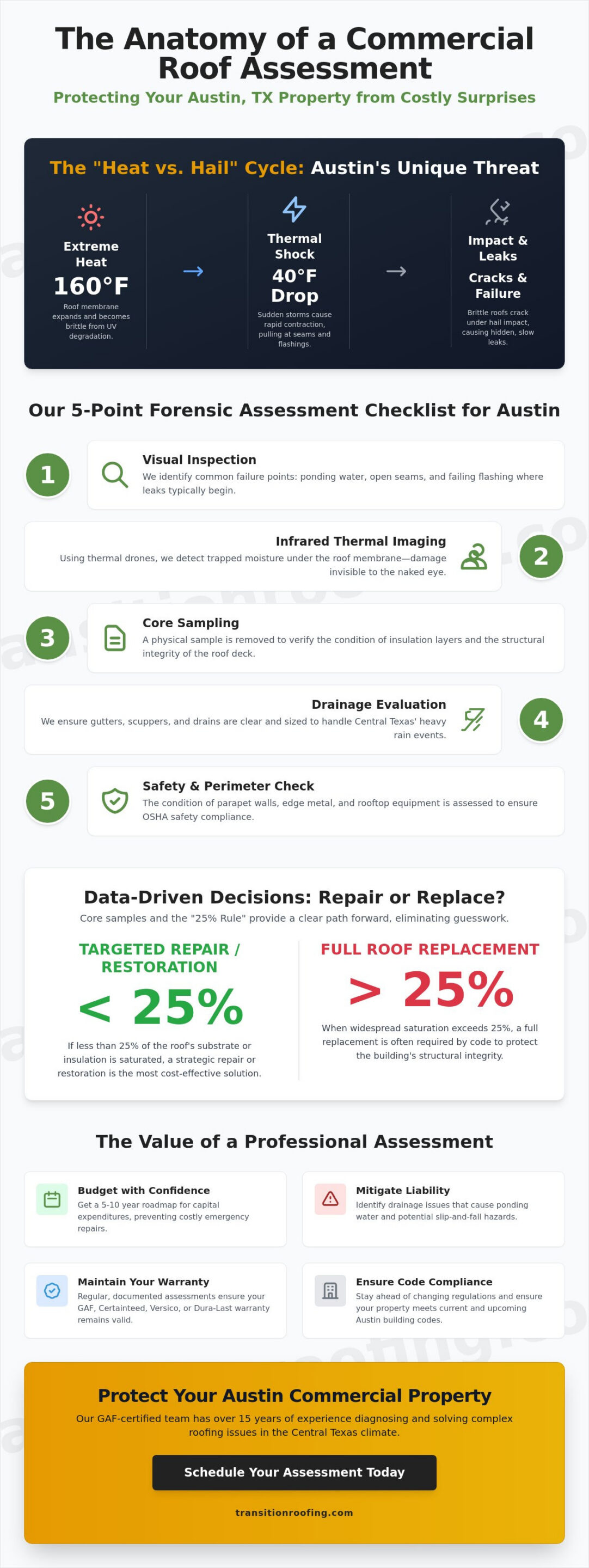
The “Heat vs. Hail” cycle in Austin is particularly destructive. During a typical summer, common commercial roof types experience thermal shock. The roof surface can reach 160 degrees before a sudden afternoon thunderstorm drops the temperature by 40 degrees in minutes. This rapid contraction causes membranes to pull away from flashings and seams. Over time, UV degradation makes these materials brittle. When the next major hail event hits, a flexible roof might bounce the impact, but a brittle, heat-damaged roof will crack, leading to hidden leaks that rot your decking for months before you notice them.
Financial Planning and Liability Mitigation
Budgeting for a major capital expenditure is easier when you have data. A documented assessment gives you a 5 to 10 year roadmap for repairs and replacement. This prevents the high cost of emergency repairs, which often run significantly higher than planned maintenance. Beyond the roof itself, these evaluations identify drainage issues that create ponding water. If left unaddressed, these areas can lead to structural sagging or even slip-and-fall liabilities if water drains onto pedestrian walkways. Regular documentation also protects your standing with manufacturers like GAF or Certainteed, ensuring your warranty remains valid when you need it most.
The 5-Point Checklist for a Commercial Roof Assessment in Austin, TX
A professional commercial roof assessment Austin follows a methodical protocol to ensure no vulnerability is overlooked. It isn’t enough to just walk the perimeter; we use a technical deep dive to verify the health of your entire system. We start with a visual inspection to look for ponding water, which is a common issue on older Austin buildings. We also check for open seams and flashing failures at the wall transitions where leaks usually begin. Second, we utilize thermal imaging. This infrared technology identifies trapped moisture beneath the membrane that the human eye simply cannot see.
Third, we perform core sampling. We remove a small physical section of the roof to check the insulation condition and deck integrity. Fourth, we conduct a drainage evaluation. We ensure gutters, scuppers, and drains are clear and properly sized for the heavy rain events common in the Central Texas climate. Finally, we finish with a safety and perimeter check. This includes assessing the condition of parapet walls and edge metal to ensure they meet OSHA safety standards. If you’re noticing signs of wear, we can take a look and give you a clear plan.
Advanced Diagnostic Tools for Modern Roofs
We often deploy thermal drones for larger properties. These drones find moisture that manual inspections might miss, especially in complex flat roofing systems. Identifying substrate saturation early prevents the need for a full deck replacement later. It’s a proactive way to maintain your asset without the guesswork of traditional methods.
Assessing Specific Commercial Materials
Every material has its own failure points. For TPO and PVC systems, we focus on seam integrity and puncture marks from wind-blown debris or hail. When inspecting metal roofing, we look for fasteners backing out and rust at the laps. Catching these small issues during an assessment prevents them from turning into major capital expenses next year.
Deciding to Repair or Replace After a Commercial Roof Assessment in Austin, TX
Once we complete a commercial roof assessment Austin, the gathered data dictates the next move. We follow the “25% Rule” to guide property managers through this decision. If repairs exceed 25% of the total roof area, or if thermal scans show moisture in more than a quarter of the insulation, a full replacement is usually the smarter investment. Constant patching on a failing system creates a cycle of unpredictable costs that often exceed the price of a new installation within a few years.
The decision also hinges on the “Remaining Service Life” (RSL). We determine this through the core samples and substrate analysis discussed in our checklist. If the core reveals a dry, intact deck, a restorative coating or targeted commercial roof repair might extend the life of the asset by five to seven years. However, if the insulation is saturated, the roof can’t insulate properly. This drives up cooling costs during the 100-degree Austin months. Your building’s specific use matters too. If you have a long-term tenant or sensitive inventory, the risk of a leak outweighs the small savings of a patch. If you aren’t sure where your property stands, schedule a professional assessment with our team today.
When a Professional Repair Makes Sense
Repairs are ideal for isolated issues. This includes mechanical damage from HVAC technicians or localized flashing leaks around a single scupper. For property managers overseeing multiple buildings in Central Texas, we use assessments to rank repairs by urgency. This allows you to fix the critical leaks now while budgeting for larger projects in the future. It’s about maintaining the integrity of the system without overspending on healthy sections.
The Case for Full Roof Replacement
Systemic failure leaves you with few options. If you see widespread seam failure or multiple previous repair attempts have failed, it’s time for a new system. Modern TPO installations act as Cool Roofs, reflecting UV rays and significantly lowering the interior temperature of your building. In the harsh Austin, TX summers, this energy efficiency can pay for a portion of the roof over its lifespan while ensuring total security for your tenants.
Why Transition Roofing is the Standard for a Commercial Roof Assessment in Austin, TX
Experience matters when your capital budget is on the line. We’ve spent over 15 years mastering the commercial roofing Austin market, helping property managers protect their structural assets. Our team holds elite certifications from GAF, Certainteed, and Versico. These aren’t just badges; they represent our technical proficiency in conducting high-level assessments that prioritize your long-term interests and keep your warranties intact.
We believe in total transparency. Every commercial roof assessment Austin we perform results in a detailed, documented report. You’ll receive clear photo documentation of every deficiency found, from seam separations to substrate saturation. We don’t just tell you there’s a problem; we show you the evidence and provide a methodical action plan. This level of detail is essential for navigating insurance claims or justifying maintenance budgets to property owners.
Our support doesn’t end with the report. If we find storm damage, we assist with insurance navigation to ensure your claim is handled fairly and accurately. Whether you need a minor Austin roof repair or a complete system replacement, we guide you through the implementation phase with a steady, reliable approach that minimizes tenant disruption.
Integrity and Long-Term Protection
We strictly avoid high-pressure sales tactics. Instead, we rely on “contractor logic” to find the most cost-effective solution for your specific building. We’re neighborly experts who understand the Central Texas business community and the unique environmental stressors of our local climate. Our goal is to move your structure from a state of vulnerability to one of total security through honest, expert advice.
Get a Clear Plan for Your Commercial Property
Uncertainty is the biggest risk to your property’s value. A professional assessment eliminates the guesswork and gives you a predictable timeline for your asset’s maintenance. If you’re managing a property and aren’t sure about your roof’s health, we can take a look and give you a clear plan. Schedule a roof inspection in Austin today to protect your investment and gain peace of mind for the next decade.
Secure Your Commercial Investment with Professional Data
Protecting your commercial property in Central Texas requires moving beyond reactive maintenance. A comprehensive commercial roof assessment Austin provides the documentation you need to manage your capital budget and avoid the stress of high-cost emergency repairs. By identifying hidden moisture and structural vulnerabilities now, you ensure your building remains a secure asset rather than a liability during the next major storm cycle.
Our team brings over 15 years of local experience to every project. As certified GAF and Certainteed installers, we provide the technical precision required for complex modern roofing systems. Every evaluation includes a comprehensive digital report with photo documentation, giving you a clear roadmap for your property’s health over the next 5 to 10 years. Don’t let unpredictable weather dictate your maintenance schedule or tenant satisfaction.
Schedule your commercial roof assessment in Austin today to get a clear plan for your property. We’re ready to help you move your structure from a state of vulnerability to one of total security with a steady, reliable approach you can trust.
Frequently Asked Questions
How much does a commercial roof assessment cost in Austin, TX?
The cost for a forensic evaluation depends on the square footage, building height, and the specific diagnostic tools required for your property. A simple visual check is different from a deep dive that uses infrared drones or core sampling. You should view this as a preventative investment. Identifying a small seam failure now prevents a total inventory loss during a Central Texas downpour. We always provide a clear scope of work before starting any evaluation.
How often should I have my commercial roof assessed?
Property managers should schedule a professional evaluation twice a year to stay ahead of the Central Texas climate. We recommend a check in the spring to identify damage from winter storms and another in the fall to assess UV degradation after the summer heat. This schedule keeps you compliant with most manufacturer warranties from GAF or Certainteed. Regular checks also ensure your drainage systems remain clear before the rainy season begins.
What is the difference between a roof inspection and a roof assessment?
A standard inspection is usually a visual walk-through to find active leaks, while a commercial roof assessment Austin is a forensic study of the system’s life expectancy. Assessments use technical tools like thermal imaging and core samples to find hidden moisture that isn’t visible on the surface. This process gives you a documented report of the roof’s remaining service life, which is essential for long-term budget predictability and insurance compliance.
Can a roof assessment help with my insurance claim after a hail storm?
Documented assessments are your strongest tool when navigating an insurance claim after an Austin hail storm. They provide a clear record of the roof’s condition before the storm hit. This prevents adjusters from claiming the damage was pre-existing. Having a professional report with photo evidence simplifies the process and helps ensure your claim covers the full scope of necessary repairs or replacement.
What happens if the assessment finds moisture under the roof membrane?
Finding moisture beneath the membrane indicates that the insulation is saturated and can no longer protect your building. If the saturation is localized, we can often perform a targeted repair to remove the wet material and patch the area. However, if the moisture is widespread, it may trigger the 25% rule where a full replacement becomes necessary. Leaving trapped moisture alone leads to deck rot and significantly higher energy costs.