
Your roof doesn’t just need to look good; it has to survive a climate that’s actively trying to destroy it. Between the 105 degree summer heat waves and the increasing frequency of severe storms, Central Texas homeowners are facing a triple threat that standard shingles simply can’t handle. You’re likely tired of watching your insurance premiums climb after every hail season or dreading your electric bill when the sun starts baking your attic.
Many neighbors ask us, what roofing material is best for Austin heat hail and wildfire-prone WUI areas? especially as wildfire risks in the Wildland-Urban Interface become a growing concern for local properties. With over 15 years of experience installing high-performance systems in Austin, we’ve identified the specific materials that provide long-term protection and peace of mind. Discover the most durable roofing systems designed to withstand Central Texas’s extreme triple threat: scorching UV rays, baseball-sized hail, and wildfire risks. We’ll break down the performance of metal, synthetic, and Class 4 shingles to help you secure your home against the next big storm.
Key Takeaways
- Understand why standard roofing fails in the Wildland-Urban Interface (WUI) and how to protect your home from Austin’s unique “triple threat” of heat, hail, and fire.
- Compare top-tier options to determine what roofing material is best for Austin heat hail and wildfire-prone WUI areas?—from standing seam metal to Class 4 impact-resistant shingles.
- Learn why your choice of underlayment and ember-resistant venting is just as critical as the surface material for surviving a Central Texas wildfire.
- Discover how to calculate the true cost of ownership and see how a heat-reflective roof can significantly lower your Austin Energy bills over the next 30 years.
What Roofing Material is Best for Austin Heat, Hail, and Wildfire-Prone WUI Areas?
The Triple Threat: Why Austin TX Roofs Face Heat, Hail, and Wildfire Risks
Choosing a new roof in Central Texas is a major decision that goes beyond simple aesthetics. Many homeowners ask what roofing material is best for Austin heat hail and wildfire-prone WUI areas because our local climate is uniquely aggressive toward traditional building products. At Transition Roofing, we’ve spent over 15 years installing commercially available roofing materials that can stand up to the specific stressors of the Hill Country. A standard shingle roof often fails here because it isn’t designed to handle 105-degree afternoons followed by rapid cooling during a thunderstorm.
To better understand this concept, watch this helpful video:
Understanding the WUI Challenge in Central Texas
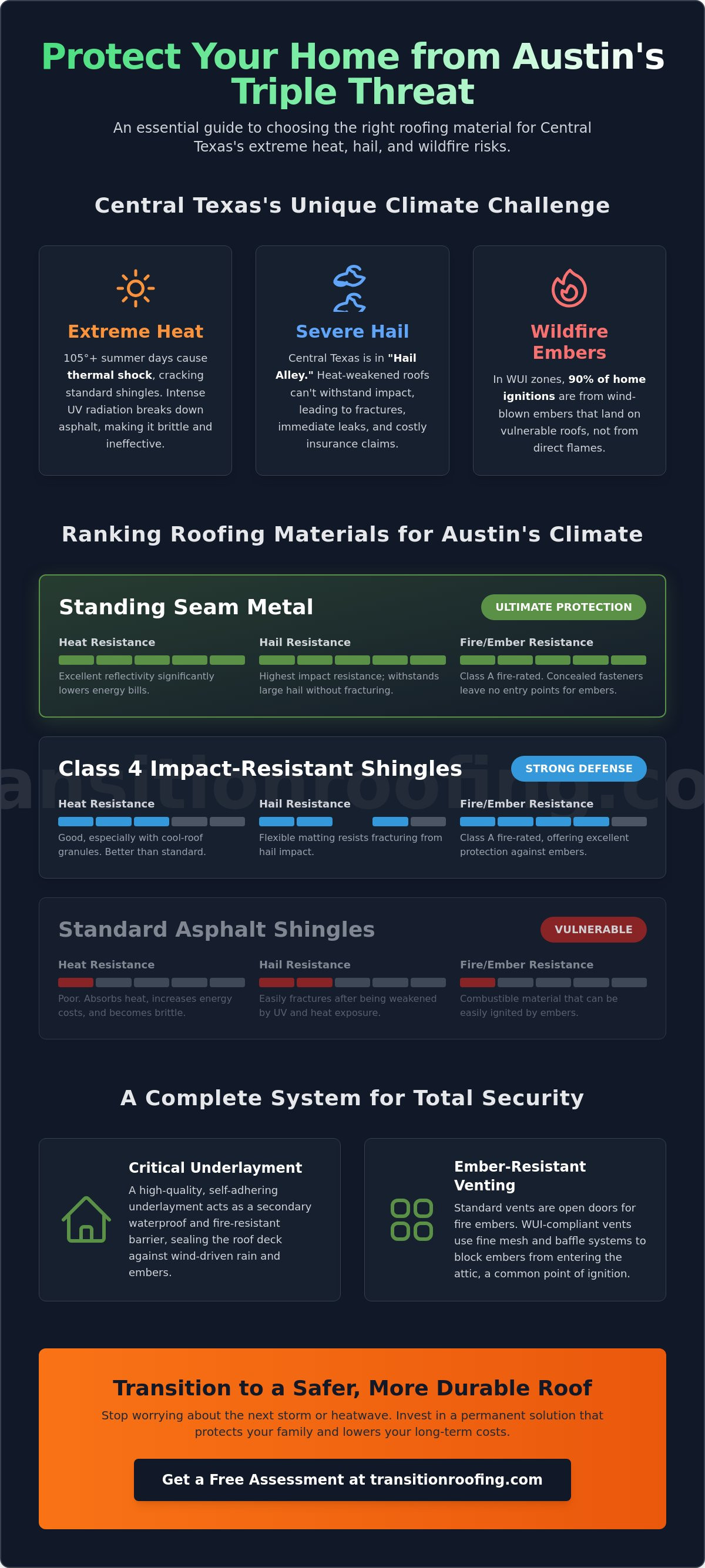
The Wildland-Urban Interface (WUI) describes areas where residential developments meet undeveloped land. In Austin TX, this includes high-risk zones like Lakeway, Bee Cave, and the Barton Creek corridor. Wildfire risk in these areas is rarely about a wall of flames hitting your house. Instead, wind-blown embers cause 90% of home ignitions during a fire event. These embers can travel over a mile and land directly on your roof. If your roofing material isn’t fire-rated, or if the roof deck isn’t properly sealed, your home becomes vulnerable from the top down. We focus on systems that act as a hardened shield against these airborne threats.
Hail and Heat: The One-Two Punch for Austin TX Properties
Central Texas sits firmly in “Hail Alley,” a region that leads the nation in billion-dollar storm damage. In 2023 alone, Texas saw record-breaking hail events that totaled billions in insured losses. The problem is compounded by our extreme heat. Most standard asphalt shingles become brittle after just three or four Austin TX summers. When 100-degree days are followed by a cold rain, the material experiences thermal shock, which causes it to expand and contract too quickly. UV radiation breaks down the molecular bonds in the asphalt, causing the oils to evaporate and the material to lose its flexibility. When hail eventually hits that sun-baked, softened asphalt, it doesn’t just bounce off; it fractures the matting and creates immediate leak points.
Evaluating What Roofing Material is Best for Austin Heat, Hail, and Wildfire-Prone WUI Areas
If you’re seeing granule loss in your gutters or noticing cracked shingles, your roof is likely losing its battle with the elements. We don’t believe in “one size fits all” solutions. Instead, we look at the specific orientation of your home and its proximity to brush lines. This is usually when we recommend a thorough assessment to see if your current system is still providing the security your family needs. If you’re dealing with storm damage or high energy bills, we can take a look and give you a clear plan for a more durable transition.
Ranking the Best Roofing Materials for Austin TX Weather and WUI Safety
Selecting the right protection requires a deep understanding of how different materials handle the unique Central Texas climate. When homeowners ask what roofing material is best for Austin heat hail and wildfire-prone WUI areas?, the answer usually starts with metal or high-impact shingles. We’ve spent over 15 years installing these systems across Travis County, and the data shows that certain materials provide a much higher return on safety and durability. Our focus is on transitioning your home from a vulnerable state to one of total security.
Standing Seam Metal: Austin TX’s Ultimate Protector
Standing seam metal is the gold standard for fire and heat reflection. Unlike corrugated metal, standing seam features vertical ribs that conceal fasteners. This design is critical for WUI safety because it leaves no exposed gaps where wind-blown embers can lodge. This follows Ready.gov wildfire preparedness standards for home hardening. These roofs also feature high thermal emissivity. Cool-roof coatings reflect up to 85% of solar radiation, which helps keep your attic temperatures stable and slashes AC costs during 100-degree Austin TX summers. While traditional shingles typically last about 20 years, a metal system provides 50 years of proven protection.
Class 4 IR Shingles: Austin TX Durability on a Budget
Class 4 impact-resistant (IR) shingles offer a cost-effective hail shield for the local climate. These products must pass the UL 2218 test, where a 2-inch steel ball is dropped twice on the same spot from 20 feet without cracking the shingle backing. If you’re seeing small granules in your gutters after a storm, it’s usually when we recommend upgrading to GAF or CertainTeed IR lines. Austin TX homeowners often qualify for insurance premium discounts of 10% to 25% by installing these systems. They provide a high-level fire rating while maintaining the traditional look of a shingled roof.
Stone-Coated Steel: The Austin TX Hybrid Solution
Stone-coated steel is a hybrid solution that combines the aesthetic of tile with the impact resistance of steel. It’s an excellent choice for older Austin TX homes that weren’t built to support the 1,000-pound per square weight of traditional clay. This material is lightweight, carries a Class A fire rating, and won’t crack during a freeze-thaw cycle. You can find more technical details in our metal roofing Austin guide for deep material specs.
Concrete and clay tiles remain popular for their natural fire resistance and high thermal mass. These materials absorb heat during the day and release it slowly at night, which helps manage indoor temperatures. However, modern synthetic composites are also gaining ground because they mimic the look of slate or wood shakes while meeting strict WUI performance codes. If you’re dealing with an aging roof and need to know which of these fits your budget, we can take a look and give you a clear plan.
Beyond the Material: Installation Standards for Austin TX WUI Compliance
Choosing a high-quality shingle or metal panel is only half the battle. When homeowners ask what roofing material is best for Austin heat hail and wildfire-prone WUI areas, they often overlook the components hidden beneath the surface. In Wildland-Urban Interface (WUI) zones, the installation method is just as critical as the material itself. A roof is a system, and any gap or weak link can lead to total loss during a Central Texas wildfire or a severe spring storm.
We bring over 15 years of experience to every project, ensuring that your roof meets the strictest safety standards. We focus on sealing the “envelope” of your home. This means using specific components that many standard contractors ignore. Our status as certified GAF and Versico installers allows us to provide specialized WUI-compliant systems that offer long-term protection and peace of mind.
Ventilation: Solving the Heat and Fire Paradox in Austin TX
Austin attics can easily reach 150 degrees during July and August. Proper ventilation is mandatory to prevent your shingles from “cooking” and to keep your energy bills low. However, traditional ridge vents often have large openings that act as an invitation for wind-blown embers. The chimney effect occurs when hot air rises and creates a suction that pulls in air from lower vents; if that air contains embers, your attic can ignite from the inside out.
- O’Hagin Style Vents: These low-profile vents are designed specifically for fire-prone areas. They use a series of internal baffles to allow air out while blocking 97 percent of ember intrusion.
- Ember-Resistant Mesh: We install secondary mesh screens over all intake points to ensure your attic breathes without becoming a fire hazard.
- System Balance: We calculate the exact net free vent area to ensure your roof lasts its full 30 to 50-year lifespan.
Underlayment and Decking: The Hidden Fire Barrier
Traditional felt paper is essentially paper soaked in oil. It’s highly flammable and brittle. For Austin TX homes in high-risk areas, we replace traditional felt with synthetic fire-shields. A Class A fire-rated assembly requires the underlayment and the surface material to work together to stop flame spread. This is usually when we recommend a full system audit before choosing a material to ensure your roof deck is prepared for these heavier, high-performance shields.
We frequently use GAF Deck-Armor or similar breathable synthetic underlayments. These products are non-combustible and provide an extra layer of moisture protection during heavy Austin thunderstorms. We also pay close attention to the perimeter. Installing a heavy-gauge drip edge and “bird stops” on tile roofs prevents embers and debris from collecting in the gaps between the roof and the fascia. If you’re concerned about your home’s vulnerability, schedule a roof inspection in Austin today to ensure your system meets current safety codes.
Making the Right Investment: Cost vs. Longevity for Austin TX Property Owners
Choosing what roofing material is best for Austin heat hail and wildfire-prone WUI areas is a financial decision as much as a safety one. In Central Texas, a roof is a 30-year investment that must withstand extreme thermal expansion and contraction. We calculate the Total Cost of Ownership (TCO) by looking at the initial price plus the cost of maintenance and energy over three decades. A standard shingle roof might seem affordable now, but it often requires replacement every 12 to 15 years due to UV degradation. Metal or Class 4 systems can last 40 years or more, effectively cutting your long-term costs in half.
Energy efficiency is a major factor in your ROI. Heat-reflective roofing, often called “cool roofs,” can lower attic temperatures by 30 to 50 degrees during a typical July afternoon. For Austin Energy customers, this high-performance choice can reduce monthly cooling bills by 10% to 15%. When storms hit, we help you decide between a targeted Austin roof repair or a full replacement. If hail damage affects more than 25% of the roof surface, or if the system is over 15 years old, a full transition to a more durable material is usually the smartest move for your property’s integrity.
Insurance and Resale Value in Austin TX
Installing a Class 4 impact-resistant roof significantly increases your home’s appraisal value. Most Texas insurance carriers offer premium discounts ranging from 20% to 30% for these materials. We’ve spent over 15 years navigating the Texas insurance claim process. Local expertise is vital here because “storm chasers” often miss the subtle structural issues that lead to leaks years later. We ensure your claim covers the high-quality materials required for WUI compliance and long-term protection.
Final Recommendation: The Transition Plan
The best choice depends on your specific goals and budget tiers:
- Budget-Conscious: Class 4 Impact-Resistant Shingles. These provide excellent hail protection and insurance discounts at a lower entry price.
- Maximum Longevity: Standing Seam Metal. This is the gold standard for resisting heat, fire, and wind.
- WUI High-Risk: Metal or Stone-Coated Steel. These materials provide the highest fire-resistance ratings for homes near greenbelts.
Regular maintenance is essential to preserve these ratings and ensure your warranty remains valid. If you’re dealing with a high-risk property in a WUI zone, we can take a look and give you a clear plan. Schedule a roof inspection in Austin today to secure your home for the next 30 years.
Beyond roofing, if you are looking to enhance your property with a premium outdoor living space, visit BigDecks to explore high-end design and construction options in Austin.
Protect Your Investment with an Austin TX WUI-Compliant Roof
Choosing the right roof for Central Texas involves more than just picking a color. You need a system that stands up to triple digit temperatures, unpredictable hail storms, and the rising threat of wildfires in our local WUI zones. We’ve seen how high quality Class 4 impact resistant shingles and standing seam metal roofs provide the best defense for homes in this region. When you’re deciding What roofing material is best for Austin heat hail and wildfire-prone WUI areas?, remember that the installation quality determines if your protection actually holds up when it matters most.
With over 15 years of local experience, Transition Roofing brings the technical expertise of GAF Master Elite and CertainTeed Select ShingleMaster certifications to every project. We specialize in residential and commercial systems that meet strict WUI safety standards while lowering your long term maintenance costs. If you’re worried about how your current roof will handle the next storm season, we can take a look and give you a clear plan for your property.
Ready to secure your home? Schedule a comprehensive WUI-compliant roof inspection in Austin today to ensure your family stays safe and your property stays protected for years to come.
Frequently Asked Questions About What Roofing Material is Best for Austin Heat Hail and Wildfire-Prone WUI Areas in Austin TX
Does Austin TX require specific roofing materials for WUI zones?
Yes, the City of Austin adopted the International Wildland-Urban Interface (WUI) Code in 2020 to protect homes from increasing fire risks. If your property falls within a designated WUI zone, you’re required to use Class A fire-rated roof coverings for all new construction and certain roof replacements. We typically install standing seam metal or specialized asphalt shingles to meet these safety standards and ensure your home remains compliant with local building codes.
Is metal roofing noisier than shingles during a Texas hailstorm?
Metal roofing isn’t significantly noisier than shingles when it’s installed over a solid roof deck with high-quality underlayment. These layers act as a sound barrier that dampens the impact of rain and hail during a typical Austin TX storm. While an old barn roof might rattle, a modern residential metal system provides a quiet interior environment. You get the benefit of extreme durability without the loud noise levels people often expect from metal surfaces.
How much can I save on insurance with a Class 4 impact-resistant roof in Austin?
Homeowners in Central Texas often save between 10% and 25% on their annual insurance premiums by switching to a Class 4 impact-resistant roof. Most major Texas insurers offer these significant discounts because materials like 24-gauge metal or UL 2218 rated shingles drastically reduce the chance of a total loss claim. When you’re deciding what roofing material is best for Austin heat hail and wildfire-prone WUI areas, these long-term insurance savings help offset the initial installation costs.
What is the best color for a roof in Austin TX to reduce heat?
Light colors like white, tan, and light gray are the most effective at reflecting solar heat away from your home. These “cool roof” colors can keep your roof surface up to 50 degrees cooler than dark shingles during a 100-degree August afternoon. By reflecting UV rays instead of absorbing them, you reduce the workload on your HVAC system and prevent your roofing materials from becoming brittle due to constant thermal expansion and contraction.
Can a wildfire-resistant roof really save my home if a fire is nearby?
A Class A fire-rated roof is your best defense because wind-blown embers cause 90% of home ignitions during a wildfire. These embers can travel over a mile and ignite flammable materials like wood shakes or debris in your gutters. Non-combustible materials like metal or stone-coated steel don’t provide fuel for the fire. If you’re seeing smoke in the area, having a secure exterior gives local fire crews a much better chance of saving your property.
Do I need to replace my whole roof if only one side has hail damage?
We usually recommend a full replacement if the damage covers more than 25% of the roof or if the shingles are over 10 years old. Insurance companies in Austin TX often won’t pay for partial repairs because matching the color and integrity of aged shingles is nearly impossible. If you’re seeing dings on your gutters or soft spots on your shingles, we can take a look and give you a clear plan for a professional restoration.