
Last April, a North Austin property manager discovered that a small drain blockage had caused a massive interior flood after a standard Central Texas thunderstorm. This single oversight led to three days of halted business operations and an insurance claim that could have been avoided with a simple check. Many building owners ask us, how often should a commercial roof be inspected and maintained? It’s a vital question when you’re balancing a maintenance budget against the unpredictable Austin weather.
You likely already know that your roof is your building’s first line of defense against 100 degree heat and sudden spring hail. At Transition Roofing, we’ve spent over 15 years helping local businesses move from reactive repairs to total security. This guide shows you the ideal maintenance schedule to avoid costly emergencies and extend your system’s life by up to 8 years. We’ll preview the specific inspection cycles required for GAF and Versico warranties while giving you a clear plan to lower your total cost of ownership over the next 20 years.
Key Takeaways
- Learn why scheduling bi-annual service in early spring and late autumn is the best way to protect your Austin facility from Central Texas heat and hail.
- Discover the definitive answer to how often should a commercial roof be inspected and maintained to extend your system’s lifespan by up to 8 years.
- Identify the specific maintenance needs for TPO and metal roofs to prevent 100-degree temperatures from causing seam failures or fastener back-outs.
- Understand how a professional inspection of HVAC units and vents can stop leaks before they disrupt your business operations.
- See how switching from emergency repairs to a preventative care cycle creates budget predictability and long-term protection for your property.
Recommended Frequency for Commercial Roof Inspections in Austin, TX
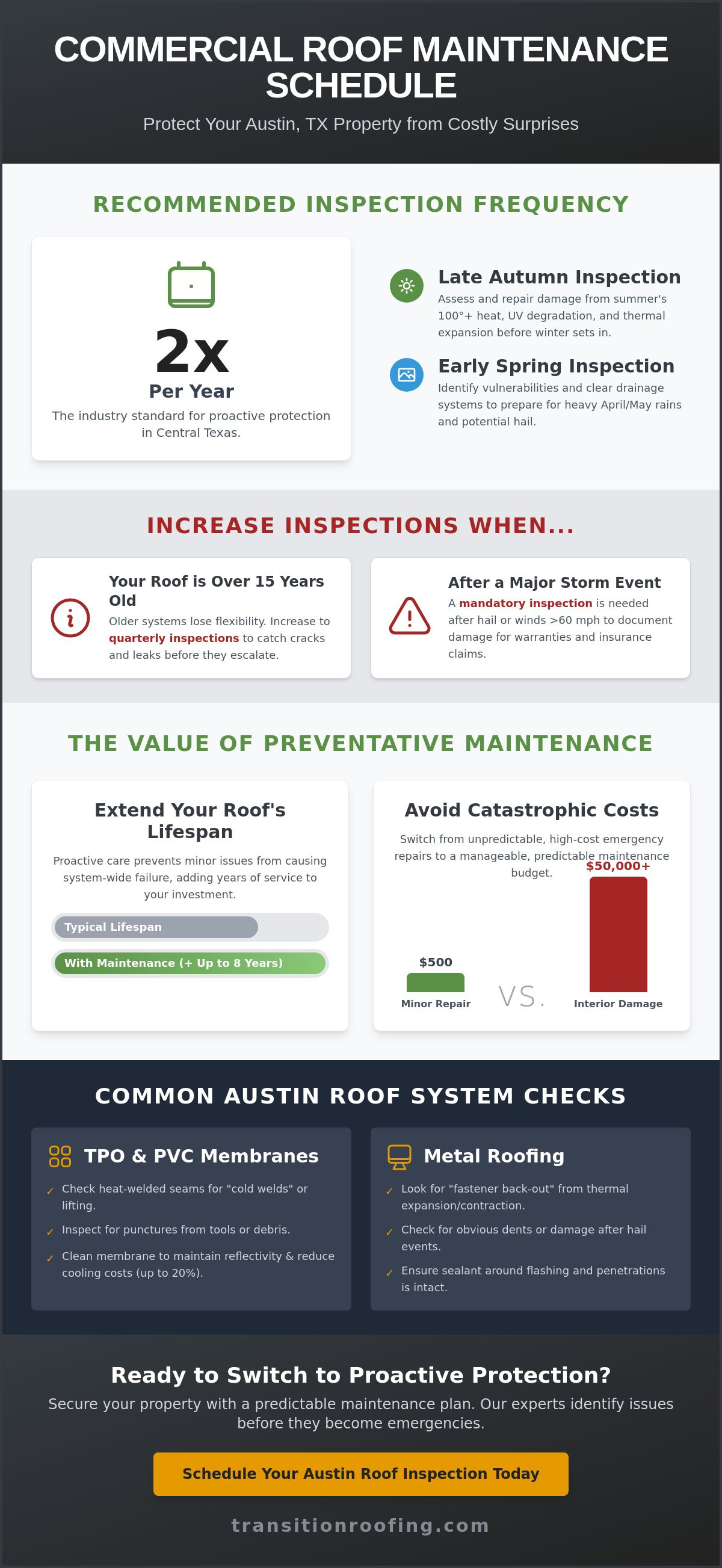
Property managers and business owners frequently ask us, how often should a commercial roof be inspected and maintained? to protect their assets. In Austin, the industry standard is twice per year. This bi-annual schedule allows us to catch minor wear before the extreme Texas seasons take hold. Understanding roofing materials and their durability helps us determine which specific components are most likely to fail during a summer heatwave or a spring storm.
To better understand this concept, watch this helpful video:
We follow a simple rule of contractor logic: it’s better to spend $500 on a minor seam repair today than $50,000 on interior damage restoration tomorrow. Once a roof passes its 15th year of service, we recommend increasing these check-ups to a quarterly frequency. Older systems lose their flexibility and become more prone to cracks and leaks under the pressure of 100-degree days and rapid temperature shifts.
Why Spring and Fall are Critical for Central Texas
Austin weather is notoriously hard on commercial buildings. We schedule spring inspections to identify vulnerabilities before the heavy April and May rain cycles begin. This allows us to clear drainage systems and ensure they can handle the intensity of a local flash flood. Autumn checks are equally vital. They help us assess UV degradation and damage from thermal expansion caused by the relentless Austin summer heat. If you’re seeing pooled water or clogged scuppers, this is usually when we recommend a professional clearing.
Post-Storm Inspections: The Non-Negotiable Step
If Austin TX experiences a hail event or wind gusts exceeding 60 mph, an immediate inspection is mandatory. Hail impacts TPO and metal roofing systems differently. While metal might show obvious dents, TPO can suffer from latent damage that isn’t visible from the ground. This damage often voids manufacturer warranties if it isn’t documented quickly. Transition Roofing uses a methodical process to document storm damage, ensuring you have the evidence needed for insurance claims.
How Often Should a Commercial Roof Be Inspected and Maintained?
For most Austin properties, the answer is every six months, plus after every major storm. This proactive approach ensures that your system reaches its full life expectancy, whether it’s a GAF TPO system or a custom metal roof. Regular maintenance is the only way to transition from a reactive “emergency” mindset to a controlled, long-term protection plan. If you’re dealing with concerns after a recent storm, we can take a look and give you a clear plan. Schedule a roof inspection in Austin today.
Maintenance Requirements for Common Austin Commercial Roof Systems
Property managers often ask, how often should a commercial roof be inspected and maintained to avoid costly emergency repairs? In Austin, TX, the answer depends heavily on your specific roofing material. Our 100-degree summers and sudden spring hailstorms stress different systems in unique ways. At Transition Roofing, we’ve spent over 15 years observing how these environmental shifts affect commercial membranes. If you’re seeing standing water or loose flashing, we can evaluate the damage and provide a steady plan for long-term protection.
TPO and PVC Membrane Care
Thermoplastic membranes like TPO and PVC are popular in Central Texas because they reflect solar heat. However, their performance relies entirely on the integrity of heat-welded seams. During an inspection, we check for “cold welds,” which are spots where the material didn’t properly fuse during installation. These spots often lift during high-wind events. It’s also critical to keep these membranes clean. A dirty white roof absorbs more heat, which can spike your Austin cooling costs by up to 20 percent. We also look for punctures caused by HVAC technicians dropping tools or wind-blown debris from seasonal storms.
Metal Roofing Maintenance in Central Texas
Metal roofs are durable, but they are prone to “fastener back-out.” This happens when the metal panels expand and contract during extreme day-to-night temperature swings, slowly unscrewing the bolts. We regularly tighten these fasteners and check the rubber washers to prevent leaks. It’s also vital to clear gutters and valleys of organic debris. When water traps form in these areas, they cause rust that can eat through the panels in just a few seasons. You can find more details in our guide to metal roofing Austin.
Flat Roofs and Modified Bitumen Systems
Flat roofs in Austin often struggle with ponding water. If water stays on the surface for more than 48 hours, it can degrade adhesives and cause structural sagging. We focus on clearing internal drainage lines that often get clogged with Texas cedar debris and silt. For Modified Bitumen roofs, we look for “alligatoring,” which is a pattern of deep cracks caused by intense UV exposure. This granule loss leaves the underlying asphalt vulnerable to the sun. As a Versico and GAF certified contractor, we recommend checking these systems twice a year to ensure the protective surface remains intact and secure.
What an Expert Commercial Roof Inspection Covers in Austin TX
Understanding how often should a commercial roof be inspected and maintained is only the first step; you also need to know what a professional assessment actually entails. At Transition Roofing, we use our 15 years of local experience to look past the surface. A standard inspection starts with a visual assessment of the entire roof field to identify thinning membranes or UV degradation caused by the 100-degree Central Texas sun. We also verify the security of wall flashing and counter-flashing, ensuring these metal components haven’t pulled away during high-wind events.
- Detailed examination of the roof membrane for punctures or physical wear.
- Security checks on all metal edge details and flashing points.
- Testing of sealants and adhesives for heat-related cracking or failure.
- Full photo documentation and reporting to maintain GAF, Versico, or Dura-last warranty compliance.
The Vulnerability of Roof Penetrations
Data shows that 90% of commercial leaks occur at penetrations rather than in the open roof field. This includes HVAC curbs, vent pipes, and electrical conduits. In Austin, the extreme temperature swings cause sealants and pitch pockets to dry out and crack. High-wind storms can also cause heavy HVAC units to shift, which often tears the surrounding membrane. We inspect every curb and pipe boot to ensure the seals remain flexible and watertight.
Managing Drainage and Ponding Water
Standing water is a primary cause of structural stress and membrane rot. We identify low spots where water pools and check that the internal slope is still effective. During the spring, Austin debris like oak tassels and cedar needles often clog scuppers and downspouts. We clear these pathways to ensure the system achieves zero ponding. If you see standing water 48 hours after rain, we can take a look and give you a clear plan. This proactive care is a vital part of how often should a commercial roof be inspected and maintained to avoid a full replacement.
If you are worried about hidden damage after the last round of hail or heavy rain, our team provides the clarity you need. Schedule a roof inspection in Austin today to ensure your property remains secure.
The Value of Preventative Maintenance Programs in Austin: How Often Should a Commercial Roof Be Inspected and Maintained?
Most commercial roofs in Central Texas fail prematurely because they’re managed through a neglect cycle. If you only call a contractor when a leak appears, you’re likely cutting your roof’s life short. When property managers ask us, “How often should a commercial roof be inspected and maintained?” we point to the data. Shifting from reactive repairs to a structured care cycle can extend a roof’s life from a 13-year average to 21 years or more. This proactive approach saves thousands in capital expenditures by avoiding early replacements.
A preventative program also offers budget predictability. Instead of facing five-figure emergency bills, you move to scheduled line-item maintenance. This creates a paper trail that’s vital for insurance peace of mind. Before the next Austin hail storm hits, having documented proof of maintenance ensures you’re ready for any claim. Manufacturers like GAF and Versico often require proof of “reasonable care” to honor their long-term warranties. Without these records, your coverage could be at risk.
Financial ROI of Proactive Care
A maintenance contract is a predictable investment that eliminates the shock of an emergency austin roof repair. Documented maintenance also increases the resale value of your commercial property. Buyers want to see that the building’s most expensive asset has been protected. Furthermore, a healthy roof impacts your building’s energy efficiency. When we keep your roof membrane in top shape, it reflects more heat and reduces the HVAC load during 100-degree Austin summers.
- Extends roof life by up to 60% compared to neglected systems.
- Maintains high solar reflectivity to lower cooling costs.
- Ensures compliance with GAF and Versico warranty clauses.
- Provides clear documentation for insurance adjusters after storm events.
Selecting a Partner with 15+ Years of Experience
Choosing a partner with over 15 years of experience matters because local expertise is the only way to combat the Central Texas climate. At Transition Roofing, our “Trusted Protector” philosophy focus on long-term security rather than quick fixes. We hold certifications from GAF and Dura-last, ensuring your property is handled by experts who understand regional weather patterns. We don’t just look for leaks; we identify the small weaknesses that lead to major failures.
If you’re seeing signs of wear or haven’t had a professional on your roof this year, we can take a look and give you a clear plan. Schedule a commercial roof inspection in Austin today to secure your property and extend the life of your investment.
Protect Your Austin Property With Proactive Maintenance
Determining how often should a commercial roof be inspected and maintained is the first step toward avoiding costly business interruptions. In Austin, the combination of 100 degree summer days and sudden spring hailstorms means a standard once a year check isn’t enough. We recommend a twice-yearly schedule to ensure your roof system survives the Central Texas climate. This consistency can extend the life of your commercial roof by 5 to 10 years while keeping your manufacturer warranties in good standing.
Transition Roofing brings over 15 years of local experience to every project. We’re certified by industry leaders like GAF, Certainteed, and Versico, which means we know exactly what to look for during a professional assessment. We focus on transitioning your roof from a source of stress to a reliable asset. If you’re seeing signs of wear or haven’t had a checkup since the last major storm, we can provide a detailed evaluation of your property’s condition. Schedule a professional commercial roof inspection in Austin today to secure your building’s future. Our team is ready to help you maintain a safe and durable workspace for years to come.
Frequently Asked Questions About Commercial Roofing in Austin TX
How much does a commercial roof inspection cost in Austin TX?
A professional commercial roof inspection in Austin TX typically costs between $500 and $1,500 for buildings under 20,000 square feet. Larger industrial facilities or multi-building complexes may see fees ranging from $2,000 to $4,000 depending on the complexity. These costs cover a comprehensive thermal scan and a detailed report on the membrane condition. Investing in this service helps you avoid the $50,000 emergency repair bills that often hit unprepared property owners in Central Texas.
Will regular maintenance help with insurance claims after Austin TX hail storms?
Yes, having a documented maintenance history is the most effective way to ensure your insurance claim is approved after a storm. Carriers often try to deny claims by citing “pre-existing wear” or “lack of upkeep.” When you provide biannual reports from the last 3 years, you prove the roof was in good health before the hail hit. This clear paper trail protects your investment and makes the adjuster’s job straightforward, leading to faster payouts.
Should I choose maintenance or a full replacement for my flat roof in Austin TX?
You should opt for a full replacement if more than 25% of your roof’s insulation is saturated with moisture. If the issues are limited to minor seam separations or localized punctures, routine maintenance and targeted repairs are the better financial choice. Property owners often ask how often should a commercial roof be inspected and maintained to avoid this expensive crossroad. Catching a small leak early prevents it from spreading through the entire substrate and forcing a premature replacement.
Can my own maintenance staff inspect our commercial roof in Austin TX?
While your staff can clear debris from drains, they usually lack the infrared technology and technical training needed for a structural assessment. Professional contractors carry certifications from GAF, Versico, and Carlisle that require specialized knowledge of membrane chemistry and wind uplift ratings. We’ve spent over 15 years spotting microscopic failures that untrained eyes miss. Relying on a certified expert also ensures your manufacturer’s warranty remains valid, as many require professional inspections to stay in force.
What is the most common cause of commercial roof failure in Austin TX?
Thermal shock caused by the intense Austin TX sun is the primary cause of roof failure in Central Texas. Roof surface temperatures can reach 160 degrees in the afternoon before dropping 40 degrees during a sudden thunderstorm. This rapid change causes the roof to expand and contract violently, which eventually cracks the flashings and pops the seams. Over 70% of the leaks we repair are a direct result of this environmental stress on the roofing system.
How long does a typical commercial roof inspection take in Austin TX?
A standard inspection for a 15,000 square foot building in Austin TX generally takes between 2 and 4 hours to complete. Larger retail centers or high-rise buildings may require a full 8 hour day to document every penetration and drainage point. We take the time to walk every square foot because a rushed inspection leads to missed defects. If you’re wondering how often should a commercial roof be inspected and maintained, we recommend a thorough check twice a year to stay ahead of the Texas weather. Schedule a roof inspection in Austin today to get a clear plan for your property.