
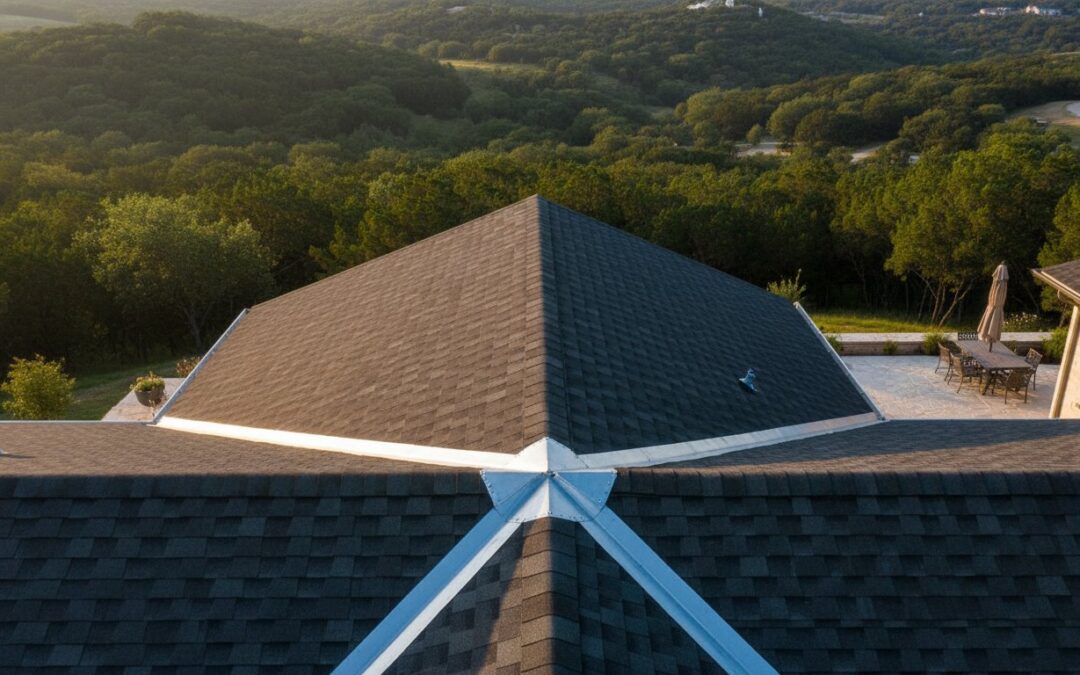
Last April, a homeowner in West Lake Hills watched as a sudden afternoon thunderstorm turned a minor valley leak into a $12,000 restoration project. It’s a common story in Central Texas where 105-degree heat and volatile spring weather test every seam of your home. You likely already know that a standard roof replacement isn’t just about shingles; it’s about the vulnerable points where different planes meet. Finding the right Tips for Transition Roofing success is essential because these areas are where most local roofs fail, often due to improper flashing or a misunderstanding of how Texas heat expands metal components.
We believe your home deserves a defense that lasts for decades, not just until the next season. This guide shares the expert knowledge required to ensure your property remains watertight and secure against the elements. You’ll learn how to navigate technical requirements like ice and water shield placement and why specific heavy-gauge flashing is non-negotiable for Austin homes. We’ll walk you through the exact steps to achieve a leak-free transition that stands up to the most unpredictable weather patterns in the Hill Country, giving you total confidence in your roofing investment.
Key Takeaways
- Identify why roof transitions are the most vulnerable points for leaks and learn how to protect these critical intersections on your Austin home.
- Discover the technical standards for watertight integrity, from selecting high-quality galvanized flashing to implementing high-temperature protective shields.
- Gain professional Tips for Transition Roofing success by understanding how Austin’s extreme heat and humidity cause thermal expansion and impact sealant longevity.
- Avoid common installation pitfalls, such as relying on temporary sealants or using improper valley flashing that restricts debris flow in wooded neighborhoods.
- Learn how a methodical “Success Roadmap” ensures your roofing project moves from a state of vulnerability to total long-term security and peace of mind.
Understanding the Critical Role of Roof Transitions in Your Home
A roof transition occurs at the intersection of two different roof planes, materials, or slopes. These junctions are the most vulnerable areas for leaks in Austin homes because they disrupt the uniform flow of water. Whether your home features a combination of metal and shingles or a porch that meets a steep gable, these points require specialized attention. Our “Transition” philosophy focuses on moving your home from a state of vulnerability to total structural security. We believe that a roof is only as strong as its weakest seam. Identifying common transition types, such as steep-to-low slope changes, roof-to-wall junctions, and dormer intersections, is the first step toward long-term protection. Understanding these Tips for Transition Roofing success helps homeowners prioritize the right repairs before a minor drip becomes a major restoration project.
Why Transitions are the #1 Leak Point in Central Texas
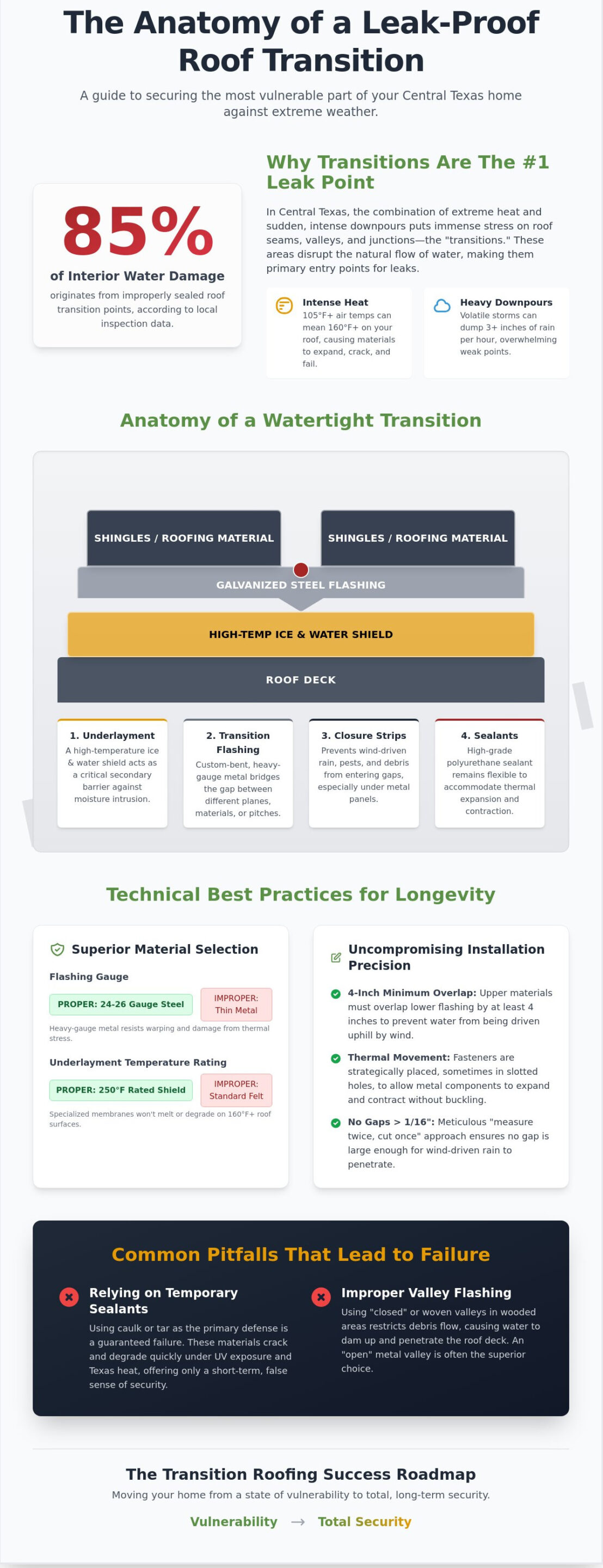
Water naturally funnels toward seams and valleys during heavy Austin downpours, which can dump 3 inches of rain in a single hour. Gravity and surface tension work together to pull moisture into pitch breaks where the roof’s angle changes. Standard shingle application often fails at these complex junctions because shingles are designed for shedding water on a continuous slope, not for sealing horizontal gaps. Statistics from local inspections show that approximately 85% of interior water damage stems from failure at these specific transition points. When wind-driven rain hits a wall-to-roof junction at 40 miles per hour, only a mechanical seal can prevent infiltration.
The Anatomy of a Successful Transition
Building a watertight junction requires a precise combination of underlayment, transition flashing, sealants, and closure strips. We follow the “shingle fashion” layering principle, which means every layer overlaps the one below it to shed water effectively. Understanding Roof Flashing is essential for any homeowner because this metal barrier provides the primary defense against moisture intrusion at seams. Integrating these components correctly is one of the top Tips for Transition Roofing success for maintaining property value. A pitch break is the horizontal line where a roof’s slope changes degree. Ensuring this line is sealed prevents the backflow of water during the high-wind storms common in Central Texas.
- Underlayment: High-temperature ice and water shields provide a secondary backup.
- Transition Flashing: Custom-bent metal bridges the gap between different pitches.
- Closure Strips: These prevent pests and wind-blown debris from entering the gap.
- Sealants: High-grade polyurethanes maintain flexibility during 100-degree Austin summers.
Technical Best Practices for a Watertight Roof Transition
Achieving a leak-free home starts with the right materials. We prioritize heavy-duty 24 or 26-gauge galvanized steel or aluminum for all transition points. These metals withstand the 100-degree Austin summers without warping or losing their shape. These are essential Tips for Transition Roofing success because cheap, thin-gauge materials fail under thermal stress. Underneath that metal, we always install a high-temperature ice and water shield. In Central Texas, roof temperatures often exceed 160 degrees. Standard underlayment can melt or degrade at these levels, so we use membranes rated for 250 degrees to ensure a permanent seal.
Precision is the difference between a dry attic and a costly repair. We follow the “measure twice, cut once” rule for every piece of custom-bent transition trim. A gap as small as 1/16 of an inch allows wind-driven rain to penetrate during a heavy downpour. Fastening patterns also require careful planning. We utilize slotted holes or specific spacing to allow the metal to expand and contract. Without this room to move, fasteners can back out or the metal can buckle over time, creating entry points for moisture.
Mastering Transition Flashing and Pitch Breaks
When a roof moves from a steep pitch to a lower one, water flow must remain uninterrupted. We align the low-to-high transition trim so the upper material overlaps the lower flashing by at least 4 inches. To stop rain from blowing upward under metal panels, we install form-fitting foam closures. These provide a physical block against the 60 mph gusts common during local spring storms. Follow this underlayment checklist for pitch changes:
- Overlap the membrane by 12 inches across the break point.
- Apply a bead of high-grade sealant at the primary seam.
- Ensure the underlayment extends 6 inches up any adjacent vertical walls.
Managing Dissimilar Material Joins
Many homes in Lakeway and Bee Cave feature a mix of metal accents and asphalt shingles. This combination requires extra attention to chemical compatibility. Some oil-based sealants react poorly with specific shingle granules, leading to premature failure within 24 to 36 months. We use polyether or silicone-based sealants that maintain flexibility and adhesion regardless of the substrate. These Tips for Transition Roofing success help prevent the common leaks seen in mixed-material designs.
When joining different metals, we install a transitional barrier, such as a rubberized membrane, to prevent galvanic corrosion. This chemical reaction occurs when two reactive metals touch, leading to rust and holes in as little as 5 years. If you’re concerned about how your different roof sections interact, our team can provide a professional inspection to verify your home’s integrity. Using the right barrier ensures that your roof remains secure and functional for its entire expected lifespan.
Navigating Austin’s Climate: Local Tips for Roof Longevity
Central Texas weather presents a unique set of challenges that standard national roofing guides rarely address. In Austin, we experience rapid temperature swings that can exceed 40 degrees in less than twelve hours. These shifts put immense strain on every component of your home. Following specific Tips for Transition Roofing success requires a focus on local environmental factors rather than generic checklists. National advice often ignores the specific way 105°F heat interacts with the high humidity found near Lake Travis or the Colorado River.
Managing Thermal Expansion in the Texas Heat
Heat is the primary enemy of structural integrity in Austin. When temperatures consistently hit triple digits, roofing materials expand at different rates. Rigidly fastening these transition areas is a common mistake that leads to “oil canning” or fasteners backing out of the decking. “In Austin, a roof can expand by up to half an inch in a single summer afternoon, putting immense pressure on transition seams.”
To ensure your roof remains secure, we implement these strategies:
- Slotted Fastening: Using slotted holes in metal transitions allows the material to slide during peak heat hours.
- Expansion Joints: We install expansion joints in runs exceeding 30 feet to prevent buckling.
- High-Grade Sealants: We use solvent-based sealants that maintain a 25% movement capability, preventing cracks when the roof cools at night.
Hail Resistance and Transition Integrity
Homeowners in Round Rock and Pflugerville are no strangers to large-diameter hail. When stones exceeding 1.5 inches strike a roof, the damage isn’t always visible from the ground. Dented flashing is particularly dangerous because it creates small basins that trap water against the house. This standing water accelerates rust and eventually bypasses the underlayment.
We recommend Class 4 impact-resistant materials for all Central Texas homes to mitigate this risk. These materials are tested to withstand 2-inch steel balls dropped from 20 feet, simulating the most severe storms. Our team specializes in identifying “hidden” hail damage at complex junctions. We look for hairline fractures in sealants and structural wood rot that occurs when moisture seeps through compromised metal-to-shingle transitions.
For those living near the water, humidity levels often stay above 65%. This constant moisture weakens standard sealants and can lead to premature wood decay if the transition isn’t perfectly sealed. Applying these Tips for Transition Roofing success ensures your property stays dry regardless of the humidity or the intensity of the next summer storm. We prioritize heavy-gauge metals and reinforced underlayments to provide the long-term protection your family deserves.
Common Pitfalls to Avoid During Roof Installation and Repair
Mistakes during the transition phase often stem from a desire for quick fixes. One of the most frequent errors we see is the “caulk-only” approach. Sealant should serve as a secondary defense, not the primary water barrier. When a contractor relies solely on a bead of caulk to bridge a gap, they’re setting the homeowner up for failure. In Austin, temperature swings cause materials to expand and contract; this movement inevitably pulls caulk away from the surface within 12 to 18 months.
In wooded neighborhoods like Rollingwood, improper valley flashing creates a hidden trap. Flashing that restricts debris flow allows leaves and twigs to accumulate. This organic matter holds moisture against the roof, rotting the underlayment over time. Proper installation ensures a clear path for runoff. Ignoring the transition between the roof deck and vertical structures like chimneys or HVAC units is another critical risk. These points require custom-bent metal flashing to remain secure. Following professional Tips for Transition Roofing success means recognizing when a specialized hand is required to maintain long-term protection. Homeowners often attempt DIY repairs in these areas, but doing so typically voids manufacturer warranties from major brands like GAF or Owens Corning, which require certified installation to remain valid.
These principles of avoiding common pitfalls by hiring experienced professionals are universal. For homeowners seeking examples of companies that specialize in high-quality flat and pitched roof solutions, even if located elsewhere, firms like I R. Wilson Roofing demonstrate the level of expertise required for long-term success.
The Dangers of Improper Sealants and Closure Strips
Cheap sealants don’t stand a chance against the 105-degree Texas sun. UV radiation breaks down standard polymers, causing them to crack and flake. Closure strips must be UV-stabilized to prevent birds and rodents from pecking them away to build nests in your roof transitions. For metal-to-metal seams, we recommend using 1/8-inch high-grade butyl tapes. This material remains pliable and watertight for decades, unlike standard tubes of roofing cement that harden and fail. While this article focuses on Texas, the principles of using quality materials are universal; you can learn more about Brisbane Roof & Paint to see how experts in other climates tackle similar leak repairs.
Why Inadequate Ventilation Leads to Transition Failure
Poor ventilation destroys transitions from the inside out. When attic temperatures exceed 140 degrees, the trapped heat “cooks” the shingles. This causes them to curl and pull away at the edges where the roof meets a wall or valley. In West Lake Hills, we calculate airflow based on the Net Free Area (NFA) to ensure complex roof shapes don’t trap stagnant air. Brittle, dark shingles that feel like crackers are a clear sign of a failing transition caused by thermal stress. Implementing these Tips for Transition Roofing success ensures your home stays cool and your roof stays intact.
Protect your investment by avoiding these common installation errors and choosing a team that understands the local climate. Contact Transition Roofing today to schedule a professional inspection of your roof’s most vulnerable points.
Partnering with Transition Roofing for Long-Term Success
The Transition Process: From Inspection to Total Protection
Our Success Roadmap turns a stressful renovation into a structured, predictable experience. It starts with a forensic estimate. We don’t just glance at your shingles from the ground. We identify hidden transition issues, such as rotted decking at the gutter line or improper counter-flashing, before we provide a final quote. This level of clarity is one of our top tips for Transition Roofing success. It prevents mid-project surprises and ensures the budget stays on track.
- Initial Forensic Inspection: We evaluate every material change and roof-to-wall connection.
- Customized Material Selection: We match the right TPO, metal, or shingle products to your specific pitch and climate needs.
- Precision Installation: Our crews follow strict manufacturer specifications to maintain warranty eligibility.
- 20-Point Final Inspection: We verify every seal and flashing point before signing off on the project.
Our “Trusted Protector” philosophy means we prioritize your property’s cleanliness as much as the roof’s durability. We’re not a “storm chaser” company that disappears once the check clears. Our physical office is located at 2500 S Capital of Texas Hwy in Austin. This local presence provides the stability you need to know we’ll be here to honor our warranties 10 years down the road.
Expert Assistance with Insurance Claims in Austin
Storm damage often hides in plain sight at complex transition points. Adjusters frequently miss these failures because they focus on broad surfaces rather than the structural junctions where different materials meet. We step in as your technical advocate. Our team provides the high-resolution photo documentation needed to show exactly how a storm compromised your roof’s integrity. We’ve found that 35% of transition leaks are misdiagnosed during initial adjuster walk-throughs, and we’re here to correct those errors.
We also help you maintain insurance compliance through detailed preventative maintenance reports. These records prove the condition of your roof prior to a loss, which makes the claims process significantly smoother. As a leading Expert Roofing Contractor in Austin, we’ve helped hundreds of clients navigate these hurdles. We ensure your transition points are restored to peak performance, protecting your property against the next extreme Central Texas weather event.
Protect Your Austin Home with Expert Roof Transitions
Securing a watertight seal requires more than just standard materials; it demands technical precision tailored to the Central Texas climate. By focusing on high quality TPO, metal, or shingle system integration, you prevent the common leaks that plague many Austin properties. These Tips for Transition Roofing success help you avoid costly pitfalls while ensuring your home stands strong against local hail and extreme heat. Since 2015, our team has specialized in storm restoration and insurance claims to provide homeowners with lasting peace of mind through every season.
Your roof is the first line of defense for your family. Don’t leave its structural integrity to chance when dealing with complex transitions between different roofing materials. Our experts bring years of localized experience to every project, moving your property from a state of vulnerability to one of total security. Secure your home today; schedule a professional roof transition inspection with Transition Roofing. We’re proud to serve our neighbors and ensure your investment stays protected for the long haul.
Frequently Asked Questions
What is a roof transition and why does it leak?
A roof transition is where two different slopes or materials meet, such as a steep gable joining a flat porch. These spots leak because water slows down and pools at the junction, often overwhelming standard 26-gauge flashing during a 2-inch-per-hour Austin downpour. Proper sealing requires specialized membranes to prevent capillary action from pulling moisture under the shingles. We focus on these critical junctions to ensure your home remains dry during the most intense Texas thunderstorms.
How much does it cost to repair a roof transition in Austin?
Repairing a faulty transition in the Austin area typically costs between $450 and $1,200 depending on the complexity of the roof. This price covers removing the existing shingles, installing new ice and water shield, and replacing the metal flashing. For a standard 10-foot transition, labor and materials usually take 4 to 6 hours to complete correctly. Investing in these repairs now prevents the $5,000 cost of replacing water-damaged drywall and insulation later.
Can I use shingles on a low-slope roof transition?
You shouldn’t use standard asphalt shingles on any roof section with a pitch below 2:12. Following these Tips for Transition Roofing success ensures you avoid the 85% failure rate associated with shingles on flat surfaces. Instead, we install 2-ply modified bitumen or TPO membranes that create a continuous, waterproof barrier where water tends to linger. This professional approach provides the long-term protection your property deserves, keeping the transition secure for 20 years or more.
Does insurance cover roof leaks at transition points after a hail storm?
Insurance usually covers transition repairs if a 1-inch hail stone or high winds physically damaged the flashing or surrounding shingles. Most Texas homeowners policies include storm restoration, but they won’t pay for leaks caused by 10 years of poor maintenance or original installation errors. We provide detailed 20-point inspections to document storm impact for your adjuster. This evidence helps 90% of our clients get the coverage they need to restore their roof’s integrity after a storm.
How long does a metal roof transition flashing last in the Texas heat?
High-quality 24-gauge steel or aluminum flashing lasts 25 to 35 years even under the 100-degree Austin sun. The metal itself remains durable, but the sealants around it often dry out and crack after 7 to 10 years of thermal expansion. Regular inspections every 24 months ensure these small sealant gaps don’t turn into major interior water damage. Our team uses high-grade polyurethanes that resist UV breakdown longer than the standard caulking found at big-box hardware stores.
What is the best material for a steep-to-low slope transition?
A combination of custom-bent 26-gauge galvanized metal and a self-adhered bitumen membrane offers the best protection for steep-to-low transitions. This dual-layer approach provides a rigid water diverter and a flexible waterproof backup. These materials withstand the 50-degree temperature swings we see in Central Texas during the spring months without losing their bond. We prioritize these heavy-duty materials because they maintain their shape and seal better than thinner, 28-gauge alternatives used by some contractors.
How do I know if my roof transition was installed incorrectly?
Look for signs like visible roofing cement smeared over shingles or water stains appearing on your ceiling within 12 inches of a slope change. If you see shingles buckled at the joint or metal flashing that isn’t tucked under the higher slope, it’s a sign of a 100% installation failure. Correcting these errors early prevents the rot that destroys 3/4-inch plywood decking. Our experts identify these flaws during a standard inspection to help you avoid a total roof collapse.
Does Transition Roofing serve areas outside of Austin, like Buda or Kyle?
Yes, we provide expert roofing services to homeowners in Buda, Kyle, and Cedar Park. Our team covers a 30-mile radius around Austin to ensure local families have access to reliable storm restoration and leak repairs. We’ve completed over 500 projects in these surrounding communities since our founding, maintaining our commitment to local craftsmanship and long-term property protection. You can trust our neighborly experts to arrive on time and treat your home with the highest respect.