
What if a commercial roof project didn’t require your business to use all its available cash at once? Financing a new commercial roof in Austin without impacting cash flow may involve borrowing for part of the work and coordinating payments with your operating needs.
Protecting cash for payroll, inventory, and daily expenses matters during a major building project. The right plan starts with the roof scope, the building’s ownership, and the amount your business wants to fund.
This guide covers common financing routes, partial-project funding, lender eligibility, and ways to coordinate payments with project timing. Use these points to prepare for a financing discussion and plan roof work around your business’s cash needs.
Key Takeaways
- SBA 504 loans can provide up to $5.5 million for eligible commercial roof projects, according to the U.S. Small Business Administration.
- You can explore financing only part of a roof project and coordinate the work and payment schedule with your available cash.
- Building ownership can shape financing eligibility, so organize property records, business financial documents, and a clear project scope.
- Learn how commercial roof installation, TPO systems, metal roofing, and repairs can fit into a practical project plan.
What’s the most common way businesses finance a commercial roof in Austin, TX?
Businesses commonly compare commercial loans with cash or a mix of both. The best fit depends on ownership, project scope, and operating reserves.
Roof Loans and Cash Payments
A loan spreads project payments while preserving more working cash. Paying from reserves avoids borrowing costs but reduces funds for other business needs. Commercial real estate equity loan approval typically takes 3-6 weeks. Compare the payment schedule with project milestones before choosing a funding mix.
There is no single useful average cost for every Austin commercial roof. Roof area, material, access, tear-off, and deck repairs all shape the scope and cost. Permit and building-code requirements also depend on the replacement scope and applicable Austin rules, so include that review in project planning.
SBA Loans for Roof Projects
SBA 7(a) loans can provide up to $5 million for eligible commercial roof projects. According to the U.S. Small Business Administration, SBA 504 loans can provide up to $5.5 million for eligible commercial roof projects. SBA loans may have repayment terms of up to 25-30 years. Compare loan size and repayment terms with the planned work.
The Internal Revenue Service says commercial solar installations qualify for a 30% federal Investment Tax Credit. That credit concerns qualifying solar installations, not roofing work alone, so keep the project scopes distinct.
Warranties and Contractor Financing
Review the roof warranty and financing agreement separately. Check the warranty’s coverage, duration, and maintenance terms. Contractor financing has its own payment schedule and charges. A lien waiver records a payment-related release of lien rights. Match each waiver to the payment stage and amount before signing.
Financing Agreement Risks and Fees
Review the interest rate, origination fees, closing costs, late charges, prepayment terms, and variable-rate conditions. Compare total repayment with the proposal, and confirm the agreement identifies the borrower, amount financed, payment schedule, and terms for missed payments. Make sure these details match the project scope and timeline.
Can financing a new commercial roof in Austin without impacting cash flow fund just a portion of the project in Austin, TX?
Yes. A business can finance selected roof work and use available cash for other project expenses. This lets you set the borrowed amount around the work you choose to fund, with each funding source assigned a clear role in the project plan.
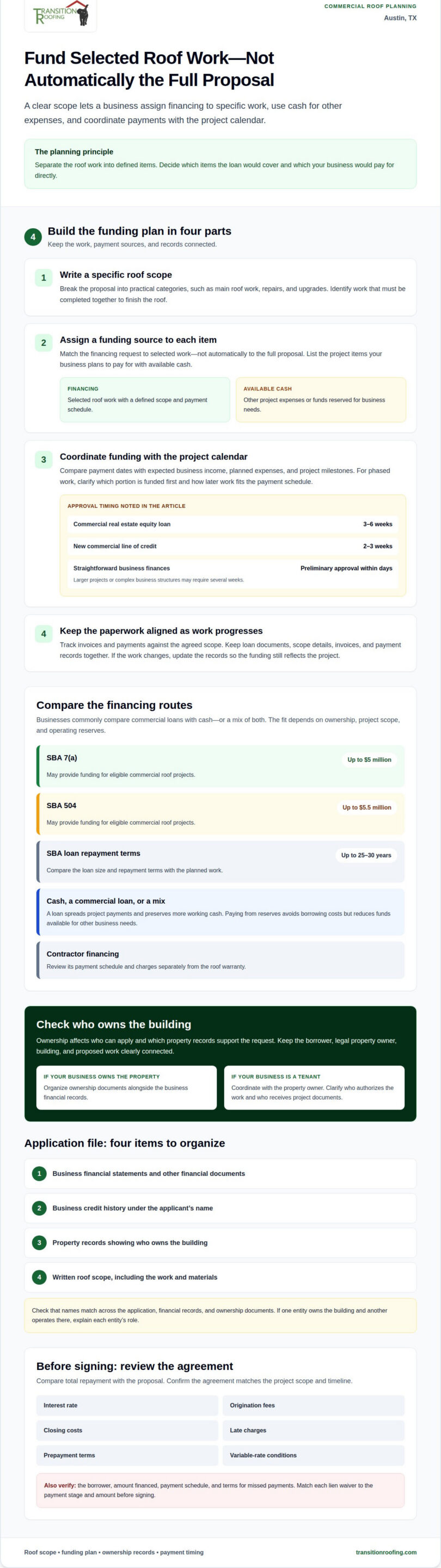
Start with a written scope divided into practical categories. Separate the main roof work, repairs, and upgrades rather than treating the proposal as one total. Then mark which items the loan would cover and which your business would pay for directly. Keep the selected work specific so the requested funding matches a defined part of the project.
- Identify work that must be completed together to finish the roof.
- List project items your business plans to cover with cash.
- Match the financing request to selected work, not automatically to the full proposal.
- Track invoices and payments against the agreed scope as the project progresses.
Coordinate the funding review with the project calendar before setting a start date. A new commercial line of credit can take 2-3 weeks for approval. Straightforward business finances may receive preliminary approval within days, while larger projects or complex business structures may require several weeks. Allow that review time when planning scheduled work and funding availability.
For phased work, clarify which portion will be funded first and how later work fits the payment schedule. Compare payment dates with expected business income and planned expenses. Keep loan documents, scope details, invoices, and payment records together. If the project scope changes, update the records so the funding still reflects the work being completed.
For commercial roofing in Austin, organize the scope and funding plan together before scheduling the work.
Building ownership and financing eligibility
Building ownership affects who can apply and which property records support the request. If your business owns its Austin building, organize ownership documents alongside financial records. If your business is a tenant, coordinate with the property owner because the roof is part of a building the tenant does not own. Distinguish the business applying for funds from the legal property owner.
Commercial roofing financing requirements typically include business financial documents, business credit history, property ownership documentation, and project scope details. Prepare these records together. A clear file connects the borrower, the building, and the proposed roof work.
- Gather financial statements and other business financial documents.
- Organize business credit history under the name of the applicant.
- Collect records that show who owns the property.
- Describe the roof work, materials, and project scope in writing.
Check that names match across the application, financial records, and ownership documents. For example, if one business entity owns the building and another operates there, explain each entity’s role. This clarifies why the applicant is requesting funds for that property. Tie the project scope to the building address and the work being financed.
For tenant-operated properties, start with the lease and the owner’s role in the roof decision. Clarify who authorizes the work, who receives project documents, and how the roof expense relates to the tenant’s operations. These details help create a consistent application package without presenting the tenant as the property owner.
Before submitting an application, compare the proposed scope with the records in the file. If the roof plan changes, update the project description to match the financing request. In Austin, heat, hail, and storms make roof condition a practical planning concern, but eligibility review still centers on the borrower’s business records, ownership documentation, and defined work. Organizing these items early gives lenders a clearer view of the request and property involved.
Commercial roof financing options
Compare funding options by repayment structure, project timing, and total borrowing cost. In Austin, the strongest fit is the one that funds essential work while preserving the operating cash your business needs.
Loans, Leases, and Payment Plans
A commercial loan provides borrowed funds that the business repays under agreed terms. A lease involves scheduled payments for the use of an asset, while a payment plan divides project charges across agreed milestones. Compare who owns the roof materials, what each payment covers, and whether the schedule matches the work. Keep the written scope aligned with the funding agreement.
Rates, Terms, and Down Payments
Interest rates, repayment terms, and down-payment requirements vary by lender and financing structure. A lender’s review may consider the business’s credit history and financial records, project scope, and building ownership. Compare the annual percentage rate, fees, total repayment amount, and payment dates. A longer term can reduce each payment while extending the period the business carries debt.
Traditional bank loan approval for a commercial roof project typically takes 2-6 weeks. Include that review period in the project calendar, and avoid setting a start date before the funding plan is ready.
Monthly Cash-Flow Impact
To reduce monthly pressure, compare loan payments with the cash your business needs for normal operations. Consider financing only part of the work and using available funds for the balance. Match payment dates to expected business income, and account for seasonal changes that affect revenue. Review the full schedule, not just the first payment.
- Separate essential roof work from optional upgrades.
- Compare total repayment alongside each proposed payment.
- Keep operating reserves in view when choosing a down payment.
For a roof scope in Austin, discuss your commercial roof project and funding priorities together.
Transition Roofing: Commercial Roof Installation
Transition Roofing can help turn a defined project scope into a practical roofing plan. Its commercial roof installation covers full replacement projects, while TPO Roofing Systems and Metal Roofing Systems offer options to consider for the building. If damage is limited, commercial roof repair may address the problem without replacing the entire roof.
Bring your roof condition, project priorities, and preferred funding approach into the planning conversation. A defined scope helps connect the work to your cash-flow plan and gives you a clearer basis for scheduling. To discuss your commercial roofing project, visit Transition Roofing online.
Plan the next step with a clear roof scope
Before moving forward, turn your financing plan into a defined roofing scope. A clear outline of the work helps you compare project needs with the funding approach you’re considering. Financing decisions remain between your business and its lender, while the roof plan gives those discussions practical detail.
For financing a new commercial roof in Austin without impacting cash flow, start with the building’s needs and the work required to protect it. Transition Roofing provides Commercial Roof Installation, TPO Roofing Systems, and commercial roof repair. The right path may involve a full installation or focused repair, based on the roof’s condition and project goals.
Bring your priorities and project questions to the next conversation. Contact Transition Roofing to discuss your commercial roof project and take a clear, steady step toward protecting your building.
Frequently Asked Questions
Do I need to own the building to qualify for financing?
Not necessarily, but building ownership documentation is typically part of a commercial financing review. If your business leases its Austin premises, distinguish the tenant’s role from the property owner’s in the project documents. Identify who operates the business, who owns the building, and who is authorizing the roof work. That clarity connects the financing request to the right business and property.
How long does it take to get financing approved?
Approval timing depends on the financing route and the application’s complexity. A new commercial line of credit can take 2-3 weeks, while traditional bank loan approval typically takes 2-6 weeks. Straightforward business finances may receive preliminary approval within days; larger projects or complex business structures may need several weeks. Build review time into the roof schedule before setting a firm start date.
What financing options are available for commercial roof replacement in Austin?
Austin businesses can compare bank loans, commercial lines of credit, SBA financing, and commercial real estate equity loans. The U.S. Small Business Administration says SBA 504 loans can provide up to $5.5 million for eligible commercial roof projects. Compare each option’s repayment structure and how it fits your ownership situation. A business may also combine financing with cash for selected project items.
Can an Austin business finance a commercial roof with a PACE loan or C-PACE assessment?
PACE or C-PACE may be an option only when an applicable local program covers the property and commercial roof work. Eligibility is central, so treat this as a conditional option rather than the foundation of your cash-flow plan. Compare it with bank, SBA, and property-equity financing, and keep the project scope and property records consistent throughout the financing review.