With an average of six to eight severe hailstorms hitting Central Texas every year, your property isn’t just at risk; it is a target. Managing a commercial asset in Austin is stressful enough without the looming fear of a denied insurance claim or a massive out of pocket deductible. You’ve likely felt the pressure of choosing between a quick fix from a storm chaser and a long term solution that actually meets the 2021 International Building Code. This guide simplifies the commercial roof insurance claim process Austin property managers must master to secure a fully funded replacement and protect their bottom line.
We will break down the shift toward percentage based deductibles, the technical difference between ACV and RCV policies, and how to document code compliance to ensure your carrier pays what they owe. You’ll learn how to navigate the 2026 regulatory landscape with confidence. By following this roadmap, you can move your structure from a state of vulnerability to one of total security while keeping your business operations running smoothly.
Key Takeaways
- Learn how to master the commercial roof insurance claim process Austin by leveraging local building codes and the latest 2026 insurance regulations.
- Discover the critical differences between ACV and RCV policies to ensure your property receives a fully funded restoration rather than a partial repair.
- Understand how a technical advocate can identify hidden storm damage that adjusters often overlook, protecting your asset from long-term structural failure.
- Find out how Austin’s specific energy conservation codes can actually help you upgrade to a high-performance TPO system at the carrier’s expense.
Understanding the Commercial Roof Insurance Claim Process in Austin, TX
The commercial roof insurance claim process Austin property managers encounter is more than a simple paperwork exercise; it’s a technical and legal negotiation. Your insurance carrier is looking for specific evidence of a “covered peril,” while your goal is to restore the building’s integrity. Understanding Property Insurance language is the first step, but the local environment dictates the second. The Central Texas climate is uniquely destructive. We see a recurring cycle where heavy spring hail is followed by months of 100-degree heat. This thermal expansion puts immense stress on commercial membranes, turning small impact points into catastrophic leaks over time.
Identifying Storm Damage on Austin Commercial Roofs
Damage on a commercial roofing Austin asset isn’t always visible from the ground. While a shingle roof shows missing pieces, flat systems hide their scars. Look for these specific indicators:
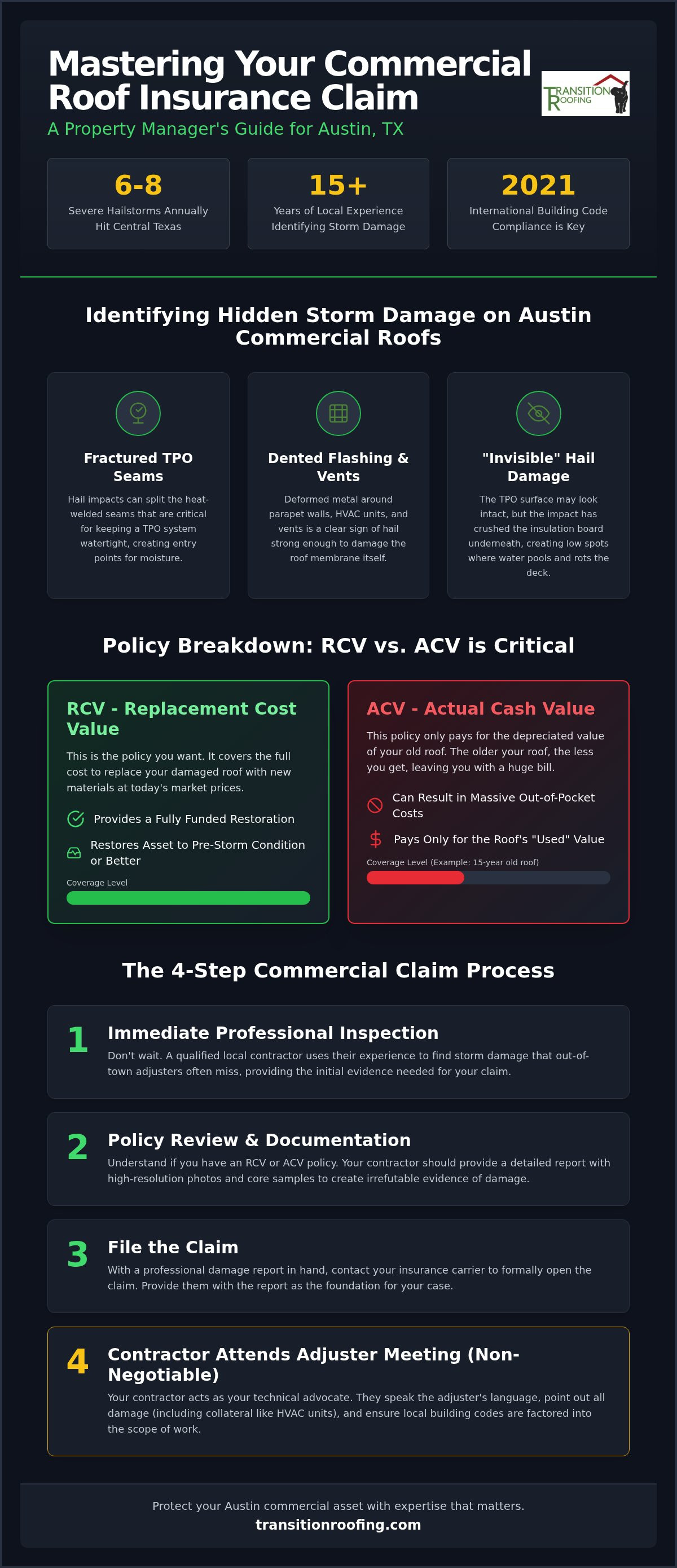
- Fractured TPO seams: Hail can split the heat-welded areas that keep the system watertight.
- Dented flashing: Deformed metal around units or parapet walls often signals a strike strong enough to damage the membrane.
- Invisible hail damage: This occurs when the top layer looks fine, but the impact has crushed the insulation board underneath.
These “bruises” create low spots where water pools. Over time, this moisture rots the structural deck from the top down, often remaining undetected until the ceiling starts dripping inside the facility.
The Risks of Delaying Your Claim in Central Texas
Waiting to file is a gamble you’ll likely lose. Carriers often use delays to argue that damage is the result of long-term wear and tear rather than a single storm event. In Austin’s humidity, a small breach leads to internal moisture trapped behind walls within weeks. Transition Roofing relies on over 15 years of local experience to identify these hidden vulnerabilities early. We help you document the damage correctly the first time to avoid the “maintenance” excuse carriers use to deny coverage.
Step-by-Step Guide to Filing Your Claim in Austin, TX
Executing the commercial roof insurance claim process Austin requires a methodical approach to ensure every detail is captured. First, secure an immediate professional inspection. We use our 15 years of Central Texas experience to find storm traces that generic adjusters often miss. Second, review your policy for Actual Cash Value (ACV) versus Replacement Cost Value (RCV) provisions. An RCV policy covers the total cost of a new roof at today’s prices, while ACV only pays for the depreciated value. This distinction can mean a difference of hundreds of thousands of dollars for large commercial assets.
Once you have a detailed damage report, file the claim with your carrier. Finally, ensure your contractor is present for the adjuster meeting. This is non-negotiable. We speak the technical language adjusters use and ensure they don’t overlook collateral damage to HVAC units or parapet walls during the walk-through.
Documentation: The Foundation of a Successful Claim
Effective claims rely on irrefutable evidence. For flat roofing systems, this means high-resolution photos and core samples. Core samples are vital because they prove the number of existing roof layers and the condition of the insulation board underneath. Transition Roofing provides transparent estimates that align with insurance adjusting software, reducing friction during the approval phase. Learn more about our commercial roofing services in Austin to see how we document these technical details.
Navigating Policy Deductibles and Payouts
In Austin, TX, most commercial policies have shifted from flat fees to percentage-based deductibles, often 2% of the building’s insured value. Under Texas House Bill 2102, it’s illegal for contractors to waive or absorb these deductibles. The final payout depends on your material type and the roof’s age. For example, a 15-year-old membrane might face higher depreciation under an ACV policy. If you’re seeing signs of wear after a storm, we can take a look and give you a clear plan for your next steps.
Navigating Adjuster Meetings and Policy Nuances in Austin, TX
The insurance adjuster is a professional risk manager for the carrier. Their primary objective is to minimize the insurance company’s financial liability; they aren’t there to maximize your payout. During the commercial roof insurance claim process Austin, having a technical advocate on your side balances the scales. Transition Roofing steps in to identify “collateral damage” that adjusters often overlook. This includes dented HVAC condenser fins, bruised gutters, and hairline fractures in parapet wall flashings that lead to long-term moisture intrusion.
We apply “Contractor Logic” to every negotiation. If a storm compromises the watertight integrity of a TPO system, a simple patch often fails because the surrounding aged material cannot properly bond with new membrane. In many cases, local building codes or the extent of the damage make a full replacement the only viable path to protecting your asset. If you are dealing with hidden leaks, we can take a look and give you a clear plan.
Meeting the Insurance Adjuster On-Site
Property managers should never meet an adjuster alone. We attend these meetings to point out subtle thermal expansion damage common in the Central Texas climate. In Austin, hail strikes often weaken a membrane, which then splits during the next 100-degree heatwave. We ensure the adjuster sees these compromised areas before they finalize their report. Having an expert present prevents the carrier from dismissing legitimate storm damage as simple “age and wear.”
ACV vs. RCV: Understanding Your Commercial Payout
Your policy type dictates your final check. Actual Cash Value (ACV) pays the depreciated value of the roof based on its age. Replacement Cost Value (RCV) covers the current market price for a new system. Most RCV policies involve “recoverable depreciation.” This means the carrier sends an initial check for the ACV amount, and you receive the remaining balance only after the work is completed and invoiced. For expert Austin roof repair guidance, always verify your policy’s specific endorsements before filing.
Why Local Expertise Matters for Austin, TX Commercial Roof Claims
Local knowledge is the difference between a denied claim and a fully funded, code-compliant roof. The commercial roof insurance claim process Austin requires more than just identifying hail hits. It involves understanding how the City of Austin enforces the 2021 International Building Code (IBC) and local energy amendments. If your current roof doesn’t meet these standards, your insurance policy’s “Law and Ordinance” coverage should pay for the necessary improvements. We provide the technical documentation that proves a simple repair is often illegal under current city rules.
Navigating Austin Building Codes and Permit Requirements
Austin requires specific Class A roof assemblies and strict insulation R-values for commercial properties. Transition Roofing ensures your new system meets these 2026 energy standards. When we provide a damage report, we include the specific code requirements that force a carrier to pay for a better, more efficient system. This “Code Upgrade” coverage is a vital part of your policy that generic out-of-state contractors often overlook. We don’t just fix leaks; we bring your entire structure up to current legal standards.
Choosing a Certified Commercial Contractor in Central Texas
Storm chasers often disappear once the insurance check clears. A locally rooted contractor with over 15 years in Central Texas understands how TPO and flat roof systems react to our intense UV exposure. We hold certifications from GAF, Versico, and Dura-last, which proves our technical authority. Why local Austin roofing excellence matters is about accountability and long-term asset protection. If you’re seeing signs of leaks or have recently weathered a storm, we recommend a professional assessment before filing your claim.
Securing Your Property with Expert Claim Management
Mastering the commercial roof insurance claim process Austin requires more than just filing paperwork; it demands a technical understanding of local building codes and rigorous documentation. By identifying hidden storm damage early and navigating the shift toward percentage-based deductibles, you can protect your asset from long-term structural failure. Your insurance policy is a contract. Having a certified expert to advocate for your property’s integrity ensures you receive the full funding required for a code-compliant restoration.
Transition Roofing brings over 15 years of Central Texas expertise to every negotiation. As an A+ rated local service provider certified by GAF, Versico, and Dura-last, we specialize in moving your structure from vulnerability to total security. If you’re dealing with storm damage or a complex claim, schedule a commercial roof inspection in Austin today. We’re ready to help you navigate the 2026 regulatory landscape with confidence. Your property deserves the protection of a neighborly expert who values craftsmanship and community trust above all else.
Frequently Asked Questions
How long do I have to file a commercial roof insurance claim in Austin, TX?
You typically have one year from the date of the storm to file your claim. However, it’s best to act within 30 to 90 days to prevent secondary damage like mold or structural rot. Waiting too long allows carriers to argue that the leaks are due to poor maintenance rather than a specific storm event. Check your specific policy endorsements for any shortened notification windows in Central Texas.
Will my insurance premiums go up if I file a claim for storm damage?
Texas law generally prevents carriers from raising your individual rates for “Act of God” events like hail or wind. However, premiums often increase across an entire zip code after a major Austin storm. Filing a legitimate claim ensures you get the benefit of the premiums you’ve already paid. It’s better to secure a new roof now than to face higher premiums later without the protection of a high-quality system.
What happens if the insurance adjuster misses damage that my contractor found?
We handle this through a process called “supplementing.” If the adjuster overlooks technical issues like damaged insulation or code requirements, we provide photo evidence and thermal scans to the carrier. This is a normal part of the commercial roof insurance claim process Austin asset managers face. Our goal is to ensure the scope of work covers everything needed to restore your building to a state of total structural security.
Can I choose my own commercial roofing contractor, or does the insurance company pick one?
You have the legal right to choose any contractor you trust for your repairs or replacement. Your insurance carrier might provide a list of “preferred” vendors, but you aren’t required to use them. Selecting a local expert with 15 years of Central Texas experience ensures your project meets Austin’s strict 2026 building codes. We prioritize your long-term asset protection over the insurance company’s desire to minimize their own repair costs.
Does insurance cover commercial roof replacement for old roofs in Austin?
Yes, insurance covers storm damage regardless of the roof’s age, but the payout structure depends on your policy type. If you have an RCV policy, they pay for a full replacement at current market rates. With an ACV policy, the carrier subtracts depreciation based on the roof’s age. If your roof is over 15 years old, we recommend a professional assessment to determine if a claim is financially viable for your property.