
Last May, an Austin property manager ignored a small ceiling drip, assuming it was a minor leak. By July, the trapped moisture under the TPO membrane had compromised the insulation, turning a simple fix into an expensive headache. You shouldn’t have to guess if your building is secure or worry about unreliable contractors who stop answering their phones after a storm. If you are searching for commercial flat roof repair near me, you need more than a quick patch; you need a long-term plan to protect your investment from the intense Central Texas sun and hail.
We believe in professional reliability and local authority, bringing over 15 years of experience and GAF and Versico certifications to every job site. We know you want documented proof for insurance and a clear understanding of your roof’s remaining lifespan. This guide explains how to identify flat roof failures early, when to choose repair over replacement, and how to navigate current Austin building codes. You will learn the exact contractor logic we use to keep buildings leak-free while maximizing every dollar of your maintenance budget.
Key Takeaways
- Identify critical failure points like ponding water and UV degradation before they lead to hidden structural damage in the Central Texas heat.
- Use the 25% Rule to determine if a repair is cost-effective or if a full replacement is the only way to protect your Austin business long-term.
- Learn why TPO heat-welding is the industry standard for permanent results when you are searching for professional commercial flat roof repair near me.
- Master the documentation process for hail damage claims to ensure your insurance provider receives the technical proof they require for a fair payout.
- Leverage expert contractor logic from GAF and Versico certified professionals with over 15 years of experience in the Austin, TX market.
Identifying Common Flat Roof Failures in Austin TX
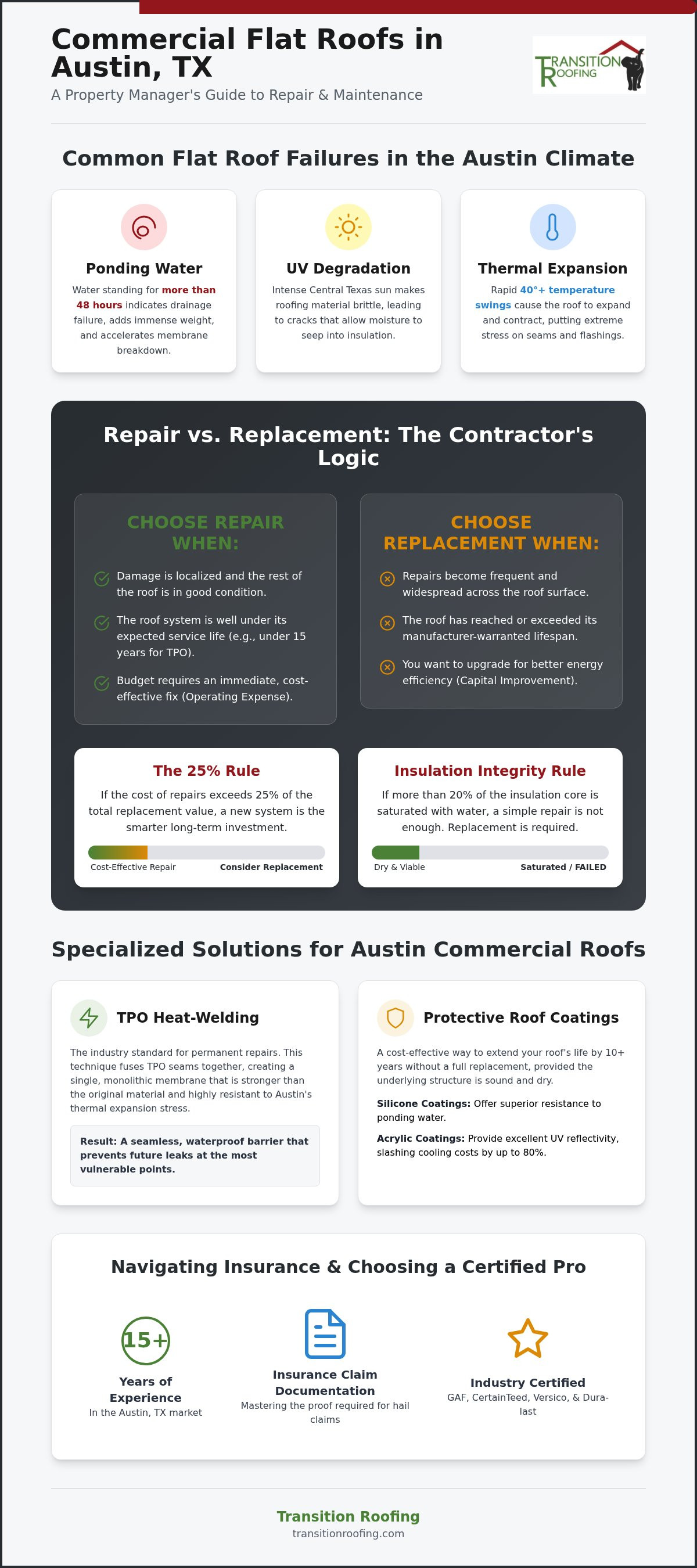
Austin’s climate is brutal on low-slope structures. Most Common Flat Roof Failures in our area stem from the relentless combination of UV exposure and sudden, heavy rain. When you’re searching for commercial flat roof repair near me, you aren’t just looking for a quick patch. You’re looking to stop a chain reaction of damage that can compromise your entire building. Our team uses 15 years of local experience to spot these issues before they become six-figure problems.
Ponding water is the most frequent red flag we see. If water stands on your roof for more than 48 hours after a storm, your drainage has failed. This standing water adds immense weight and accelerates the breakdown of the membrane. In the Central Texas sun, this water acts like a magnifying glass, literally cooking older EPDM and bitumen systems. This UV degradation makes the material brittle, leading to cracks that allow moisture to seep into the insulation.
Thermal expansion also plays a major role in local roof failure. In Austin, it’s common to see 40-degree temperature swings between a scorching afternoon and a cool night. This causes the roof to expand and contract rapidly, putting extreme stress on seams and flashings. We also find frequent punctures caused by HVAC technicians or recent hail events. Even a small hole can saturate your insulation long before a leak appears on your ceiling.
Signs of Hidden Water Damage
Hidden moisture is a silent killer for commercial properties. Look for bubbling or blistering in the membrane; this often means air or water is trapped underneath. If you walk the roof and feel “spongy” spots, the insulation core is likely wet and needs immediate attention. Inside, keep an eye out for ceiling stains or mold growth near roof drains. These aren’t just cosmetic issues. They are signs that your building’s envelope is compromised and requires professional commercial flat roof repair.
The Role of Drainage Systems
Clogged scuppers and drains are the primary cause of “emergency” repairs in Austin. During our heavy seasonal downpours, a single blocked drain can back up thousands of gallons of water in minutes. This creates hydrostatic pressure that forces water into the smallest gaps in your seams. We’ve seen entire systems fail simply because a drain wasn’t cleared of debris. Regular maintenance is the only way to ensure your drainage system can handle the Central Texas climate.
Commercial Flat Roof Repair vs. Replacement in Austin TX
Deciding between a localized patch and a full tear-off is the most critical financial choice a property manager will make. When you’re looking for commercial flat roof repair near me, you need a clear framework to determine if your money is being spent wisely. Our team uses “contractor logic” based on 15 years of local experience to help you make this call. We look at the 25% Rule; if the cost of repairs exceeds a quarter of the total replacement value, it’s usually time to invest in a new system.
Insulation integrity is the second major factor. If a moisture scan reveals that more than 20% of your roof’s insulation core is saturated, a repair is merely a temporary band-aid. Wet insulation loses its R-value and can lead to structural rot or mold. Additionally, any professional work on your roof must strictly adhere to OSHA fall protection standards to ensure safety and limit owner liability. If your TPO or PVC system has passed the 15-year mark in the harsh Austin climate, the membrane has likely lost the flexibility needed to handle thermal expansion.
When to Choose a Commercial Roof Coating
If your roof is structurally sound and the insulation is dry, a coating can be a game-changer. Silicone coatings offer superior ponding water resistance, while acrylic options provide excellent UV reflectivity. These systems can extend the life of your roof by 10 years or more without the cost of a full Commercial Roof Installation in Central Texas. This is usually when we recommend a professional core test to ensure the substrate is a good candidate for restoration.
Cost-Benefit Analysis for Property Managers
Repairs are often handled as immediate operating expenses, which can be helpful for annual budgeting. However, a full replacement is a capital improvement that adds long-term value to the property. You must also consider business downtime. A localized repair is quiet and fast, while a full tear-off involves heavy equipment and potential disruptions. Modern TPO systems can slash Austin cooling bills by reflecting up to 80% of solar heat, often paying for themselves in energy savings over time.
Specialized Repair Techniques for Austin TX Commercial Roofs
Effective commercial flat roof repair near me requires more than just a bucket of tar. In Austin, TX, the specific materials used on your building dictate the repair method. For TPO systems, heat welding is the gold standard. TPO is a thermoplastic material designed to be fused together using hot air at temperatures exceeding 800 degrees. Mechanical patches using glue or tape are temporary fixes. They often peel off within a single season due to the intense Central Texas heat. A heat-welded patch creates a monolithic bond that is actually stronger than the surrounding membrane.
Modified bitumen systems require a different approach. While many old-school contractors still use torch-down methods, we prioritize safety by using cold-applied adhesives. This eliminates the fire risk associated with open flames on commercial rooftops. We also focus heavily on flashing and curb repairs. These are the points where your roof meets HVAC units or parapet walls. Because these areas expand at different rates than the main roof surface, they are the most vulnerable to leaks. Our team holds certifications from GAF, Versico, and Dura-last, ensuring every repair meets strict manufacturer standards.
The Importance of Certified Craftsmanship
Hiring a generic handyman or “solar cowboy” for specialized membrane work can void your manufacturer warranty. If you need a Expert Roofing Contractor in Austin, TX, look for GAF or Versico certifications. These credentials prove the contractor has been trained in specific welding techniques and material handling. This expertise ensures that your repair doesn’t just stop the leak today but lasts for the remaining life of the system. It protects your investment and your peace of mind.
Emergency Leak Mitigation
If you discover a leak during a heavy Austin storm, immediate action is necessary to prevent interior damage. We recommend professional tarping or temporary seals to bridge the gap until the weather clears for a permanent fix. Safety protocols are vital for multi-story commercial buildings; don’t attempt to walk a wet roof without proper equipment. If you’re dealing with an active leak, contact us for a professional repair plan to secure your building immediately.
Navigating Insurance and Maintenance for Austin TX Commercial Roofs
Navigating insurance claims for commercial flat roof repair near me is often the most stressful part of property management in Central Texas. After a major hail event, you need a partner who understands the technical difference between standard wear-and-tear and legitimate storm damage. We use “contractor logic” to document impact points that adjusters might overlook. Because Austin enforces the 2021 International Building Code, your claim must often include costs for modern insulation requirements and wind speed design. We provide the documented proof you need to ensure your building is returned to a state of total security.
Transition Roofing focuses on transparency. We don’t believe in high-pressure sales; we believe in integrity and long-term protection. Our team provides detailed estimates that align with industry standards, helping you understand the remaining lifespan of your system before you commit to a project. Whether you’re dealing with a TPO membrane or a modified bitumen system, we ensure your insurance provider sees the full scope of necessary work.
Filing a Commercial Roofing Claim
- Step 1: Secure a professional inspection immediately after a storm. We provide photo documentation of all punctures and compromised seams.
- Step 2: Review your policy to see if you have Actual Cash Value (ACV) or Replacement Cost Value (RCV). This determines how much out-of-pocket cost you’ll face.
- Step 3: Have your contractor present when the adjuster arrives. We speak their language and point out technical failures that aren’t visible from the ground.
Scheduled Maintenance: The Key to Longevity
A preventative maintenance program is the best way to avoid six-figure disasters. Semi-annual checks allow us to clear debris from scuppers and drains, preventing the ponding water issues we discussed earlier. We also perform annual seam inspections to catch small cracks before they saturate your insulation. This proactive approach can extend the life of a TPO system to its full 20-year potential. Schedule a professional commercial roof inspection in Austin today.
If you’re dealing with a persistent leak or suspect recent hail damage, we can take a look and give you a clear plan. Schedule a roof inspection in Austin today to protect your assets with expert local care.
Secure Your Austin Commercial Asset for the Long Term
Managing a low-slope roof in the Central Texas climate doesn’t have to be a source of constant stress. By identifying failures like ponding water early and applying the 25% rule to your repair-versus-replace decisions, you can protect your building’s structural integrity and your bottom line. We’ve seen how heat-welded TPO patches and professional insurance documentation can turn a potential disaster into a managed maintenance event.
If you’re currently searching for commercial flat roof repair near me, you need a partner who values integrity as much as craftsmanship. Transition Roofing brings over 15 years of local expertise as a GAF and Versico certified contractor. We are A+ rated for commercial storm recovery and specialize in moving your property from a state of vulnerability to total security. We understand the specific environmental stressors of Austin and San Antonio, ensuring your roof is built to withstand whatever the next season brings.
Don’t wait for the next major storm to test your seams. Request a Transparent Commercial Roof Evaluation in Austin today. We’ll give you a clear plan based on contractor logic and local building codes so you can focus on running your business with peace of mind. We are ready to help you secure your investment.
Frequently Asked Questions
How much does commercial flat roof repair cost in Austin?
The total cost of a repair depends on the specific membrane material and whether the water has reached the insulation core. Minor fixes for punctures are straightforward, but replacing saturated insulation boards requires more labor and materials. We provide transparent estimates after a physical inspection to ensure you aren’t surprised by hidden costs during the project.
Can a flat roof be repaired if it is leaking in multiple places?
Yes, multiple leaks can be repaired if the underlying insulation is still dry. However, if the leaks are widespread across the entire surface, it often indicates the membrane has reached the end of its useful life. We use the 25% rule to determine if localized repairs are still a sound investment for your business or if a full system update is needed.
How long does a typical commercial flat roof repair take?
Most minor repairs are completed within a single day to keep your business running smoothly. Larger projects involving multiple penetrations or curb repairs around HVAC units might take two to three days. We schedule work to minimize disruption to your tenants and operations, ensuring the building is watertight by the end of every shift.
Does insurance cover commercial roof leaks caused by age?
Standard insurance policies typically don’t cover leaks resulting from age or poor maintenance. Coverage is generally reserved for “sudden and accidental” damage, such as a hail storm or high wind event common in Central Texas. This is why we emphasize documented preventative maintenance to help distinguish between normal wear-and-tear and valid storm-related claims.
What is the best flat roofing material for the Austin heat?
White TPO is the top choice for the Austin heat because of its high solar reflectivity. It keeps the building envelope cooler and puts less strain on your HVAC system during 100-degree days. If you are looking for commercial flat roof repair near me, ensure your contractor is certified to work with high-quality membranes like Versico or GAF for the best long-term results.
How often should I have my commercial flat roof inspected?
You should schedule a professional inspection at least twice a year in Austin, TX. These visits allow us to clear drains and check seams before the spring storm season and the intense summer heat. Staying ahead of maintenance is the only way to avoid expensive emergency repairs and keep your manufacturer warranty valid for its full term.