If you manage a commercial facility in Austin, you know that a single afternoon hail storm can wreck your entire annual maintenance budget. It’s hard to stay ahead when you’re constantly reacting to leaks or worrying about the Texas sun degrading your TPO membrane. You deserve a strategy that moves you from a state of vulnerability to total security. Implementing a professional commercial roof asset management plan is the only way to stop the cycle of emergency repairs and start treating your roof like the high-value asset it is.
We understand the pressure of protecting a Central Texas property while keeping costs under control. You probably feel like you’re flying blind without a documented history of previous repairs or a clear idea of when a full replacement is actually necessary. This guide will show you how to build a predictable five-year roofing budget and extend the life of your system by 20 years or more. We will cover everything from following current building codes to organizing data for insurance claims so you can finally manage your facility with confidence and clarity.
Key Takeaways
- Stop reacting to leaks and start planning with a commercial roof asset management plan that stabilizes your annual maintenance budget.
- Learn how to time your inspections in March and November to protect your facility from Austin’s extreme hail and heat cycles.
- Discover how to extend your roof’s lifespan to 20+ years by prioritizing proactive restorations over expensive full replacements.
- Build a documented history of your TPO or metal roofing system to ensure your insurance claims are approved after a storm.
What is a Commercial Roof Asset Management Plan in Austin, TX?
A commercial roof asset management plan isn’t just a folder of old invoices. It’s a living document that tracks the inventory, current condition, and remaining service life of every roof section on your property. In a city like Austin, where TPO and flat roof systems face brutal conditions, this plan serves as your financial roadmap. It helps you distinguish between immediate operational expenses (OpEx) and long-term capital expenditures (CapEx) so you can avoid budget-breaking surprises.
By formalizing a professional Asset Management Plan, you gain total visibility into your facility’s health. You’ll know exactly which sections are under warranty, which need a simple coating, and which are nearing the end of their 20-year lifecycle. This level of detail is essential for staying compliant with local building codes and ensuring your property value remains high.
To better understand how technology integrates into this strategy, watch this helpful video:
Reactive vs. Proactive: The Cost of Waiting
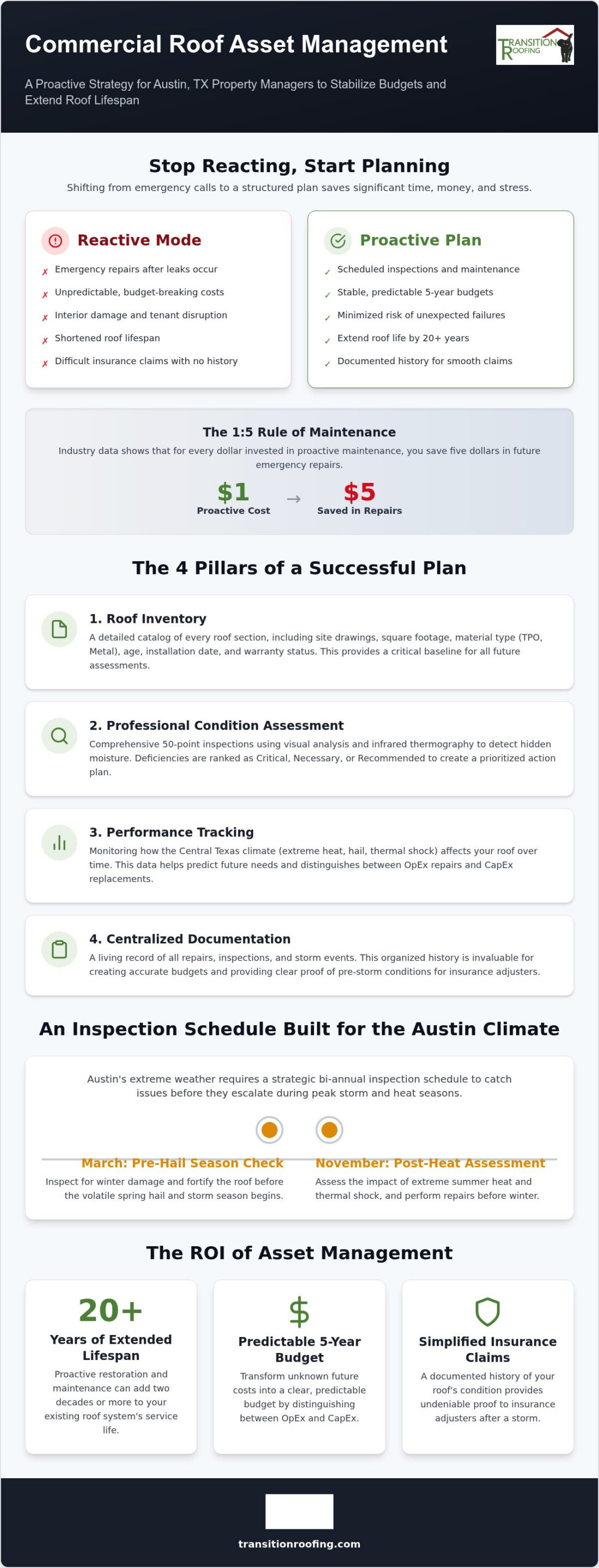
Most property managers operate in reactive mode, only calling a contractor when water is dripping into a tenant’s office. This is the most expensive way to manage a building. Industry data suggests a “1:5 rule” where every dollar spent on proactive maintenance saves five dollars in emergency repairs. Consider a common Austin scenario: a heavy spring flash flood. If your commercial roof asset management plan includes regular drain clearing, the water flows away. Without it, a clogged drain leads to structural ponding, interior damage, and a massive emergency bill.
Asset Management for Austin’s Unique Climate
The Central Texas climate is particularly hard on commercial roofing. TPO systems often suffer from thermal shock. This happens when rapid temperature swings from 100-degree days to sudden cooling rain cause materials to expand and contract violently. A dedicated plan tracks these environmental stressors over time. It also creates a documented timeline of hail impact history. When the next major storm hits, having this data ready makes the commercial roofing Austin insurance claim process much smoother. You can easily prove the roof’s pre-storm condition to the adjuster without any guesswork.
Core Elements of a Successful Strategy in Austin, TX
A successful commercial roof asset management plan relies on four pillars: inventory, assessment, tracking, and documentation. Without these, you’re just guessing at your roof’s health. High-level organizations use these same principles to manage massive facilities; for instance, the U.S. Department of Energy highlights the success of their GSA award-winning Roof Asset Management Program as a way to modernize infrastructure and reduce costs. By applying this logic to your local property, you move from reactive repairs to total asset control.
The Roof Inventory: More Than Just a List
A proper inventory goes beyond a simple list of addresses. It requires accurate site drawings and precise square footage for every roof section. This level of detail allows us to track performance across different TPO roofing systems and metal sections. We catalog the exact age, installation date, and warranty status for each area. This data is vital when a storm hits, as it provides a baseline of your asset’s condition before any damage occurs.
Professional Condition Assessments
In Austin, TX, we recommend bi-annual assessments timed for March and November. This schedule captures the state of your roof before the spring hail season and after the extreme summer heat. During a 50-point inspection, a commercial roofing contractor in Austin, TX looks for more than just surface leaks. We use infrared thermography to detect hidden moisture trapped within the insulation of flat roofs. This technology identifies problems that are invisible to the naked eye, allowing for targeted repairs instead of full replacements.
Once the inspection is complete, we use “contractor logic” to rank deficiencies as Critical, Necessary, or Recommended. This turns a long list of potential issues into a manageable action plan for your budget. Maintaining this historical data log is like having a “Carfax” for your building. It proves to insurance adjusters and warranty providers that you’ve met your maintenance obligations. If you’re seeing signs of wear on your facility, we can help you start your inventory with a professional walkthrough and assessment.
Predicting Costs and ROI for Austin, TX Property Owners
A commercial roof shouldn’t be a financial black hole. When you shift your perspective from “fixing leaks” to calculating the Total Cost of Ownership (TCO), the numbers change in your favor. According to BOMA Magazine, properties with a formal management program see significant reductions in long-term capital costs. A well-executed commercial roof asset management plan allows you to justify roof restorations, such as high-performance coatings, which cost a fraction of a full tear-off and replacement while adding years of service.
This strategy also creates what we call the “Transition Effect” on property value. In the competitive Austin real estate market, a building with a documented history of maintenance sells faster and for a higher price. Buyers aren’t just looking at the roof; they’re looking for proof that they won’t inherit a massive liability. Having a clear record of every repair and inspection turns your roof into a selling point rather than a negotiation hurdle.
CapEx vs. OpEx: Financial Planning for Roofs
The most common objection we hear is that there isn’t enough room in this year’s budget for roofing work. However, the plan actually creates the budget by identifying needs 5 to 10 years in advance. It allows you to move away from “surprise” $100,000 capital expenditures and toward manageable $20,000 annual operational increments. This steady rhythm prevents the financial shock that often follows a Central Texas hail storm. It’s much easier to explain a planned maintenance line item to stakeholders than an unbudgeted emergency replacement.
Maximizing ROI with Extended Warranties
Our certifications with GAF and Certainteed provide a unique advantage for your facility. These manufacturers often allow for warranty extensions if you can prove the roof has been professionally maintained according to their standards. For instance, having a documented history validates the necessity and quality of a metal roof repair in Austin for insurance adjusters, making the claim process much more straightforward. If you’re ready to stop guessing and start budgeting, schedule a consultation with Transition Roofing to build your 5-year financial roadmap.
Implementing Your Plan with Transition Roofing in Austin, TX
Transition Roofing brings over 15 years of Central Texas experience to every commercial roof asset management plan we develop. We don’t just hand you a binder; we build a digital inventory that follows your building’s lifecycle. For 2026, we’ve optimized our scheduling to address the specific environmental stressors of our region. This means conducting deep-dive inspections in March to prepare for spring hail and in November to assess damage from the relentless summer heat. We move your data from paper to the cloud, giving you 24/7 access to photos, repair logs, and budget forecasts from any device.
Every facility has different technical needs. As a specialized flat roofing company Austin managers trust, we tailor plans for TPO and PVC systems that require specific welding and seam checks. Our approach ensures that every square foot of your roof is accounted for and maintained according to manufacturer standards.
The Transition Maintenance Program
Our maintenance program handles the “silent killers” of commercial roofs. We focus on clearing debris and ensuring drains are wide open before those heavy Central Texas downpours. We also perform minor flashing repairs to stop leaks before they start. If you manage properties across the I-35 corridor, our commercial roofing San Antonio and Austin teams coordinate seamlessly. This provides consistent reporting and protection for your entire multi-site portfolio.
Your Next Step: The Initial Baseline Audit
The first step is always the most critical. An initial baseline audit establishes the “ground truth” for your asset. We catalog every penetration, seam, and warranty detail to create a starting point for your financial roadmap. If you’re managing a facility in Central Texas without a clear roof history, we can perform a baseline audit to get you started. Schedule a roof inspection in Austin today to secure your property for the years ahead.
Securing Your Facility’s Financial Future
Managing a commercial property in Central Texas is a significant responsibility. You’ve seen how a commercial roof asset management plan transforms unpredictable roofing emergencies into a predictable, budget-friendly strategy. By prioritizing proactive maintenance and timing your inspections for the Austin climate, you can extend your roof’s life by 20 years or more. This approach doesn’t just prevent leaks; it builds a documented history that protects your investment during insurance claims and increases your property’s resale value.
Transition Roofing brings over 15 years of Austin experience to your facility. As a GAF Master Select Certified contractor specialized in TPO, PVC, and metal systems, we understand the specific stressors of Texas heat and hail. We are here to help you move from a state of vulnerability to total security. If you’re ready to take control of your roofing budget, Schedule a professional roof asset audit in Austin today. We’ll provide a clear, honest assessment of your roof’s current health and a roadmap for its future. Your property is in safe hands.
Frequently Asked Questions about Austin Commercial Roofing
How much does a commercial roof asset management plan cost in Austin?
The cost varies based on the total square footage of your facility and the complexity of the roofing sections involved. While we don’t provide flat rates without a baseline audit, most property managers find the annual fee is significantly lower than the price of a single emergency repair. It’s a strategic operational expense that prevents the financial shock of unbudgeted capital replacements.
Can a roof management plan help with my insurance claim after a hail storm?
Yes, a commercial roof asset management plan is your best defense when dealing with insurance adjusters. It provides a dated, documented history of your roof’s condition prior to the storm. This proof of “pre-loss” condition makes it much harder for insurance companies to claim that leaks were caused by existing neglect or simple wear and tear.
How often should a commercial roof be inspected in Central Texas?
We recommend professional inspections twice a year to account for the Central Texas climate. The first inspection should happen in March to prepare for the spring hail season. The second should take place in November to assess how the intense summer UV exposure and thermal shock affected your seams and flashings. This rhythm ensures your roof stays secure year-round.
Does a maintenance plan void my existing roof warranty?
No, a maintenance plan actually protects your warranty rather than voiding it. Most major manufacturers like GAF and Certainteed require documented professional maintenance to keep their warranties valid. If you don’t have a record of regular inspections and minor repairs, the manufacturer may deny your claim when a major problem occurs. Professional upkeep is the “insurance” for your warranty.
What is the typical lifespan of a commercial TPO roof in Austin, TX?
A TPO roof in Austin typically lasts between 15 and 25 years. The exact lifespan depends on the thickness of the membrane and the quality of the maintenance it receives. Because your commercial roof asset management plan tracks UV degradation and seam health, it helps you reach that 25-year mark by catching small issues before they turn into system-wide failures.