

The cheapest TPO bid you receive today might actually be the most expensive investment you make over the next decade. In the brutal heat of Central Texas, a poorly installed roof leads to skyrocketing energy bills and premature seam failure. You want a quote that makes sense and a roof that actually protects your bottom line. We understand the frustration of unpredictable commercial roofing estimates and the confusion over whether to tear off your old system or install a recover.
This guide provides a realistic breakdown of TPO roofing cost Austin for 2026. Drawing on over 15 years of local experience with Versico and Dura-last systems, we’ll explain how material thickness and labor factors influence your total project price. You will learn how the latest 2021 IECC energy codes impact your insulation requirements and how to choose a system that withstands Austin’s extreme summer storms. We’re moving beyond vague guesses to give you the contractor logic needed for a high-quality, energy-efficient solution.
Key Takeaways
- Learn the realistic 2026 TPO roofing cost Austin ranges, including how local labor and disposal fees impact your final quote.
- Understand the building codes that dictate whether you can save money with a roof recover or if a full tear-off is legally required.
- Discover how white TPO membranes act as a cool roof by reflecting up to 80% of UV rays to lower your building’s cooling bills.
- Identify why robotic heat-welding is the expert standard for leak-proof seams compared to cheaper manual installation methods.
- See how the latest 2021 IECC energy codes and insulation requirements change the math on your long-term commercial ROI.
Why TPO Roofing Costs Vary in Austin, TX
TPO (Thermoplastic Polyolefin) has become the gold standard for commercial roofing in Austin. It’s a highly reflective Flat roof membrane that helps building owners fight the punishing Central Texas sun. When calculating your TPO roofing cost Austin, you have to account for the “Austin Factor.” In 2026, local labor demand and supply chain logistics play a massive role in the final quote. Since the city is growing so fast, securing specialized crews and getting materials to a congested job site requires careful planning and local connections.
Project complexity also shifts the price. If your building is several stories high or has limited access, we have to factor in crane rentals and advanced safety equipment. Navigating these logistics requires a contractor with over 15 years of local experience. We understand the specific permitting and code requirements that an out-of-town roofer might miss. Choosing a team that knows the local landscape ensures your project stays on schedule and within budget.
To better understand how these systems are installed and maintained in our climate, watch this helpful video:
The Role of Membrane Thickness (45-mil vs. 60-mil vs. 80-mil)
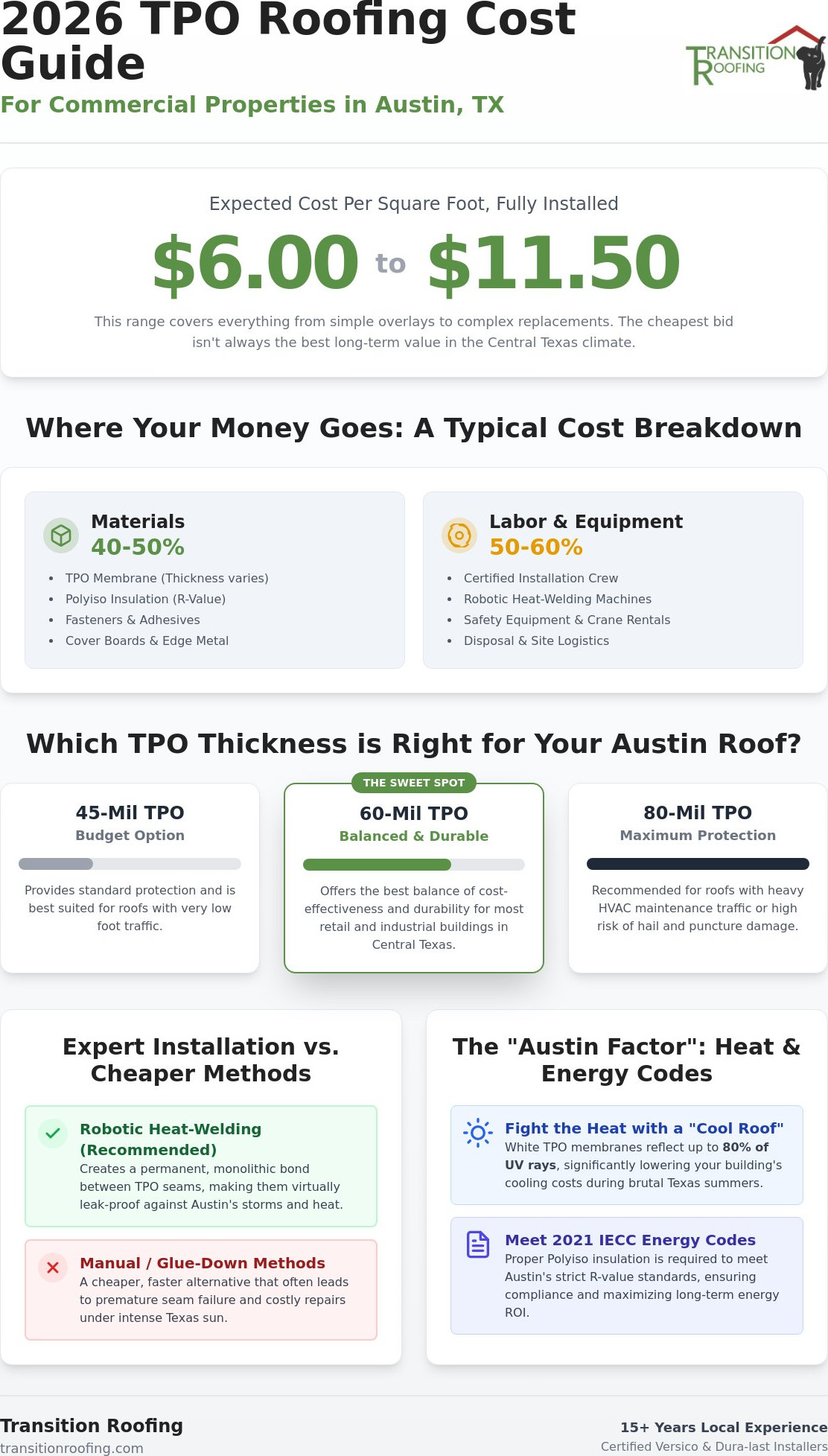
The thickness of your TPO membrane determines its puncture resistance and lifespan. While 45-mil is the budget option, we usually find that 60-mil is the “sweet spot” for most retail and industrial buildings in Central Texas. It offers a better balance of durability and cost. If your roof has heavy HVAC maintenance traffic or you’re worried about frequent hail, investing in an 80-mil membrane is the smartest move for long-term protection.
Insulation and R-Value Requirements in Central Texas
Your insulation choice is just as important as the membrane itself. Polyiso insulation thickness directly impacts your upfront costs and your 10-year energy ROI. Austin building codes now follow stricter energy efficiency standards, such as the 2021 IECC. We ensure your new system meets these R-value requirements so you don’t face compliance issues. Investing in proper insulation isn’t just about following rules; it’s about keeping your cooling costs manageable during a 105-degree August.
2026 TPO Roofing Cost Austin Breakdown per Square Foot in TX
For 2026, a realistic TPO roofing cost Austin typically ranges between $6.00 and $11.50 per square foot for a complete, professionally installed system. This range covers the full spectrum of project types, from simple overlays to complex structural replacements. While it’s tempting to focus only on the bottom line, contractor logic suggests that the cheapest bid often hides long-term risks. Low-cost estimates frequently exclude critical components like high-quality edge metal or specialized flashing details that prevent leaks during Austin’s intense spring storms.
We recommend investing in premium options like Versico and Dura-last. These systems offer superior warranty protection and better resistance to the thermal expansion common in the Central Texas climate. Choosing a higher-tier material now often saves thousands of dollars in repairs over the next decade. If you’re trying to figure out which factors apply to your building, we can provide a detailed commercial roof assessment to clarify your needs.
Material vs. Labor: Where Your Money Goes
Material costs generally represent 40-50% of your total quote. Local contractors with over 15 years of experience leverage bulk purchasing power to keep these prices as stable as possible for their clients. Labor costs in Austin TX carry a premium because of the skill required for heat-welded seam technology. Unlike cheaper “glue-down” methods, robotic heat-welding creates a monolithic bond that won’t pull apart when the Texas heat hits triple digits. You aren’t just paying for time; you’re paying for a crew certified to handle these technical specifications.
Hidden Factors: Flashing, Penetrations, and Curbs
A “clean” warehouse roof with no obstructions is significantly cheaper to install than a retail center with 50 HVAC units. Every curb, vent, and skylight requires meticulous “detailing” to remain watertight. Following University TPO Roofing Guidelines ensures these penetrations are handled according to industry best practices.
- HVAC Curbs: Each unit requires custom flashing and reinforced corners.
- Roof Drains: Proper integration with the TPO membrane is vital to prevent interior water damage.
- Parapet Walls: High walls require more material and more labor for vertical termination.
These details often separate a 10-year roof from a 25-year roof.
Replacement vs. Recover: Saving Money on TPO Roofing in Austin, TX
Choosing between a full tear-off and a roof recover is one of the biggest decisions affecting your total TPO roofing cost Austin. A recover involves installing a new membrane directly over your existing system. This approach saves significant money on labor and disposal fees, which are rising at Austin-area landfills in 2026. However, you must follow the “Two-Layer Rule.” Austin building codes generally forbid adding a third roof layer. If your building already has two systems in place, a full replacement is your only legal option.
A full tear-off is necessary when structural damage or saturated insulation is present. Ignoring these issues creates a dangerous “short-term fix” that will fail prematurely. For a deeper dive into which system fits your building best, explore our guide on Commercial Roofing Austin. If you’re dealing with persistent leaks, we can take a look and give you a clear plan for your property.
When a Recover Makes Sense
A recover is often the most cost-effective path for well-maintained buildings. To qualify, your existing roof substrate must be dry and the structural deck must be sound. By avoiding the intensive labor of a tear-off, you can often reduce the total project price by 20-30%. This allows you to allocate more of your budget toward premium membranes like Versico or Dura-last, which offer better long-term protection against the Central Texas climate.
The Dangers of Trapped Moisture
Installing a new roof over wet insulation is a recipe for disaster. Trapped moisture acts like a “wet sponge,” leading to mold growth and the rapid deterioration of your building’s structural components. In the high Austin humidity, this moisture can’t escape once it’s sealed under a new membrane. We use infrared scans to detect hidden water pockets before any work begins. This methodical approach prevents premature TPO failure and ensures your investment is secure. If you suspect your current roof is holding water, schedule a roof inspection in Austin today to verify your insulation’s integrity.
Long-Term Value: Why Quality TPO Installation Matters in Austin, TX
The real ROI of your investment isn’t found in the initial TPO roofing cost Austin, but in how the system performs during a record-breaking summer. White TPO membranes act as a “cool roof” by reflecting up to 80% of UV rays. In the Central Texas sun, this reflection prevents the roof surface from becoming a heat sink that radiates warmth into your building. By keeping the structure cooler, you significantly reduce the strain on your HVAC system and extend its operational lifespan.
Installation technique is the deciding factor in whether your roof lasts 10 years or 25 years. We prioritize robotic heat-welding over manual “glue-down” methods. Heat-welded seams are physically fused together, making them much stronger than the membrane itself. Manual adhesives often dry out and fail under the intense heat of Austin TX, leading to leaks that are difficult to track. A small investment in preventative maintenance, such as a $500 annual inspection, can protect a $50,000 asset by catching minor seam issues before they become catastrophic failures. You can learn more about our specialized approach by visiting our Flat Roofing Company Austin page.
Energy Savings and Tax Credits
Building owners in Austin often see a noticeable reduction in HVAC runtime during triple-digit August days after switching to TPO. This efficiency translates directly into lower monthly utility bills. For 2026, there are various federal and local incentives available for energy-efficient commercial upgrades. These credits can offset a portion of your project costs, making the transition to a high-reflectivity system even more financially attractive. We stay updated on these regulations to help our clients maximize their return on investment.
Choosing the Right Austin Contractor
Local roots matter when it comes to long-term accountability. Transition Roofing is deeply committed to the communities of Austin, Round Rock, and Pflugerville. We understand the specific environmental stressors, like sudden hailstorms and extreme thermal cycling, that commercial buildings face here. Our team brings over 15 years of experience and certifications with top-tier manufacturers like Versico and Dura-last to every project. If you’re looking at a TPO project in 2026, schedule a professional roof inspection in Austin today for a clear, no-fluff estimate. If you’re dealing with a leak or an aging system, we can take a look and give you a clear plan.
Secure Your Commercial Investment in 2026
Investing in a new TPO system is about more than just checking a box on property maintenance. It’s about moving your building from a state of vulnerability to total security against the Central Texas climate. We’ve explored how the TPO roofing cost Austin is shaped by local labor demands, strict building codes, and the critical choice between a recover and a full tear-off. You now know that robotic heat-welding and high-reflectivity membranes aren’t just technical upgrades; they’re essential tools for lowering your overhead and protecting your structural integrity.
With over 15 years of Central Texas expertise, we’re here to help you navigate these choices without the stress of unpredictable quotes. As certified Versico and Dura-last installers, we prioritize quality craftsmanship that lasts. We’re A+ rated for local commercial storm recovery, so you can trust that your asset is in safe, capable hands. If you’re dealing with an aging roof or recent storm damage, we’re ready to provide the professional guidance you need to make an informed decision.
Get a Transparent TPO Estimate for Your Austin Building. We can take a look at your property and give you a clear, honest plan for long-term protection.
Frequently Asked Questions
How much does a TPO roof cost per square foot in Austin, TX in 2026?
The total TPO roofing cost Austin depends on your specific project type, such as a new installation, a full tear-off, or a simple recover. Factors like the building’s height, the number of HVAC units on the roof, and the thickness of the membrane (60-mil versus 80-mil) will influence the final estimate. We also have to account for the 2021 IECC energy code requirements, which may dictate thicker insulation to meet modern R-value standards in Central Texas.
How long does a TPO roof last in the Texas heat?
A professionally installed TPO system typically lasts between 20 and 25 years in the Austin climate. While the white surface is excellent for reflecting UV rays, the extreme heat can stress the seams over time. This is why we prioritize robotic heat-welding over manual gluing. Using high-tier materials from manufacturers like Versico and Dura-last ensures the membrane remains flexible and durable through years of triple-digit summer days.
Can I install TPO over my existing flat roof to save money?
You can often install a TPO recover over an existing system to save on labor and disposal fees. However, Austin building codes generally follow the “Two-Layer Rule,” which forbids adding a third roofing layer to a structure. Before recommending a recover, we always perform an infrared scan. If the existing insulation is saturated with moisture, a recover is not a viable solution because it will trap water and lead to structural rot.
Is TPO better than PVC or Modified Bitumen for Austin businesses?
TPO is currently the most popular choice for Central Texas commercial properties because it balances upfront cost with high energy efficiency. PVC is a great alternative for restaurants because it resists animal fats and grease, while Modified Bitumen is extremely tough but tends to absorb more heat. For most retail, warehouse, or office spaces in Austin, TPO provides the best ROI by significantly lowering summer cooling costs.
Does insurance cover TPO roof replacement after an Austin hail storm?
Most commercial insurance policies cover TPO replacement if the damage is caused by a sudden, covered event like wind or hail. We have over 15 years of experience providing insurance claim assistance to help property managers document damage that isn’t always visible from the ground. It is important to check for micro-fractures or seam separations after a major storm to ensure your building remains watertight and secure.