
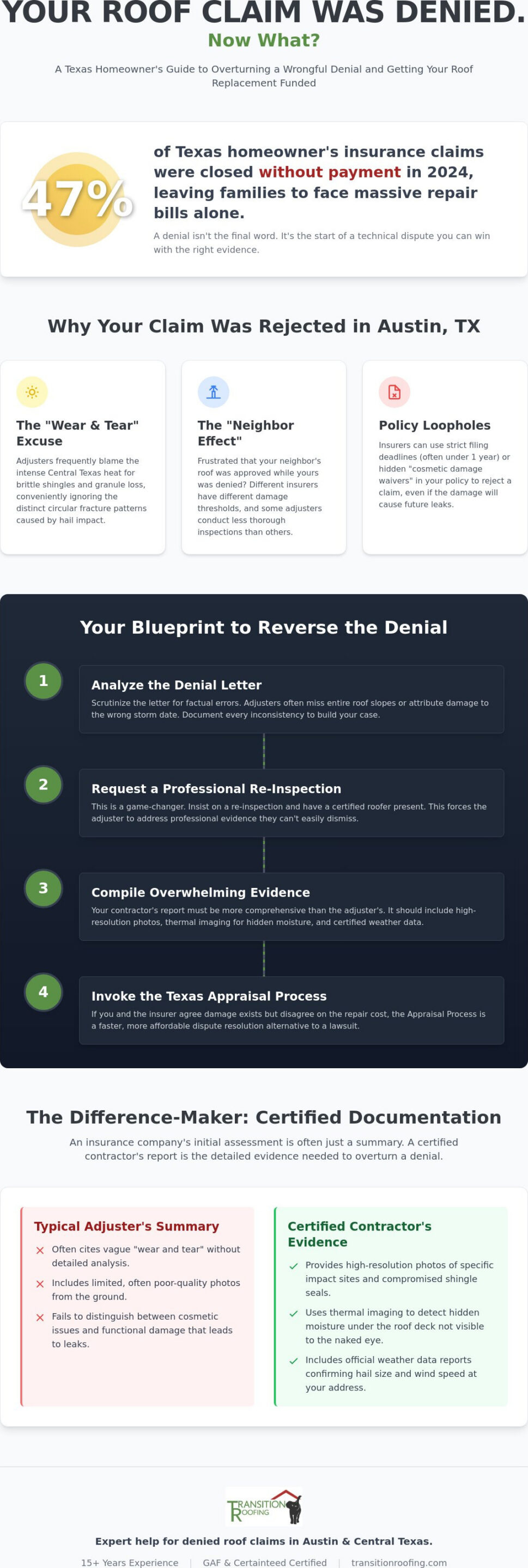
Did you know that approximately 47% of homeowners insurance claims in Texas were closed without payment in 2024? It’s a frustrating reality for many families in Austin and across Central Texas. You pay your premiums for years, yet when a hail storm hits, you’re left wondering why your neighbor’s roof was replaced while yours was rejected. If you’re looking for denied roof claim help Texas homeowners can actually use to fight back, you’ve come to the right place.
We understand the anxiety of facing a massive repair bill alone while worrying about the next round of spring storms. A denial isn’t always a final “no.” It’s often just a sign that the insurance company needs more professional evidence than their adjuster found. This guide will show you exactly how to challenge a wrongful denial and get your roof repaired using proven contractor evidence and Texas-specific claim strategies. We’ll walk through the documentation you need, the legal timelines for appeals, and how to turn a rejection into a fully funded project.
Key Takeaways
- Identify the technical reasons adjusters use to deny claims, such as “wear and tear,” and understand why your neighbor’s roof was replaced while yours was rejected.
- Discover how to secure the denied roof claim help Texas homeowners need by identifying factual errors in your denial letter and requesting a professional re-inspection.
- Learn how the Texas Appraisal Process serves as a faster, more affordable alternative to a lawsuit for resolving disputes over the cost of your repairs.
- Understand the importance of using GAF and Certainteed certified documentation to provide the clear, technical evidence required to reverse a wrongful insurance denial.
Why Insurance Companies Deny Roof Claims in Austin, TX
In the context of Texas insurance law, a denied roof claim is a formal decision by your carrier to refuse payment for reported damages based on specific policy exclusions or a perceived lack of evidence that a covered peril caused the loss. Many homeowners in Austin, TX feel blindsided when they receive a denial letter; especially after a major storm. If you are searching for denied roof claim help Texas experts provide, it’s vital to understand that adjusters often look for any reason to categorize storm damage as a maintenance issue. They might cite “manufacturing defects” or “insufficient damage” to avoid a payout.
One of the most common frustrations is the “Neighbor Effect.” You might see your neighbor getting a full residential roof replacement while your claim is flatly rejected. This happens because different insurance companies have different damage thresholds; or perhaps your adjuster didn’t look closely enough at the impact sites. Under a standard homeowners insurance policy, the burden of proof often falls on the property owner to show that the damage was caused by a specific storm event.
To better understand why these denials happen even when damage is visible, watch this helpful video:
The ‘Wear and Tear’ Excuse in Central Texas
The intense heat in Central Texas is a major factor in claim denials. Years of 100-degree days cause shingles to become brittle and lose granules. Adjusters frequently use this aging process as a shield, claiming the damage is just “normal wear and tear” rather than hail impact. Contractor logic tells us that hail bruises look very different from thermal cracking; however, an adjuster might overlook these subtle signs to save the company money. They focus on functional damage like leaks, often ignoring cosmetic hail hits that will eventually lead to structural failure.
Filing Deadlines and Policy Exclusions
Timing is everything when you need denied roof claim help Texas residents can rely on. While you usually have up to two years to file a lawsuit, your policy likely has much stricter deadlines for reporting the initial loss. Waiting more than a year can kill your claim because it allows the carrier to argue the damage happened during a different, non-covered event. You should also check for cosmetic damage waivers. These hidden clauses mean the insurer won’t pay for dents that don’t cause a leak, even if they ruin the value of your metal roof or shingles.
Steps to Take for Denied Roof Claim Help in Austin, TX
Receiving a denial is not the end of the process; it’s often just the beginning of a technical dispute. Your first move is to carefully review the denial letter for “fact-finding” errors. Adjusters are human; they often miss specific slopes or attribute damage to the wrong storm date entirely. If you feel the assessment was unfair or lacked a thorough walk-through, you can file a complaint with the Texas Department of Insurance to document the dispute officially. This creates a necessary paper trail when seeking the denied roof claim help Texas homeowners need to overturn a carrier’s decision.
The Power of a Professional Re-Inspection
Most initial inspections happen with only the insurance adjuster present. Requesting a re-inspection and having a Transition Roofing expert on the roof at the same time fundamentally changes the outcome. Our team brings over 15 years of Central Texas experience to these meetings. We use “contractor logic” to point out “missed hits” and fractured shingle mats that an adjuster might overlook during a rushed inspection. When two professionals look at the same shingle together, it’s much harder for a carrier to claim the damage is just “wear and tear.”
Documentation: The Key to Overturning Denials
To win an appeal, you need data that is more comprehensive than the adjuster’s summary. A professional damage report from a GAF or Certainteed certified contractor includes:
- High-resolution photos of impact sites and compromised seals.
- Thermal imaging to detect hidden moisture trapped under the roof deck.
- Detailed weather data reports confirming the exact hail size and wind speeds at your property coordinates.
Gathering “before” photos from previous maintenance or old real estate listings also proves the roof was in good health prior to the storm. If you’re seeing signs of leaks or missing shingles that were ignored, this is usually when we recommend getting a professional damage assessment to build a stronger case for your appeal. Proving that your roof was well-maintained before the storm removes the “neglect” excuse that many carriers use to avoid paying for a residential roof replacement.
Navigating the Texas Appraisal Process in Austin, TX
If your insurance company admits there is damage but refuses to pay a fair price for a full residential roof replacement, you have a powerful tool called the Appraisal Clause. This is often the best path for denied roof claim help Texas homeowners can access without the stress of a courtroom. The appraisal process is designed to resolve disputes over the “amount of loss” quickly and impartially. It’s a contractual right found in most Texas policies that bypasses the standard claims department.
The process is straightforward: you hire an independent appraiser, the insurance company hires their own, and these two professionals select a neutral third party called an “umpire.” If the two appraisers agree on the repair cost, the case is settled. If they disagree, the umpire steps in to make the final decision. This keeps the decision in the hands of experts who understand the Central Texas climate and actual construction costs rather than generic software estimates.
It’s vital to know the difference between a Public Adjuster and a Contractor Consultant. In Texas, a roofing contractor cannot legally act as your public adjuster on a claim they are also repairing. We serve as expert consultants; providing the technical evidence and “contractor logic” your appraiser needs to justify a higher payout based on current Austin, TX material and labor rates. To see how these professionals help property owners navigate complex losses in other major cities, you can discover Public Adjusters Atlanta and their specialized representation services.
Appraisal vs. Litigation: Which is Right for You?
Choosing between appraisal and a lawsuit usually comes down to cost and time. Lawsuits in Central Texas can drag on for years. Attorneys often charge a 40% contingency fee, which significantly reduces the funds available for your actual roof. Appraisal typically wraps up in weeks or months. While you pay your appraiser a fee, you generally keep a much larger portion of the settlement to put toward your home’s protection.
Your Rights Under the Texas Insurance Code
The Texas Homeowners Bill of Rights protects you from “Bad Faith” practices, such as an insurer failing to conduct a reasonable investigation. One critical step in this cycle is the “Proof of Loss” form. This is your formal, sworn statement regarding the extent of the damage. If you’re struggling to get a fair estimate after a storm, contact Transition Roofing today so we can provide the detailed documentation required to support your appraisal and ensure your property is restored to total security.
Expert Denied Roof Claim Help in Austin, TX with Transition Roofing
Transition Roofing bridges the gap between technical roof damage and the complex language of insurance policies. With over 15 years of experience in the Central Texas climate, we’ve seen every tactic carriers use to avoid paying for legitimate storm damage. If you’re struggling to secure the denied roof claim help Texas residents need, our background as a GAF and Certainteed certified contractor provides the technical weight your case requires. We don’t just guess; we provide the forensic evidence that forces adjusters to take a second look at your property.
Our Process for Overturning Denied Claims
Our approach starts with a comprehensive, free inspection to document exactly what the first adjuster missed. We provide a detailed damage report that serves as the foundation for your appeal. If your case requires a public adjuster or an attorney, we work directly with them as technical consultants. We ensure they have the high-resolution photos and core samples needed to prove the scope of the loss. From that first meeting on your roof to the final walkthrough after your Residential Roof Replacement is complete, we stay by your side to ensure the job is done right.
Protecting Your Home for the Long Term
Insurance companies often push for “patch jobs” or minor repairs to save money. However, a patch doesn’t restore the structural integrity of your home. It often leaves your property vulnerable to leaks during the next round of Central Texas hail storms. We focus on total security. Our goal is to move your home from a state of vulnerability to one of complete protection using high-quality materials. If your claim was denied, don’t give up. Contact Transition Roofing in Austin today for a clear second opinion and a plan to get your roof replaced properly.
Secure Your Home’s Future After a Claim Denial
A rejection letter from your insurance carrier doesn’t have to be the final word on your roof’s health. As we’ve discussed, denials in the Central Texas climate often stem from a lack of technical evidence rather than a lack of actual damage. By understanding your policy rights and utilizing the appraisal process, you can challenge an unfair decision without the need for a years-long legal battle. The most effective way to get the denied roof claim help Texas homeowners need is to present a professional damage report that uses “contractor logic” to prove the storm’s impact.
Transition Roofing brings over 15 years of Central Texas experience to your side. We are GAF and Certainteed certified experts who have assisted with over 1,000 insurance claims. We know how to document the subtle signs of hail impact that adjusters often miss. If you’re dealing with a frustrating denial, we can take a look and give you a clear plan to move forward. Schedule a Free Professional Inspection in Austin Today to start the process of restoring your property to total security. You don’t have to face the insurance company alone; with the right partner and professional documentation, you can get the results your home deserves.
Frequently Asked Questions
Can I really get help for a denied roof claim in Texas if my roof is old?
Yes, age isn’t an automatic disqualifier for a legitimate storm damage claim. While insurance companies often use age as an excuse to label damage as “wear and tear,” a specific hail or wind event is still a covered peril under most policies. The payout amount might vary depending on whether you have an Actual Cash Value or Replacement Cost Value policy, but the damage itself should still be covered. Seeking denied roof claim help Texas experts provide can help you prove that a storm, not just time, caused the failure.
How much does it cost to hire help for a denied roof claim in Austin?
Initial professional damage assessments from a certified contractor are typically free of charge. If your case moves into the formal appraisal process, you’ll pay a fee for your independent appraiser, which is often a flat rate or hourly fee. Public adjusters and attorneys usually work on contingency, taking a percentage of the final settlement. We always recommend starting with a professional inspection to determine if the potential recovery justifies the cost of hiring paid advocates.
What is the time limit to appeal a denied roof claim in Texas?
You generally have two years to file a lawsuit for a denied claim in Texas, but your individual policy likely has much tighter deadlines for the internal appeal process. Many policies require you to report the loss within one year of the storm event. Acting quickly is vital in Austin, TX because waiting allows the insurance company to argue that subsequent storms or heat degradation caused the damage, making it much harder to overturn the original denial.
Do I need a lawyer for a denied roof insurance claim in Austin, TX?
A lawyer isn’t always necessary to resolve a claim dispute. The appraisal process mentioned earlier in this guide is a contractual right that is often faster and less expensive than litigation. You should consider a lawyer primarily if you believe your carrier is acting in “bad faith” or if the appraisal process doesn’t reach a fair resolution. For those dealing with other forms of liability or negligence, The Todd Law Group, PLLC provides professional legal support across Texas. Most homeowners find that professional contractor documentation and appraisal are enough to secure the denied roof claim help Texas residents need.
Can a roofing contractor help me talk to my insurance adjuster?
A contractor can provide essential technical support by meeting the adjuster on your roof during a re-inspection. While Texas law prohibits a contractor from acting as a public insurance adjuster on a claim they are repairing, we can point out specific damage and “missed hits” that an adjuster might have overlooked. Having a GAF or Certainteed certified expert present ensures the adjuster sees the full scope of the damage using “contractor logic” and professional-grade evidence.