Did you know that a simple HVAC repair or a missed bi-annual inspection could completely void your multi-million dollar roof protection? It’s a common nightmare for property managers who realize too late that their paperwork isn’t the safety net they thought it was. Having your commercial roofing warranty explained properly is the only way to avoid massive out-of-pocket costs when a Central Texas storm hits. You’ve likely felt the stress of trying to decipher the “fine print” while balancing maintenance budgets and tenant complaints.
It’s confusing to distinguish between material defects and workmanship errors, especially with insurers implementing stricter depreciation schedules for roofs older than 15 years in 2026. You deserve a clear path to total security without the technical jargon. We understand that your priority is long-term protection and keeping your assets in safe, capable hands.
This guide gives you the facts on exactly how these agreements work in Austin, TX. We’ll compare NDL versus material warranties and explain why local building codes matter for your coverage. You’ll learn the specific steps to keep your warranty valid through heat waves and hailstorms so you can manage your property with total confidence.
Key Takeaways
- Understand the vital differences between NDL and material-only coverage in our commercial roofing warranty explained, so you can choose the right level of security for your building.
- Stop the “finger-pointing” between manufacturers and installers by partnering with contractors who use top-tier systems like GAF or CertainTeed.
- Learn why neglecting bi-annual inspections or making unauthorized repairs can instantly void your coverage and leave you with total liability.
- Differentiate between warranty claims and insurance issues, especially regarding “Acts of God” like the heavy hail common in the Austin TX climate.
- Build a bulletproof maintenance paper trail to satisfy 2026 warranty requirements and extend the service life of your TPO or metal roof.
Understanding the Types of Commercial Roof Warranties in Austin TX
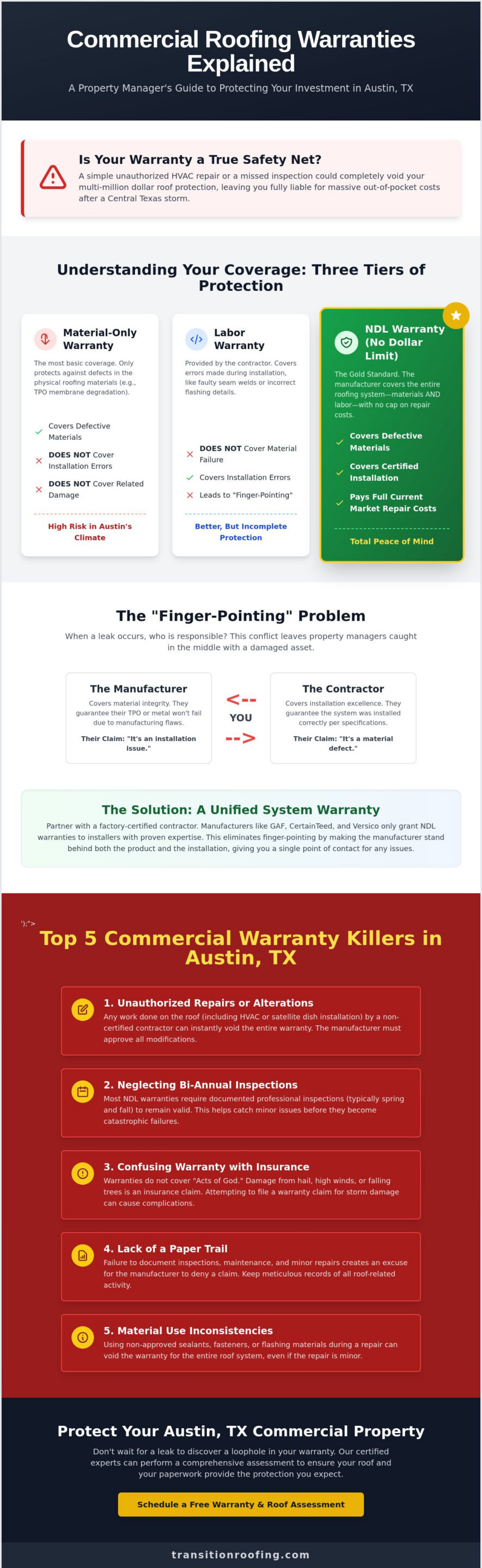
At its core, a roof warranty is more than just a piece of paper; it is a legal definition of a warranty that binds a manufacturer or contractor to the performance of your roof. For property managers in Central Texas, having your commercial roofing warranty explained correctly is the difference between a protected asset and a financial disaster. Unlike insurance, which covers sudden “Acts of God” like the heavy hail common in the Austin area, a warranty addresses defects and installation errors.
The Austin climate is particularly hard on flat roofs. Intense UV radiation and triple-digit summer temperatures cause materials to expand and contract rapidly. This thermal cycling often leads to premature failures that standard material-only warranties won’t cover. To protect your investment, you need a strategy that accounts for both the product and the hands that install it.
To better understand this concept, watch this helpful video:
Material vs. Labor vs. NDL Coverage
Understanding the hierarchy of protection is vital for your budget. Most manufacturers offer a Material Warranty, which only covers the physical roofing membrane. If the seams fail due to heat but the membrane itself is “fine,” you’re likely out of luck. A Labor or Workmanship Warranty is provided by your contractor to cover installation errors. The No Dollar Limit (NDL) Warranty is the gold standard. It combines both aspects and removes the cap on repair costs, ensuring the manufacturer stands behind the entire system.
Why NDL is Essential for Central Texas Businesses
In a fast-growing market like Austin, TX, the cost of labor and materials fluctuates constantly. A standard pro-rated warranty might only pay out a fraction of what a repair actually costs five years from now. An NDL warranty ensures the manufacturer pays the full current market rate for repairs throughout the term. This provides a fixed-cost security blanket for your maintenance budget. When we install commercial roofing in Austin, we prioritize these comprehensive agreements to ensure your building stays bone-dry regardless of market inflation.
Manufacturer vs. Contractor Warranties: What’s the Difference in Austin TX?
One of the biggest frustrations for property managers is the “finger-pointing” game. When a leak occurs, a manufacturer might claim the installation was flawed, while the contractor insists the material was defective. This leaves you caught in the middle with a damaged building. Having your commercial roofing warranty explained means understanding that these are two separate layers of protection that must work together. To avoid these disputes, we use top-tier brands like GAF and CertainTeed. These manufacturers trust our 15 years of experience to install their systems correctly, which allows us to offer dual protection that covers both the product and the labor.
The Manufacturer’s Role: Material Integrity
Manufacturers like GAF or Versico focus on the chemical stability and physical durability of the roofing membrane. They guarantee that your TPO or metal roof won’t degrade prematurely due to manufacturing flaws. These agreements are governed by Federal Warranty Law, which ensures that companies stand behind their written promises. For a manufacturer to issue a full “System Warranty,” they require specific installation details to be met. They may even send an inspector to the site in Austin, TX, to verify that every seam and fastener meets their rigorous standards before the warranty is finalized.
The Contractor’s Role: Installation Excellence
While a manufacturer covers the material, your contractor covers the execution. Most commercial leaks don’t happen in the middle of a roof; they occur at “penetrations” like vents, drains, and HVAC units. These are almost always workmanship issues. A contractor warranty is typically shorter, ranging from 2 to 10 years, but it is your first line of defense. A reliable Austin TX roofer stands behind their flashing and seam work because they know the local climate demands perfection. If you are seeing water stains near your roof-mounted equipment, this is usually when we recommend a professional assessment to see if your contractor’s workmanship coverage is still active. Learn more about our commercial roofing services in Austin to see how we bridge the gap between material quality and installation excellence.
Why Your Austin TX Commercial Warranty Might Be Voided
Many property managers believe their coverage is an absolute safety net. Then, they file a claim and receive a rejection letter. When we have a commercial roofing warranty explained to our clients, we emphasize that these agreements are performance-based. They are not “set it and forget it” policies. Most voided claims stem from simple neglect or misunderstandings about what a manufacturer actually covers. If you aren’t following the specific rules laid out in your agreement, you are essentially self-insuring your building without realizing it.
The Maintenance Requirement Clause
Manufacturers like Versico or GAF require proof of care to keep their promises active. You must document annual or bi-annual inspections to show you’ve kept the system in good working order. If your roof drains are clogged and cause “ponding water” for more than 48 hours, the manufacturer will likely deny your leak claim. They view standing water as a maintenance failure rather than a product defect. Keeping a detailed paper trail of every inspection and minor repair is the only way to prove you have upheld your end of the deal.
Austin Weather: Hail, Heat, and UV Stress
The Central Texas climate is brutal on roofing membranes. 100-degree days accelerate the aging of TPO and metal systems through constant UV stress and thermal expansion. While warranties cover “normal wear” and material defects, they do not cover “extraordinary weather events” or “Acts of God.” If a major storm drops large hail on your building, that is an insurance issue, not a warranty one. Knowing this distinction helps you call the right professional first and avoids weeks of frustration during the claims process.
Unauthorized modifications are another common pitfall. Adding a new HVAC unit or a satellite dish without involving a certified roofer can instantly terminate your coverage. New penetrations must be flashed and sealed according to strict manufacturer standards. How we handle flat roofing and repairs in Austin ensures that any modifications you make are fully compliant with your existing warranty terms. If you are planning building upgrades or need to verify your current coverage status, schedule a roof inspection in Austin today so we can help you keep your investment secure.
How to Maximize Your Roof’s Lifespan and Warranty Coverage in Austin TX
Your commercial roof is a major capital asset. To keep it secure, you must treat your warranty as a performance partnership rather than a passive policy. Having your commercial roofing warranty explained means realizing that the burden of proof often lies with the property owner. You must establish a bulletproof paper trail. Save every inspection report, repair receipt, and photographic record. Manufacturers require this documentation to prove you haven’t neglected the system when you file a claim. Without these records, a manufacturer can easily argue that a leak was caused by lack of care rather than a material defect.
Bi-annual inspections are the industry standard for properties in Austin, TX. We recommend scheduled checks every Spring and Fall. Spring inspections identify damage from winter storms and high winds. Fall inspections ensure the membrane is prepared for the intense heat and UV stress of the Central Texas summer. Catching a small seam failure during a routine check prevents a catastrophic leak that could void your entire agreement later. Only use certified contractors for these repairs to ensure the system integrity remains intact. We hold certifications with GAF, CertainTeed, Versico, and Dura-last, which means our work meets the rigorous standards these manufacturers demand. For those overseeing multiple sites, see our guide for property managers in San Antonio for localized climate advice.
Developing a Preventative Maintenance Plan
A formal maintenance plan is the “insurance” for your warranty. It shifts your strategy from reactive repairs to proactive protection. These programs are designed to satisfy the specific “duty of care” clauses found in most NDL warranties. Transition Roofing provides the professional documentation and digital logs that manufacturers demand during a claim. This level of organization makes the process smoother and prevents the “finger-pointing” that often stalls commercial repairs.
What to Do When a Leak Occurs
If you spot water intrusion, don’t wait. Most manufacturers require written notification within 30 days of discovering a leak. If you delay, they can argue that secondary damage, such as mold or wet insulation, was caused by your failure to act. If you’re dealing with a leak on a warranted roof, we can help you navigate the claim process and perform repairs that keep your coverage active.
If you’re dealing with a recurring leak or need to verify your current warranty status, we can take a look and give you a clear plan. Schedule a roof inspection in Austin today to ensure your building stays protected for the long haul.
Securing Your Commercial Investment in Central Texas
Managing a property is complex enough without the threat of unexpected structural failures. Having your commercial roofing warranty explained ensures you know the difference between a minor repair and a major capital expense. Remember that a No Dollar Limit (NDL) warranty is your best defense against rising material costs and market shifts. However, that protection only stays active if you maintain a strict paper trail and perform bi-annual inspections to catch issues before they escalate. Neglecting these requirements is the fastest way to turn a warranted roof into a massive out-of-pocket liability.
We bring over 15 years of Central Texas experience to every project. As GAF and Certainteed Certified contractors, we specialize in high-performance TPO and metal systems designed to withstand the brutal Austin climate. We don’t just install roofs; we provide the long-term security your business deserves. Our team understands the technical documentation manufacturers demand, ensuring your paperwork is always in order during a claim. If you’re dealing with a recurring leak or simply want to verify your coverage, we can provide a thorough assessment and a clear plan. Schedule a professional roof inspection in Austin today to keep your warranty valid and your assets safe. You can manage your property with total confidence knowing your roof is in expert hands.
Frequently Asked Questions
Does a commercial roof warranty cover leaks caused by hail?
No, a standard commercial roof warranty does not cover leaks caused by hail or other major weather events. These agreements are designed to protect you against material defects and installation errors rather than “Acts of God.” In the Central Texas climate, hail damage is an insurance matter. It’s essential to have your commercial roofing warranty explained clearly so you know to contact your insurer immediately after a major storm hits your Austin property.
What is the difference between a 20-year and a 30-year NDL warranty?
The primary differences are the thickness of the membrane and the rigor of the installation requirements. A 30-year NDL warranty usually requires a higher-mil TPO or specialized metal finish compared to a 20-year system. Manufacturers also demand more extensive flashing details and reinforced seams for longer terms. While the 30-year option provides a decade of extra security, it requires a higher initial investment in both high-grade materials and certified labor.
Can I lose my roof warranty if I install a new HVAC unit?
Yes, unauthorized modifications like adding an HVAC unit can instantly void your coverage. Manufacturers require that any new penetrations or equipment curbs be installed and flashed by a certified roofing contractor. If a mechanical contractor cuts into your roof without proper oversight, the manufacturer will likely deny any future leak claims. We always recommend coordinating building upgrades with your roofer to ensure the work is documented and the system’s integrity remains intact.
Is a commercial roof warranty transferable if I sell my Austin property?
Most commercial warranties are transferable, but you must follow specific administrative steps to maintain the coverage. Manufacturers usually require written notice of the sale and a transfer fee within a set window, often 30 days. They may also require a certified inspection to document the roof’s condition at the time of the deed transfer. This process protects the new owner and ensures the asset’s long-term security in the Austin, TX market.
How much does a typical commercial roof warranty cost?
There isn’t a single flat price for a warranty because the cost depends on the roof’s size, the system type, and the desired term length. Manufacturers charge a fee to inspect and register the roof, which is included in your contractor’s total project estimate. While an NDL warranty adds to the initial budget, it removes the financial cap on future repairs. This makes it a methodical choice for property managers who prioritize long-term budget stability.