What if the biggest threat to your property’s recovery isn’t the Texas hail storm, but the way an adjuster views your complex TPO or metal roofing system? Most property managers in Central Texas know that commercial roofing insurance claims Austin are forensic projects. They require a level of technical evidence that residential adjusters often overlook. It’s frustrating to face potential claim denials or business downtime when you’re just trying to protect a high-value asset.
We understand that managing a claim feels like a second job you didn’t ask for. This guide is here to change that. You’ll learn how to secure a fully funded roof replacement or repair by using expert documentation and seasoned contractor logic that insurance companies cannot ignore. Our goal is to move your structure from a state of vulnerability to one of total security with zero stress.
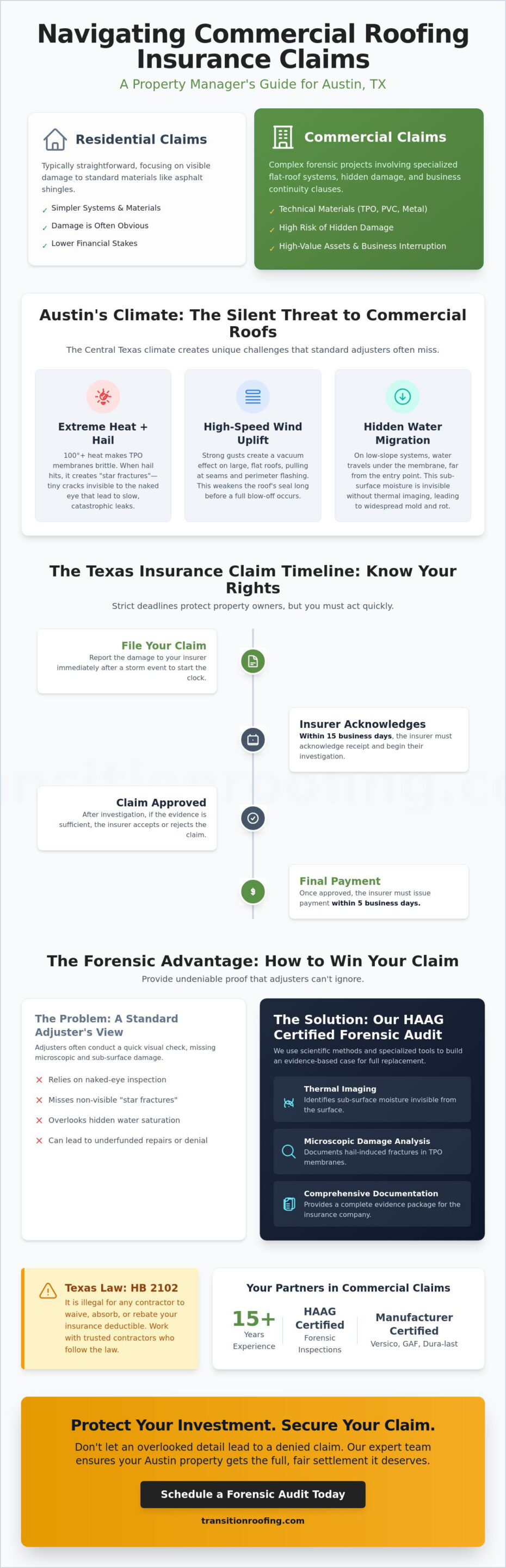
We’ll cover the strict 2026 Texas claim deadlines, including the 15-day requirement for insurers to acknowledge your claim and the 5-day window for final payment once approved. We also explain why Texas House Bill 2102 makes it illegal for any contractor to waive your deductible. By the end, you’ll have a clear plan to ensure your Austin building stays protected for the long haul.
Key Takeaways
- Learn why commercial claims for flat systems are high-stakes projects that require more technical evidence than standard residential repairs.
- Identify how Austin’s 100-degree heat makes TPO membranes susceptible to “star fractures” and hidden water damage.
- Navigate the 2026 legal requirements for commercial roofing insurance claims Austin by following mandatory deadlines for claim filing and payment.
- Prevent underfunded repairs by conducting a comprehensive forensic audit of your roof before the insurance adjuster arrives.
- Secure your investment by working with local experts who hold specialized commercial certifications from Versico, Dura-last, and GAF.
Understanding Commercial Roofing Insurance Claims in Austin TX
Commercial claims are far more than just paperwork. They are complex legal and structural recovery efforts designed to protect high-value assets. Unlike a standard house, a warehouse or office building has massive surface areas with low-slope or flat designs. These systems are prone to ponding water if the drainage isn’t perfect after a storm. When you’re managing commercial roofing insurance claims Austin, you’re handling a high-stakes financial project. Understanding property insurance basics is a good start; however, commercial policies have specific requirements for structural integrity and drainage that residential adjusters often miss.
Central Texas storms bring heavy hail and extreme wind. You need a professional inspection immediately after a weather event. Waiting months can lead to secondary interior damage that insurance companies might try to deny. We’ve spent over 15 years helping Austin property managers secure their buildings and navigate these complex processes. Early detection is the only way to protect your tenants, your inventory, and your bottom line.
To better understand this concept, watch this helpful video:
Commercial vs. Residential Claims: Key Differences
Commercial roofs use specialized materials like TPO, PVC, or metal. The drainage systems are often internal and highly technical. If a drain is blocked by storm debris, the weight of the water can threaten the entire structural integrity of the building. Commercial policies also frequently include business interruption clauses. If a leak shuts down your operation, the claim must account for that lost revenue. This is why a commercial roof installation requires a different level of documentation than a shingle replacement.
The Role of HAAG Certified Inspectors
A standard insurance adjuster might walk your roof and claim it looks fine. A forensic inspection goes much deeper. HAAG certified professionals use specialized techniques to find microscopic hail fractures in TPO membranes. These fractures are often invisible to the naked eye. Over time, they allow water to seep into the insulation, leading to mold and catastrophic failure. We use this technical data to provide evidence that adjusters cannot ignore. This ensures your claim covers the actual damage, not just what is visible from the ground.
Identifying Storm Damage on TPO and Flat Roofs in Austin TX
Austin’s 100-degree heat bakes TPO membranes until they lose their natural flexibility. When hail hits these brittle surfaces, it creates star fractures. These tiny, radiating cracks allow water to seep into the system over time. If you’re managing commercial roofing insurance claims Austin, you must document these fractures early. They are the primary cause of slow, catastrophic leaks that ruin interior assets like warehouse inventory or office electronics.
Wind uplift is another silent killer for large-scale flat roofs in Central Texas. High-speed gusts create a vacuum effect that pulls on the perimeter flashing and loosens the seams. This weakens the structural seal even if the roof doesn’t blow off. For metal systems, hail is more than an aesthetic issue. Heavy impact can crack protective coatings, leading to rust and fastener failure. We recommend a thorough forensic check after any major storm to catch these issues before they escalate.
Hidden Damage in Low-Slope Systems
Water often migrates far from the original point of entry. It travels under the insulation boards, making the true damage invisible from the surface. Thermal imaging identifies sub-surface moisture in commercial roofs by highlighting the temperature gaps between wet and dry materials. This data provides the objective proof needed to justify a full system replacement rather than a simple patch job.
Evidence Required for Austin Adjusters
Austin adjusters are under pressure to limit payouts, so you must provide undeniable proof of damage. This forensic evidence ensures your claim reflects the actual cost of restoration. Required documentation includes:
- Core samples that reveal moisture trapped within the roof assembly layers.
- Seam tests to verify if the heat-welds have been compromised by wind or impact.
- Drainage evaluations to ensure the structural slope hasn’t shifted or sagged.
You can find more material-specific repair details through our flat roofing company Austin resource. The Texas Department of Insurance guide also outlines what your carrier is legally required to cover during this process. Having this data ready prevents the “wait and see” approach that many insurers prefer.
Maximizing Your Payout: Adjuster Coordination in Austin TX
Managing commercial roofing insurance claims Austin requires a methodical approach to ensure you aren’t left paying for expensive repairs out of pocket. The process starts with immediate action. Texas law requires property owners to mitigate further damage. This means you must secure emergency tarping or temporary seals as soon as it’s safe. If you don’t take these steps, the insurance company may argue that subsequent water damage was your fault, not the result of the storm.
The coordination process follows four specific steps to ensure a full recovery:
- Step 1: Immediate emergency tarping to stop active leaks and protect interior assets.
- Step 2: A comprehensive forensic audit to document damage before the insurance adjuster arrives.
- Step 3: On-site meetings with the adjuster to advocate for code-compliant materials and manufacturer standards.
- Step 4: Filing supplemental claims for “hidden” damage discovered only after the old roof is removed.
Once the building is stable, you need a forensic audit. Doing this before the insurance adjuster arrives sets the standard for the entire claim. We use technical data and core samples to prove the extent of the damage. This preparation ensures that when the adjuster steps onto your roof, they’re looking at facts rather than just a quick visual walkthrough.
Why Adjuster Meetings Matter
Adjusters often look for the most cost-effective fix, which frequently means suggesting spot repairs for TPO or metal systems. However, localized patches often fail to restore the structural integrity of a large commercial roof. We meet the adjuster on-site to advocate for a full replacement when necessary. We ensure they account for current Austin TX building codes and manufacturer-specific requirements from brands like Versico or Dura-last. If a system doesn’t meet these high standards, it’s not truly restored.
Navigating Supplemental Filings
It’s common to find hidden damage once the old roof is removed. You might find rotted decking or compromised insulation that wasn’t visible during the first inspection. These items require supplemental filings. Supplements are cost adjustments for necessary work missed in the initial insurance estimate. We use industry-standard software to align our pricing with what insurance carriers expect. This transparent process prevents financial surprises and ensures the project is fully funded.
If you’re worried about an upcoming adjuster meeting, we can provide Insurance Claim Assistance to help you get a fair assessment.
Choosing Transition Roofing for Commercial Claims in Austin TX
Successful commercial roofing insurance claims Austin depend entirely on the technical proficiency of your contractor. We don’t just fix leaks; we build systems that withstand the unique Central Texas climate. Our team holds specialized certifications from Versico, Dura-last, GAF, and CertainTeed. These credentials mean we understand the forensic details required to install high-performance TPO and metal systems that meet strict manufacturer warranty standards. While some contractors focus only on residential shingles, we specialize in the complex needs of large-scale commercial assets.
We use a transparent estimate process that eliminates surprises for property managers. You’ll receive a detailed breakdown of every component required for a code-compliant restoration. This clear communication helps you manage your budget and provides the documentation your insurance carrier needs to approve the full scope of work. You can view our past work and expertise by visiting our commercial roofing Austin project portfolio.
Our 15-Year Track Record in Central Texas
We’ve spent over 15 years managing storm recovery projects across the region. We’ve helped businesses in Round Rock, Cedar Park, and Pflugerville recover from devastating hail and wind events. Our approach is rooted in “contractor logic,” which means we prioritize the long-term protection of your building over a quick, temporary fix. We understand how the Austin sun degrades membranes and how local wind patterns affect perimeter flashing. This regional expertise ensures your roof stays secure long after the claim is closed.
Schedule Your Commercial Inspection Today
If you’re seeing leaks after the last hail storm, we can provide a clear plan for your claim. It’s better to act early than to wait for water to damage your tenant’s inventory or your building’s structural decking. We’ll provide the forensic evidence needed to guide you through the process with confidence. Schedule a comprehensive commercial roof inspection in Austin today to protect your asset and ensure your property is fully restored.
Secure Your Commercial Asset for the Long Term
Navigating commercial roofing insurance claims Austin doesn’t have to be a source of business downtime or financial stress. You now understand that a successful claim relies on forensic evidence and technical coordination rather than just a quick visual check. By identifying hidden damage like star fractures early and advocating for code-compliant materials, you protect the structural integrity of your building and your bottom line.
We’ve spent over 15 years mastering the technical details of TPO and flat roof insurance recovery across Central Texas. Our team holds specialized certifications from Versico, Dura-last, GAF, and CertainTeed, ensuring your restoration meets the highest industry standards. We prioritize the long-term security of your property by using “contractor logic” to solve problems before they lead to catastrophic leaks or interior damage.
If you’re dealing with the aftermath of a storm, we can take a look and give you a clear plan. Don’t leave your high-value asset to chance with an underfunded claim. Schedule your Austin commercial roof inspection today and move your structure from a state of vulnerability to one of total security. We’re here to help you restore your roof with integrity and local expertise.
Frequently Asked Questions About Austin TX Commercial Claims
How long do I have to file a commercial roofing insurance claim in Austin?
You typically have 12 months from the date of the storm to file a claim in Texas. This timeframe can vary based on your specific policy language and insurance carrier. It is best to act quickly because older damage is harder to prove as storm-related. Delaying also risks secondary water damage that your policy might not cover if you didn’t mitigate the issue.
Will my insurance premium increase if I file a claim for storm damage?
Filing a claim for weather-related damage generally shouldn’t cause an individual premium hike. Texas law prevents insurers from raising rates for a single property owner based on an “Act of God” claim like hail or wind. However, premiums in the entire Austin TX area may rise if the region experiences widespread storm activity. You’re essentially paying for the coverage already, so use it when legitimate damage occurs.
What happens if the insurance adjuster denies my commercial roof claim?
If your claim is denied, you have the right to request a second inspection or file a formal appeal. Denials often happen because an adjuster missed technical evidence like star fractures in TPO membranes. We recommend having a contractor present for the re-inspection to provide forensic documentation. If you’re managing commercial roofing insurance claims Austin, professional representation ensures the carrier sees the full scope of the structural damage.
Does commercial insurance cover code upgrades for older Austin buildings?
Most commercial policies cover code upgrades if you have “Law and Ordinance” coverage in your policy. Austin building codes have recently been updated to require better ice and water shield protection and specific insulation R-values. If your policy includes this coverage, the insurance company must pay for the extra costs to bring your older building up to current 2026 standards. We check your policy early to ensure these upgrades are included.
Can I choose my own contractor for an insurance-funded commercial roof replacement?
Yes, you have the legal right to choose any qualified contractor for your roof replacement. Your insurance company cannot force you to use their “preferred” vendor. It is vital to select a local expert who understands the Central Texas climate and holds certifications from GAF or Versico. Remember that under Texas House Bill 2102, it is illegal for any contractor to offer to waive or absorb your insurance deductible.