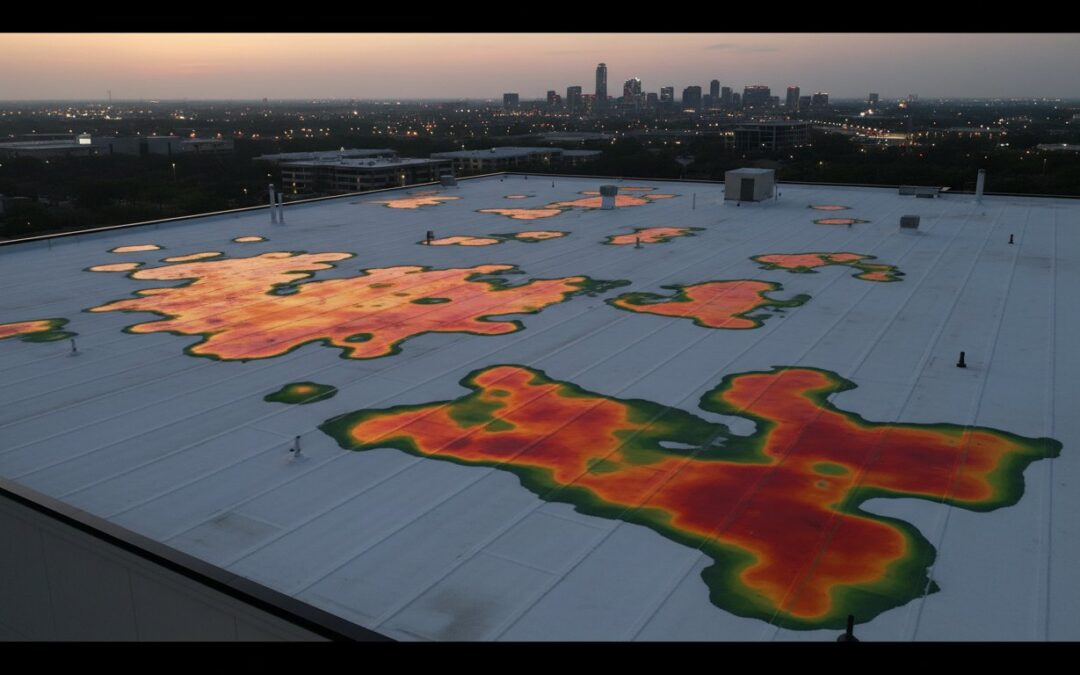
What if the “total roof failure” you’ve been warned about is actually just a few isolated wet spots hiding under the surface? Most property managers in Central Texas feel trapped in a cycle of patching the same leaks while watching their energy bills climb. It’s frustrating to pay for repairs that don’t stick, especially when you’re worried about the massive cost of a full replacement. A professional commercial roof infrared moisture survey Austin changes the conversation by showing you exactly where the water is and, more importantly, where it isn’t.
Our team has spent over 15 years helping local owners navigate these structural headaches with technical precision and GAF certified expertise. We know that wet insulation can hold onto heat long after the sun sets, often showing a temperature difference of 5 to 15 degrees compared to dry areas. This data allows us to pinpoint damage that the naked eye misses. We’ll show you how infrared technology creates a clear map for targeted repairs, validates insurance claims, and helps you avoid spending thousands on a new roof you don’t actually need yet.
Key Takeaways
- Learn why scheduling a commercial roof infrared moisture survey Austin during the post-sunset “thermal window” is the most accurate way to find hidden leaks.
- Discover how hard thermal data provides the objective proof needed to validate insurance claims after severe Central Texas hail storms.
- Find out how pinpointing specific wet spots allows for targeted TPO repairs that can save you from a premature and unnecessary roof replacement.
- See how localized data can help you transition from reactive repairs to a fluid-applied restoration that extends your roof life by up to 20 years.
The Science of Infrared Moisture Surveys for Austin TX Commercial Roofs
Visible inspections are often a guessing game. On a flat roof, standing water is easy to spot, but subsurface saturation is invisible to the eye. In fact, standard visual checks miss roughly 90% of sub-surface moisture trapped within your roofing assembly. Infrared thermography is a non-destructive moisture detection method that identifies trapped water by measuring surface temperature variations. By using a commercial roof infrared moisture survey Austin property owners can identify the exact boundaries of damage before it spreads. The Science of Infrared Thermography provides the technical foundation for this process, allowing us to see through the membrane without cutting into the roof.
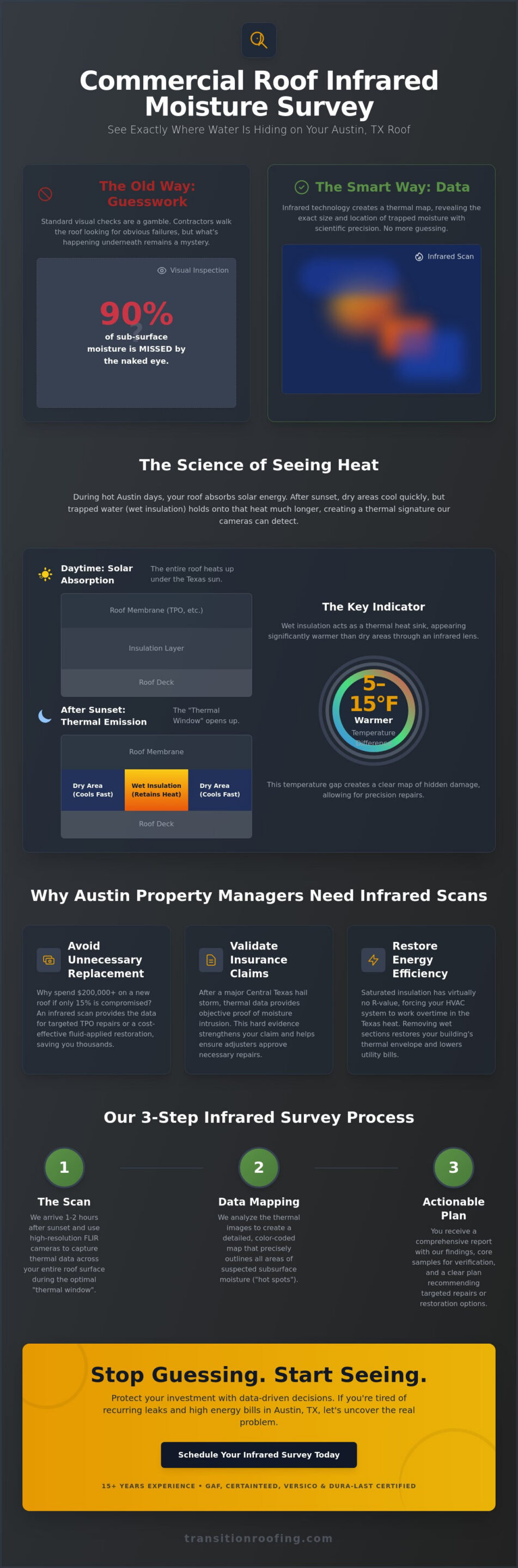
During Austin’s 100-degree summer days, your roof absorbs a massive amount of solar energy. Dry insulation releases this heat quickly once the sun goes down, but wet insulation acts as a thermal heat sink. This creates a specific “thermal window” usually one to two hours after sunset when the temperature difference between wet and dry areas is most visible. To better understand how these thermal signatures reveal hidden damage, watch this helpful video:
How Thermal Imaging Detects Trapped Moisture
We use high-resolution FLIR cameras to capture these temperature variances with high accuracy. Wet insulation typically appears 5 to 15 degrees warmer than dry areas during the nighttime cooling cycle. This happens because water has a high thermal capacitance, meaning it holds onto heat much longer than the surrounding dry materials. Our survey process maps these “hot spots” with precision, giving you a clear guide for targeted commercial roof repair rather than a full replacement.
The Impact of the Central Texas Climate on Roof Decay
The Central Texas climate is notoriously hard on commercial membranes. Extreme temperature swings cause constant expansion and contraction, which eventually creates small cracks or seam failures. When our characteristic flash floods hit, these minor punctures allow water to pour into the insulation. Without a commercial roof infrared moisture survey Austin, this water remains trapped. It rots your decking and drives up cooling costs as the wet insulation loses its ability to block heat.
Why Property Managers in Austin TX Need Infrared Scans Before Replacement
Property managers in Central Texas often face a difficult choice: keep patching a failing roof or spend $200,000 or more on a full TPO replacement. A commercial roof infrared moisture survey Austin provides the data needed to make an informed decision. Instead of guessing based on a few visible drips, you get a radiometric map of exactly what is happening under the membrane. This is especially critical during commercial real estate due diligence or after a major Austin hail storm. Insurance adjusters are much more likely to approve a claim when you present clear, thermal evidence of storm-related moisture intrusion.
Beyond repairs, these surveys directly impact your bottom line. Wet insulation has almost no R-value, which means your HVAC system has to work twice as hard to fight the Texas heat. According to the U.S. Department of Energy on Thermographic Inspections, these scans are essential for detecting heat loss and moisture in building envelopes. By identifying and replacing only the saturated sections, you restore the thermal efficiency of your building and lower monthly utility expenses. It’s a simple way to protect your operating budget while ensuring long-term structural integrity.
Identifying Wet Insulation vs. Surface Leaks
A leak inside your building is rarely directly below the hole in the roof. Water often enters through a small puncture, travels along the insulation boards, and finally drips into the facility 20 or 30 feet away. Without a scan, contractors might patch the wrong area. Infrared surveys show the entire path of the moisture. This ensures we address the root cause rather than just the symptom, stopping the spread of rot before it compromises the metal decking.
Avoiding Unnecessary Full Roof Replacements
We follow a standard “25% Rule” for commercial properties in Austin, TX. If our scan shows that less than 25% of the roof insulation is saturated, a full replacement is usually an unnecessary expense. In these cases, we recommend targeted commercial roof repair to remove only the wet sections. This surgical approach saves you tens of thousands of dollars while extending the life of your existing system. If you’re seeing recurring leaks despite multiple repair attempts, this is usually when we recommend getting a professional scan to see what’s actually happening beneath the surface.
The Transition Roofing Process for Infrared Surveys in Austin TX
We don’t just walk onto a roof with a camera and start clicking. A professional commercial roof infrared moisture survey Austin requires a methodical approach based on engineering standards. We strictly follow ASTM C1153, which is the national standard for locating wet insulation with infrared imaging. This means we only perform scans at night, at least 1 to 2 hours after sunset. The roof must be dry, and wind speeds must be below 15 mph to ensure the thermal data is accurate. The Science of Infrared Moisture Surveys shows that these specific conditions are necessary to see the heat radiating from saturated materials.
Our process involves a “trust but verify” rule. While the infrared camera identifies thermal anomalies, we confirm those findings with physical moisture probes or core samples. This prevents “false positives” caused by internal heat sources or heavy debris. With over 15 years of experience handling flat roofing in Austin TX, we know how to distinguish between a simple puddle and deep-seated insulation rot. Once the scan is complete, we provide a digital map that serves as a blueprint for your repair plan.
What to Expect During Your Austin TX Roof Scan
Preparation is key for a successful survey. We ask property managers to ensure the roof is clear of heavy debris and that we have safe access to all sections after dark. The process typically follows this timeline:
- Daytime Walk-through: We identify safety hazards and mark “hot spots” like HVAC units that might give off heat.
- Nighttime Scan: Our thermographers walk the roof during the cooling cycle to capture radiometric images.
- Verification: We use moisture meters to confirm the wet areas identified by the camera.
- Reporting: You receive a final report within 48 to 72 hours.
Understanding Your Infrared Moisture Report
Your report will feature thermograms, which are color-coded images of your roof’s heat signature. On these maps, bright yellow or red areas usually indicate trapped moisture, while dark blue or purple sections are dry and healthy. We use this data to prioritize your 2026 maintenance budget. If we find that only a small corner of your Versico or GAF system is wet, we can plan a targeted patch rather than a full tear-off. If you want to stop guessing about your roof’s condition, schedule a professional roof survey with our team today.
Turning Survey Data into a Long-Term Roofing Plan in Austin TX
A commercial roof infrared moisture survey Austin is only as valuable as the plan that follows it. Once the data identifies the exact boundaries of trapped water, we stop the guessing game and start the fixing process. We use this radiometric map to build a surgical repair strategy. If the scan identifies localized “islands” of wet insulation, we perform targeted commercial roofing Austin repairs. This involves cutting out only the saturated sections and replacing them with new insulation and TPO patches that match your existing system.
With over 15 years of experience working with GAF, Versico, and Dura-last systems, we know exactly how to integrate these repairs so they maintain the integrity of your warranty. If your building is over 10 years old, this data is where we recommend starting. It’s the only way to ensure you aren’t overpaying for a full replacement when a targeted restoration would suffice. Once the wet spots are removed, we can often apply a fluid-applied coating. This restoration can extend your roof’s life by 10 to 20 years while significantly improving reflectivity in the Central Texas sun.
Targeted Repairs and Restoration Strategies
We focus on saving every square foot of dry insulation possible. By removing only the saturated portions identified in the scan, we stop moisture from migrating to healthy areas of the roof. This surgical approach is a core part of how we manage commercial roofing Austin projects. It keeps costs low and prevents the massive operational disruption of a total tear-off. It’s a practical, contractor-led solution that prioritizes your budget over a quick sale.
Budgeting for Commercial Roof Maintenance in 2026
Smart property management relies on predictable costs rather than emergency surprises. We use infrared data as a baseline for our preventative maintenance programs. Instead of waiting for a ceiling to drip, we check the known “hot spots” annually to ensure small punctures don’t turn into major saturation issues. As a leading flat roofing company Austin, we help you move from reactive repairs to a planned maintenance schedule. This keeps your structure secure and your energy bills manageable.
If you’re dealing with recurring leaks or high energy bills, we can take a look and give you a clear plan. Schedule a roof inspection in Austin today.
Take Control of Your Austin TX Roof Maintenance Strategy
Stopping a recurring leak shouldn’t feel like a guessing game. By using a commercial roof infrared moisture survey Austin, you get the hard data needed to protect your building and your budget. This process allows you to identify subsurface saturation before it leads to a total system failure. Instead of overpaying for a full replacement, you can focus your 2026 resources on targeted repairs that actually solve the problem. This surgical approach ensures you’re only replacing what’s truly damaged and keeping your healthy roofing materials in service longer.
Transition Roofing brings over 15 years of Austin roofing experience to every project. As GAF and Versico Certified Installers, we provide detailed ASTM-compliant reporting that stands up to insurance adjusters and property boards alike. We’ll help you move from reactive patching to a long-term plan that secures your asset for years to come. Dealing with a mystery leak? Schedule your Austin TX commercial roof infrared survey today. We’re ready to help you save your roof and protect your bottom line.
Frequently Asked Questions
How much does a commercial roof infrared moisture survey cost in Austin?
The cost of a survey depends primarily on the total square footage of your building and the complexity of the roof’s layout. A large industrial warehouse with a wide, open TPO surface is often more straightforward to scan than a multi-level office complex with numerous HVAC units and penetrations. While we don’t provide flat rates, this service is always a small fraction of the cost of a full roof replacement. It’s a strategic investment that helps you avoid replacing thousands of square feet of perfectly dry insulation.
Can infrared find leaks on a metal roof in Austin TX?
Infrared technology is more challenging to use on metal roofing systems because the metal surface is highly reflective. In thermography, this is known as “low emissivity,” meaning the metal reflects the temperature of the sky rather than showing its own heat signature. While it’s not the primary tool for metal, it can sometimes work if there’s a specific type of insulation backing. For most metal buildings in Central Texas, we typically recommend a physical inspection to check for seam failures and fastener issues instead.
What is the best time of year to perform an infrared roof scan in Central Texas?
You can perform a commercial roof infrared moisture survey Austin during any season as long as there is a significant temperature swing between day and night. Austin’s hot summer and sunny fall days are ideal because the sun provides a massive “thermal load” to the roof. This ensures that any trapped water stays warm long after the sun goes down, creating the clear temperature contrast we need to see on our cameras. We just need a clear night with low wind to get the most accurate data.
Does insurance pay for an infrared moisture survey after a hail storm?
Many insurance carriers will cover or reimburse the cost of an infrared scan if it’s used to document legitimate storm damage. After a major Austin hail storm, the impact can create small fractures in the membrane that aren’t immediately visible. Providing a radiometric report gives the adjuster hard evidence of moisture intrusion that justifies a larger claim. We often include these surveys as part of our insurance claim assistance to ensure property managers get the full coverage they deserve for their repairs.
How accurate are infrared moisture surveys for flat roofs?
When performed by an expert following ASTM C1153 standards, these surveys are incredibly accurate for identifying wet insulation. The physics are reliable because water simply holds heat longer than dry materials like polyiso board. We regularly see a 5 to 15 degree temperature difference that clearly outlines the saturated area. To ensure 100% accuracy, we always verify the “hot spots” with a moisture meter. This combined approach gives you a foolproof map for your next commercial roof infrared moisture survey Austin project.