In the Central Texas climate, a professional roof repair isn’t just a quick patch; it’s a strategic restoration against extreme 2026 UV heat and seasonal hail. You’ve likely spent the morning wondering if that small ceiling stain from the last Austin storm is a simple fix or the start of a $15,000 replacement. It’s frustrating to handle insurance adjusters while worrying about hidden mold or finding a contractor who won’t disappear once the check clears. We understand that protecting your family means more than just shingles and nails.
This guide will teach you how to identify damage accurately, navigate the strict 12 to 18 month insurance filing deadlines, and choose materials that stand up to the Austin sun. We’ll break down why the average repair cost in Austin hit $781 this year and how to ensure your home meets the current 2024 International Residential Code standards. You’ll gain the clarity needed to move your roof from a state of uncertainty to total security with a plan built on local expertise and proven craftsmanship.
Key Takeaways
- Identify hidden hail bruising that damages your shingles long before a visible leak appears in your ceiling.
- Use contractor logic to determine when a roof repair provides real value versus when the 15-year rule suggests a full replacement.
- Navigate the insurance process with confidence by learning how to document storm impact for your adjuster immediately.
- Secure your home’s integrity by choosing a certified expert who understands the unique weather challenges of Central Texas.
Common Signs You Need Roof Repair in Austin TX
Identifying damage after a Central Texas storm requires a trained eye. Most homeowners look for obvious holes, but the “bruising” effect from Austin hail is often more destructive. These dark, soft spots indicate that the shingle’s internal mat has fractured. When you are understanding the role of a roofer, you realize that their job is to spot these microscopic fractures before they turn into major leaks. Even if your roof looks fine from the driveway, a 2026 storm can leave it compromised and in need of professional roof repair.
To better understand this concept, watch this helpful video:
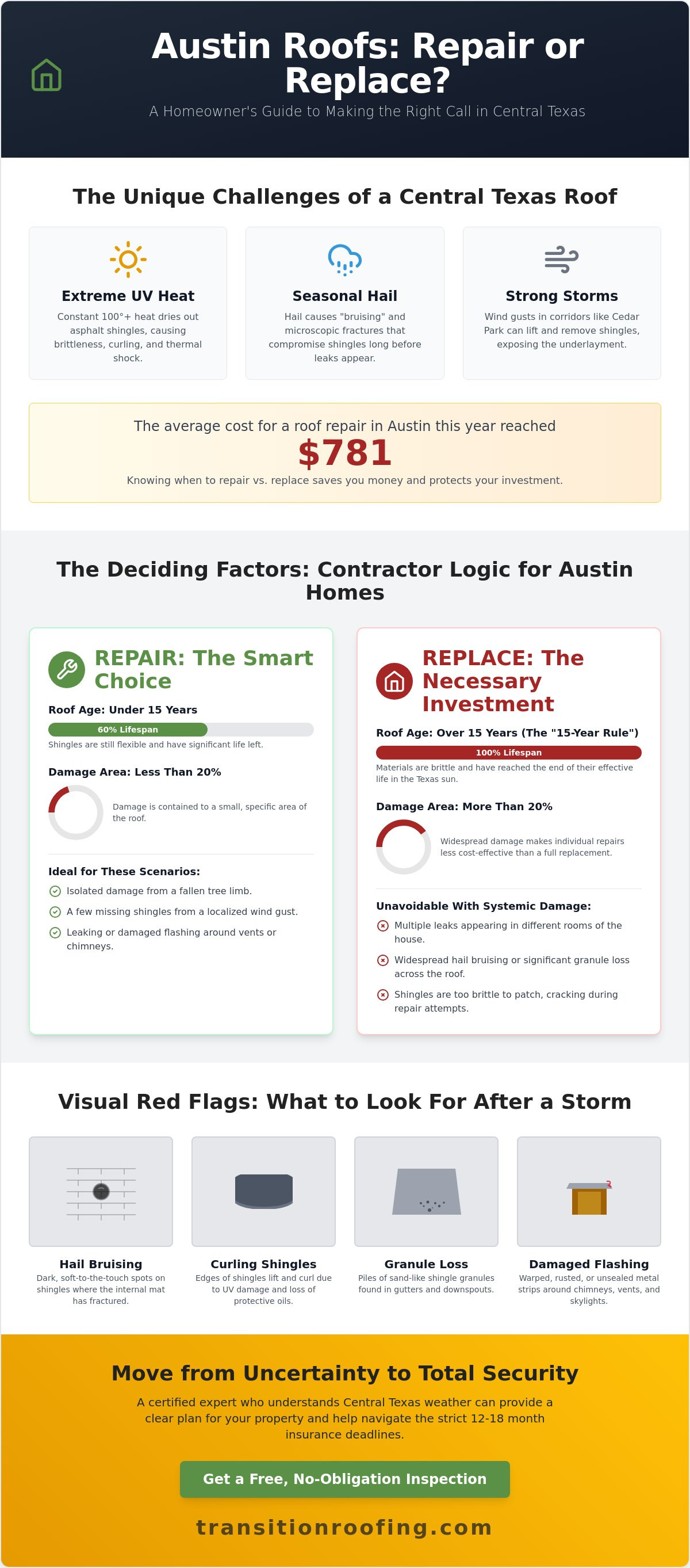
The 100-degree Austin heat is another silent enemy that dries out asphalt shingles. Constant UV exposure causes shingles to lose their protective oils, leading to brittleness and curling. This contributes to thermal shock, which is the rapid expansion and contraction of roofing materials in Texas as temperatures swing from blistering afternoons to cooler nights. This cycle eventually pulls fasteners loose and opens gaps for water to enter.
Visual Red Flags for Austin Homeowners
Look for “alligatoring” on flat roofs in Pflugerville and Round Rock, where the surface cracks like a reptile’s skin due to age and sun. In the Cedar Park wind corridor, missing shingles are a high-priority roof repair need because they leave the underlayment exposed to the next downpour. Check the flashing around chimneys and vents after heavy rains. If these metal seals are warped or rusted, water will bypass your shingles entirely and enter your living space.
Hidden Damage: What You Can’t See from the Ground
Check your gutters and downspouts for excessive granule loss. If you see piles of sand-like material, your shingles are no longer shedding water properly. A small attic leak today might seem minor, but in the humid Central Texas climate, it will cause structural wood rot by next summer. If you’re seeing these signs, we can take a look and give you a clear plan to protect your home’s structural integrity.
Roof Repair vs. Replacement: Making the Right Call in Austin TX
Deciding between a targeted patch and a full replacement requires what we call “contractor logic.” This means looking at the overall health of your roofing system rather than just the immediate leak. While general guidelines from the National Roofing Contractors Association offer a great baseline, the Austin climate demands a more rigorous standard. We focus on the 15-year rule because Central Texas heat and storms age materials much faster than the national average.
If your roof is approaching 15 years of age, a roof repair might be a waste of money. The asphalt becomes brittle and loses its ability to seal properly. We also evaluate the percentage of damage across your entire residential roofing system. If more than 20% of the surface shows signs of wind or hail impact, the cost of multiple repairs often approaches the price of a full replacement. In these cases, a new roof is the more secure long-term investment for your property.
When a Repair is the Smart Choice
A focused repair is often the best solution for isolated issues. If a single fallen limb caused a puncture or a localized wind gust lifted a few shingles, we can restore the area without a full tear-off. Replacing damaged flashing around chimneys or vents is another common fix that stops leaks at their source. For Austin property managers, sticking to a preventative maintenance schedule is the best way to catch these small issues before they require a major capital expense.
When Replacement is Unavoidable
Replacement is necessary when the damage is systemic. If you have multiple leaks appearing in different rooms, the underlayment has likely reached the end of its life. Widespread hail damage also compromises the integrity of the shingles beyond what a simple roof repair can fix. When shingles become too brittle from UV degradation, they often crack when a contractor tries to install a patch. This makes it impossible to create a water-tight seal. If you’re seeing signs of widespread wear, we can take a look and give you a clear plan for your property.
Navigating the Roof Repair and Insurance Process in Austin TX
Filing an insurance claim for roof repair in Central Texas has become more complex in 2026. Homeowners now face stricter documentation requirements and shorter windows for reporting. Most policies require you to file within 12 to 18 months of a storm, but waiting that long often leads to denied claims due to “neglect.” The process begins the moment the storm passes. Take clear photos of your yard, dented gutters, and any shingles found on the ground. This immediate evidence creates a solid foundation for your claim before the next rain arrives.
A local contractor acts as your technical advocate during this process. While insurance adjusters are trained to spot general damage, they often miss the subtle hail bruising common in the Austin area. Having an expert on-site ensures every fractured shingle mat is recorded. Be wary of any “door-to-door” contractors offering to waive your deductible. In Texas, it is illegal for a contractor to absorb a deductible, and these offers are a major red flag for insurance fraud. Working with a legitimate partner ensures your Austin roof repair and storm recovery follows all legal and safety standards.
Filing Your Claim: A Step-by-Step Guide
- Contact a trusted roofer for a professional inspection before calling your insurance company. This confirms if the damage actually exceeds your deductible.
- Submit the contractor’s detailed damage report to your insurance provider to initiate the claim.
- Schedule the adjuster’s meeting and ensure your contractor is present to walk the roof with them.
Transition Roofing assists homeowners by providing transparent, line-item estimates that adjusters can easily verify. This methodical approach prevents delays and helps you secure a fair price for quality work.
Avoiding ‘Storm Chasers’ in Central Texas
Out-of-state “storm chasers” often flood Austin neighborhoods after a major hail event. These companies rarely have a permanent Austin address and often disappear once they collect the final check. Only work with contractors who have deep roots in the community and verified Texas references. A local specialist understands the 2024 International Residential Code requirements and will be here to honor their warranty for years to come. If you’re dealing with a complex leak or storm damage, schedule a roof inspection in Austin today to get a clear, honest assessment of your home.
Why Local Expertise Matters for Roof Repair in Austin TX
Since the State of Texas doesn’t require a specific roofing license, manufacturer certifications are the only way to verify a contractor’s skill. We maintain elite status with industry leaders like GAF, Certainteed, Versico, and Dura-last. These certifications prove we’ve been vetted for financial stability and high-quality installations. With over 15 years of experience in Central Texas, we’ve seen every way a roof can fail. This deep local history is vital for complex leak detection where water often travels far from the original entry point before appearing on your ceiling.
We customize every roof repair to match your specific material and slope. Shingle roofs require different ventilation strategies than metal or TPO systems to survive the 2026 heat. For business owners, we provide specialized commercial roofing in Austin to ensure your inventory and operations remain dry during seasonal downpours. Our team understands the 2024 International Residential Code requirements, ensuring your repairs meet all current safety standards.
The Materials Built for Texas Weather
- High-performance GAF shingles are engineered to resist 130mph winds and heavy hail impact common in Travis County.
- TPO and metal roofing offer superior UV reflection, which is essential for Austin’s flat-roof commercial buildings.
- Reflective “cool roof” granules help mitigate heat absorption and can reduce your cooling costs by 10% to 25% during July and August.
The Transition Roofing Promise
Our process is built on transparency and integrity. You’ll receive a detailed, line-item estimate with zero hidden fees before any work begins. We focus on the “transition” of your property, moving it from a state of storm-damaged vulnerability to one of total security. This isn’t just about a one-time transaction; it’s about providing long-term protection for our neighbors in the Austin area. We’re proud of the high standards we maintain and the community trust we’ve built since our founding.
If you’re seeing signs of wear or dealing with a persistent leak, we can take a look and give you a clear plan. Schedule a roof inspection in Austin today to protect your property and ensure your home is ready for the next Texas summer.
Secure Your Home Against the Next Central Texas Storm
Restoring your roof is about more than just fixing a leak; it’s about long-term protection. You now know how to spot the subtle signs of hail bruising and when a roof repair provides better value than a full replacement. By acting within the 12 to 18 month insurance window and documenting damage immediately, you protect your home’s structural integrity and your financial investment. Waiting until next summer to address a small attic drip often leads to expensive structural wood rot that could’ve been prevented with a timely inspection.
Our team at Transition Roofing brings over 15 years of local Austin experience to every project. As GAF and Certainteed Certified specialists, we understand how to navigate complex insurance claims and install systems that withstand 130mph winds. We’re dedicated to providing a transparent transition from storm damage to total security. If you’re dealing with a leak or storm damage, we can take a look and give you a clear plan today. You deserve the peace of mind that comes from working with a neighborly expert who stands by their craftsmanship.
Frequently Asked Questions
How much does the average roof repair cost in Austin TX?
The average cost for a roof repair in Austin is $781, with most homeowners paying between $297 and $1,314. These 2026 market rates typically range from $3.50 to $12 per square foot depending on the materials and damage extent. Labor costs in Central Texas currently average between $390 and $700 for professional restoration work. If you receive an estimate far below these ranges, it often indicates a lack of proper certifications or low-quality materials.
Will my insurance cover roof repair from a hail storm?
Most Texas homeowners’ insurance policies cover restoration if the damage results from sudden weather events like hail or high winds. You must document the impact immediately, as many 2026 policies require you to file a claim within 12 to 18 months of the storm. Since the claims process has become more stringent, having a local expert present during the adjuster’s inspection ensures that subtle hail bruising is properly identified and documented.
How long does a typical roof repair take to complete?
A minor roof repair involving isolated shingle replacement or flashing fixes usually takes between three and five hours to complete. More complex projects that involve structural wood rot or multiple roof sections can take one to two full days of labor. We maintain a methodical pace to ensure every component meets the 2024 International Residential Code standards. Our goal is a swift transition that restores your home’s security without dragging out the construction process.
Can I repair my own roof to save money in Austin?
While DIY fixes are possible, we don’t recommend them because they often void manufacturer warranties and skip critical safety protocols. Professional roof repair ensures that your home remains compliant with local building codes and survives the 100-degree Austin heat. Mistakes made during a DIY attempt can lead to hidden leaks that cause thousands in interior damage. It’s usually more cost-effective to hire a certified expert who uses proven materials like GAF or Certainteed.
What happens if I ignore a small leak on my Austin roof?
Ignoring a small leak leads to structural wood rot and mold growth within six to twelve months. In the humid Central Texas climate, even a tiny drip can saturate your insulation and compromise the integrity of your roof deck. What starts as a minor $297 repair can quickly escalate into a full $15,000 replacement if the underlying structure begins to fail. If you’re seeing a ceiling stain, this is usually when we recommend a professional inspection to prevent a small problem from becoming a total loss.