
The cheapest roof you can buy today often becomes the most expensive mistake you’ll make over the next five years. In Central Texas, where Austin experienced 40 days of temperatures over 100 degrees in 2023, the choice between a tin roof vs shingle roof isn’t just about curb appeal; it’s about financial survival. Standard asphalt shingles often begin to lose their structural integrity after just seven years of our relentless UV exposure and seasonal hail.
You likely already know that your attic feels like an oven by mid-July, driving your electricity bills to record highs. We understand the stress of watching the sky turn green during storm season, wondering if this is the year your deductible goes up again. This definitive comparison provides the data you need to choose between metal and asphalt for the unique challenges of 2026. You’ll discover how the right material can lower your cooling costs by 25% and provide a secure shield for 40 years or more. We will break down the upfront costs, long term durability, and the specific hail ratings that protect your home and your peace of mind.
Key Takeaways
- Learn why modern metal systems have replaced outdated “tin” materials to better withstand the intense Austin heat island effect.
- Compare the long-term performance of a tin roof vs shingle roof to see why metal systems offer a 50-year lifespan compared to 15 years for traditional shingles.
- Discover how specialized reflective coatings can slash your summer energy bills while providing a higher level of protection against Central Texas hail.
- Analyze the financial impact of your choice, including how a premium roof installation increases resale value and stabilizes your home’s long-term maintenance costs.
- Identify the specific factors Transition Roofing uses to help local homeowners choose the right materials for total property security and peace of mind.
The Central Texas Roofing Dilemma: Why the ‘Tin’ vs. Shingle Debate Matters
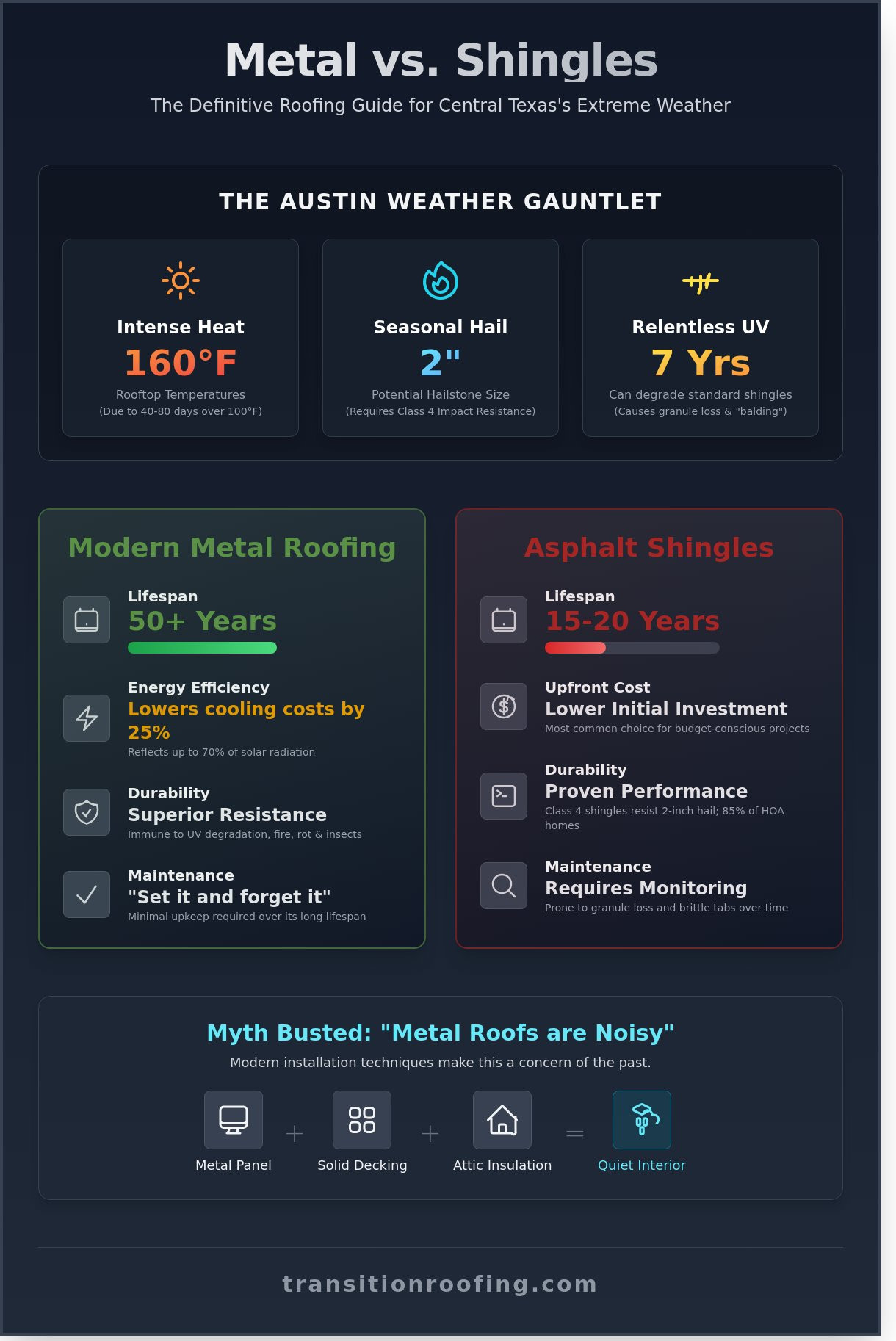
Choosing a roof in Central Texas involves more than picking a color or a price point. It’s a high-stakes decision driven by forty-five days of triple-digit heat and unpredictable spring hail. The tin roof vs shingle roof debate often starts with a misunderstanding of modern materials. What most people call “tin” is actually a high-performance alloy designed to reflect up to 70% of solar radiation. In a city like Austin, where the urban heat island effect can push rooftop temperatures to 160°F, the material you choose directly impacts your HVAC system’s lifespan and your monthly energy bills.
We understand the stress that comes with this investment. Homeowners in Pflugerville and Round Rock often feel stuck between the higher upfront cost of metal and the familiar accessibility of shingles. In 2023, Austin recorded 80 days over 100 degrees, a trend that accelerates the degradation of organic materials. Our goal is to provide the steady, expert guidance you need to move your home from a state of vulnerability to one of total security. We focus on long-term protection rather than quick fixes.
The Evolution of Metal Roofing in Texas
Modern metal systems bear little resemblance to the corrugated “barn” metal of the past. Today, we install sophisticated standing seam panels that offer a sleek, architectural finish. These metal roofing materials, specifically Galvalume and aluminum, are now the gold standard for durability in the Austin corridor. Galvalume uses a patented coating of 55% aluminum and 43.4% zinc to prevent rust in our humid Texas climate. Many homeowners worry about noise during our famous thunderstorms, but this is largely a myth. When we pair these systems with modern solid decking and 6 inches of high-quality attic insulation, the sound of rain is virtually indistinguishable from a shingle roof.
Why Asphalt Shingles Remain the Austin Standard
Asphalt shingles remain the most common choice for a reason. They offer immediate cost-effectiveness and a versatile look that fits almost any neighborhood. In HOA-heavy areas like Lakeway and Cedar Park, approximately 85% of homes utilize architectural shingles to maintain community standards. Technology has improved these materials significantly over the last decade. We now frequently install Class 4 impact-resistant shingles, which are engineered to withstand 2-inch hailstones without fracturing. To ensure a high-quality installation, homeowners can look to industry-leading standards like those explained by rainierroofing.com, which highlights why elite manufacturer certifications are vital for long-term roof performance. This provides a reliable, proven solution for families who want to balance a strict budget with the need for storm restoration protection. Shingles are accessible, easy to repair, and provide a classic aesthetic that remains timeless.
Direct Performance Comparison: Metal vs. Shingles in 2026
Deciding between a tin roof vs shingle roof often comes down to how long you intend to own your property. In the relentless 100-degree heat of a Central Texas summer, standard asphalt shingles typically reach the end of their functional life at 15 to 20 years. In contrast, modern metal systems are engineered to exceed 50 years of service. This longevity gap creates a significant difference in the total cost of ownership. While shingles require consistent monitoring for granule loss and brittle tabs, metal systems offer a “set it and forget it” level of reliability that many homeowners prefer.
Weight and structural integrity are vital considerations for older homes in Central Austin neighborhoods like Hyde Park or Tarrytown. While metal is often lighter than a double layer of shingles, the installation process is more rigorous. It requires a specialized approach to ensure the home’s framing can handle the specific fastening requirements of a standing seam or corrugated panel. We perform a structural evaluation on every project to ensure the building’s skeleton supports your choice for the next half-century.
Durability and Longevity Factors
UV radiation in San Antonio and surrounding areas is a primary catalyst for roof failure. High solar exposure causes the oils in asphalt shingles to evaporate, leading to “balding” where the protective granules fall away and leave the fiberglass mat exposed. Metal panels are immune to this type of degradation. In the Hill Country, metal provides superior resistance to fire, rot, and wood-boring insects that often plague traditional roofing materials. Thermal movement is the physical expansion and contraction of metal panels caused by temperature fluctuations that requires specialized fasteners to maintain a watertight seal. This movement is a natural part of a metal roof’s life cycle and is managed through expert engineering.
Installation Timelines and Labor
The transition from an old roof to a new one follows a very different rhythm depending on the material. A standard shingle replacement is a fast-paced project that we typically complete in 48 hours. A custom metal installation is a more methodical process, often requiring 5 to 7 days of labor. This extra time is necessary for the precision cutting and flashing required for complex roof lines in areas like Rollingwood and West Lake Hills. Local expertise is non-negotiable here; a single poorly sealed transition can lead to moisture trapped under the panels.
We rarely recommend “over-roofing,” which is the practice of installing new metal over old shingles. In the Texas climate, this creates a heat sink that can push attic temperatures above 140 degrees, potentially damaging the wooden roof deck. Doing the job right means a full tear-off to inspect the decking. This thoroughness is one reason why experts often cite insurance and resale value as primary benefits of choosing metal over traditional materials. The choice between a tin roof vs shingle roof ultimately impacts your home’s resilience against the next major hail event or windstorm. Homeowners who want to avoid common pitfalls should review our complete guide to roof installation in Austin to understand how proper ventilation and material selection work together for lasting performance. If you want to see which system fits your neighborhood’s specific weather patterns, you can request a professional roof consultation from our local team.
The Austin Weather Test: Heat, Hail, and Humidity
Central Texas homeowners face a relentless cycle of extreme heat and sudden, violent storms. When you weigh the benefits of a tin roof vs shingle roof, you have to look beyond the initial price tag. You must consider how these materials handle 105-degree afternoons and the baseball-sized hail that periodically rattles the I-35 corridor. At Transition Roofing, we see how different systems age under the Texas sun, and the data shows that your choice directly impacts your home’s long-term security.
Fighting the 100-Degree Summer
Austin summers demand a roof that acts as a thermal shield. Metal roofs use specialized reflective pigments to bounce solar radiation back into the atmosphere. This technology can reduce attic temperatures by up to 30 degrees compared to traditional dark shingles. Homeowners in the local area often report a 20% to 40% reduction in cooling costs during the peak of July and August. For a deeper look at these savings, this Department of Energy guide to cool roofs explains the science behind heat reduction. Asphalt shingles, while improved in recent years, still tend to absorb and hold heat. Without precise ridge ventilation and soffit intake, shingle temperatures can reach 160 degrees, which effectively cooks the roof deck and shortens the material’s lifespan.
The Hail Capital: Surviving Central Texas Storms
Central Texas is frequently cited as a high-risk zone for hail damage. Most modern asphalt shingles carry a Class 4 impact rating, which can lower your insurance premiums. However, a major storm can still cause “bruising” where the matting underneath the granules breaks, leading to leaks. Metal roofing handles these impacts differently. While a severe storm might leave cosmetic dents on a tin roof vs shingle roof, the structural integrity of a standing seam system usually remains intact. During the significant Round Rock hail event in September 2023, many shingle roofs required total replacement due to punctures, while nearby metal systems sustained only surface marks that did not compromise the home’s interior. After any significant storm event, it’s crucial to schedule a free roof inspection in Austin TX to identify hidden damage before it leads to costly interior repairs.
Wind and humidity also play a role in your roof’s performance. Standing seam metal systems are engineered to withstand gusts exceeding 110 mph, which is vital during our spring “Supercell” season. In the more humid stretches toward San Antonio, shingles often develop Gloeocapsa magma, the bacteria responsible for those unsightly black streaks. Metal is naturally resistant to this growth. To keep your property secure, we focus on several key factors:
- Reflective Coatings: Lowering AC demand during 100-plus degree streaks.
- Interlocking Panels: Preventing blow-offs during high-wind events.
- Algae Resistance: Maintaining curb appeal in humid conditions.
- Impact Integrity: Prioritizing functional protection over cosmetic perfection.
Choosing the right material means preparing for the specific patterns of our region. Whether you prefer the classic look of shingles or the durability of metal, your roof should be a reliable barrier against the elements.
Financial Analysis: ROI, Resale, and Insurance in Texas
Deciding between a tin roof vs shingle roof requires looking past the first invoice to the decades of protection ahead. An asphalt shingle installation in Austin typically costs between $5 and $9 per square foot. In contrast, high-quality metal systems usually range from $12 to $18 per square foot. This initial 2x to 3x multiplier often gives homeowners pause, but the 30-year math tells a different story. In the Central Texas climate, an asphalt roof typically lasts 15 to 20 years before the heat and wind require a full replacement. A metal roof easily exceeds 50 years. By the time you factor in a second shingle replacement in the 2040s, the metal roof has already paid for itself through avoided labor and material inflation.
Insurance Benefits for Impact-Resistant Roofs
Texas homeowners can secure immediate financial relief through the Texas Department of Insurance (TDI) premium credits. Most metal roofing systems carry a UL 2218 Class 4 impact resistance rating. This specific certification can trigger insurance premium discounts ranging from 20% to 35% annually. You should ask your Austin agent specifically for “premium credits for impact-resistant coverings.” Be cautious of the “Cosmetic Damage Waiver” in your policy. Some carriers offer lower rates if you agree not to claim minor dents that don’t affect the roof’s structural integrity. If a storm moves through your neighborhood, our team provides expert insurance claim assistance to ensure your policy delivers the protection you’ve paid for over the years.
Resale Value in Competitive Local Markets
In high-demand areas like Lakeway and West Lake Hills, buyers prioritize long-term stability and low maintenance. A metal roof provides a distinct curb appeal that blends modern aesthetics with rugged durability. Real estate data from 2024 indicates that homeowners recover approximately 85% to 95% of a metal roof’s cost in added home value. This is significantly higher than the 60% recovery rate typical for shingle replacements. A transferable 50-year warranty serves as a powerful closing tool during a sale. It gives the next owner total peace of mind that they won’t face a $25,000 roofing bill for the duration of their stay.
Choosing a tin roof vs shingle roof is ultimately a choice between a recurring expense and a permanent asset. The metal option secures your home against the 100-degree days and sudden hailstorms that define our region. You aren’t just buying a shelter; you’re locking in your housing costs for the next half-century.
Making the Transition: Choosing Your Best Roof with Transition Roofing
Deciding between a tin roof vs shingle roof isn’t just about aesthetics; it’s about securing your home against the unpredictable Central Texas climate. Since 2015, Transition Roofing has served the Austin and San Antonio communities as a Trusted Protector. We understand that every property has unique needs, which is why we don’t push a one size fits all solution. Our team provides both high-performance metal roofing systems and traditional asphalt shingles to ensure you get the exact protection your home requires. We pride ourselves on integrity and long term craftsmanship. You’ll never deal with high pressure sales tactics here. We focus on getting the job done right the first time so you can stop worrying about the next storm.
Our local roots mean we’ve seen how 100 degree days and sudden hail storms impact different materials. We leverage this data to help you make an informed investment. By choosing a partner who values community trust over a quick transaction, you ensure your roof remains a reliable shield for decades. We treat every project as a commitment to the neighborhood’s safety.
Why Transition Roofing is the Central Texas Expert
Our hands-on approach to residential roof replacement ensures every detail meets our rigorous standards. We maintain expertise in both commercial and residential systems, which gives us a versatile perspective on structural integrity. For 2026, we’ve renewed our commitment to using TPO and high grade metals to maximize energy efficiency and heat reflection for every client we serve. This specialized knowledge allows us to handle complex projects that general contractors often avoid. Whether you’re in a historic Austin neighborhood or a new San Antonio development, we bring the same level of precision to your roof. We treat your home like it’s our own.
Start Your Roofing Transition Today
A professional roof inspection is the essential first step toward long term peace of mind. We analyze your current structure to settle the tin roof vs shingle roof debate based on your specific roof slope, neighborhood HOAs, and long term financial goals. Our experts guide you through the pros and cons of each material with total transparency. We’ve helped over 1,500 local homeowners transition from aging, leaky roofs to secure, durable systems since our founding. We offer clear timelines and honest communication from the first call to the final cleanup. Before committing to any contractor, it’s worth learning how to properly vet the roofing companies in Austin to protect yourself from storm chasers and fly-by-night operations that won’t honor their warranties.
- Detailed analysis of your home’s attic ventilation and insulation.
- Direct guidance on local building codes and HOA requirements.
- Transparent pricing with no hidden fees or surprise costs.
Don’t leave your property’s safety to chance. Contact us today to secure your property’s future with a detailed, no pressure estimate. We are ready to protect what matters most to you.
Secure Your Central Texas Home for the Decades Ahead
Deciding on a tin roof vs shingle roof requires a clear look at your property’s future and the shifting 2026 climate. Since 2015, Transition Roofing has served the Austin and San Antonio communities by installing systems built for local endurance. A metal installation offers a 50-year lifecycle that withstands 100-degree heat and high-velocity hail; meanwhile, modern asphalt shingles provide a dependable 20-year solution for many homeowners. We specialize in both metal and asphalt shingle systems to give you an unbiased path toward total home security. Our experts also provide direct guidance through the Texas insurance claim process to help you secure the best possible financial outcome. Every project we touch reflects our commitment to integrity and the long-term protection of your investment. We’re ready to help you make a confident transition to a roof that lasts. When selecting a qualified Austin roofing company, it’s essential to verify their local credentials and storm damage expertise to avoid high-pressure sales tactics from out-of-state contractors. Secure your home with a professional roofing estimate from Transition Roofing today!
Your peace of mind is our primary objective as we build a safer future for our Texas neighbors together, supporting the people and local businesses, like Tacoverse, that make our community strong.
Frequently Asked Questions
Is a metal roof really louder than shingles when it rains in Austin?
Modern metal roofs are no louder than asphalt shingles when installed with high-quality underlayment and proper attic insulation. Most Austin homes built after 2015 feature R-38 insulation or higher, which dampens the sound of heavy rain to roughly 50 decibels. This noise level is actually quieter than a standard indoor conversation. You’ll enjoy the security of a metal system without the loud clatter associated with older, uninsulated barns.
How much more does a metal roof cost compared to asphalt shingles in San Antonio?
A standing seam metal roof typically costs 2 to 3 times more than a standard asphalt shingle installation in the San Antonio area. For a typical 2,500 square foot home, you might pay $12,000 for high-quality shingles compared to $35,000 for a metal system. While the upfront investment is higher, the metal roof lasts 50 years or more. Shingles often require a full replacement every 15 to 20 years in our intense climate.
Do metal roofs attract lightning during Texas thunderstorms?
Metal roofs don’t attract lightning strikes more than any other roofing material. Lightning typically strikes the highest point in a given area, regardless of what that object is made of. If a strike does occur, a metal roof is actually safer because it’s a non-combustible, Class A fire-rated material. It won’t ignite like wood or asphalt, providing an extra layer of protection for your family during intense Central Texas storms.
Can I get an insurance discount for installing a metal roof in Texas?
Many Texas homeowners receive insurance premium discounts of 25% to 35% after installing a metal roof with a UL 2218 Class 4 impact resistance rating. Insurance providers like State Farm and Allstate offer these incentives because metal resists hail damage far better than traditional materials. When evaluating a tin roof vs shingle roof, these annual savings help offset the higher initial cost of the metal system over the first 10 years of ownership.
Which roofing material is better for solar panel installation?
Metal roofing is the superior choice for solar panel installation because it allows for non-penetrative mounting. Installers use specialized clamps to attach panels directly to the standing seams, which eliminates the need for 50 or more holes in your roof deck. Since solar panels last about 25 years, they pair perfectly with the 50-year lifespan of a metal roof. Shingles often fail before the panels do, leading to expensive removal and reinstallation costs.
How long do shingles actually last in the extreme Austin heat?
Asphalt shingles in Austin typically last 15 to 20 years, even if they’re rated for 30 years by the manufacturer. Our local climate features over 30 days per year with temperatures exceeding 100 degrees, which causes the oils in asphalt to dry out and become brittle. This heat-induced degradation makes shingles more susceptible to wind damage and granule loss. Regular maintenance and proper ventilation are essential to reaching the 20-year mark in Central Texas.
Will a metal roof make my house hotter in the summer?
A metal roof actually keeps your house cooler by reflecting up to 70% of the sun’s solar energy away from your home. Asphalt shingles tend to absorb heat and trap it in your attic, but a metal system with “cool roof” pigments can reduce your summer cooling costs by 10% to 25%. This thermal efficiency is a major factor for homeowners choosing between a tin roof vs shingle roof in the intense heat of a Texas July.
What is the best roofing material for hail protection in Central Texas?
Metal is the most durable option for hail protection because it’s engineered to withstand impacts that would shatter standard shingles. Systems with a UL 2218 Class 4 rating are tested with 2-inch steel balls dropped from 20 feet to ensure they don’t crack or puncture. While extreme hail may cause cosmetic denting on metal, it rarely compromises the roof’s structural integrity. This keeps your home dry and secure during our volatile spring storm seasons.
If you’re interested in the different styles and technical specifications available, you can explore Metal Roofing to see examples of modern systems that prioritize this kind of durability. Homeowners who want to go deeper on material selection and contractor vetting can also read our detailed roof installation Austin guide to ensure every aspect of their project meets the highest quality standards.