
The lowest initial bid may not be the best value for a school roof. To present a roofing budget to a school board in Cedar Park, compare restoration or recovery with replacement, include long-term maintenance needs, and add a 15-20% contingency to the project budget. That gives board members a clearer view of the funding request and the risks it covers.
It’s understandable to focus on upfront cost when school funds must serve students and buildings. But a useful proposal also explains the roof’s condition, the work each option involves, and how the project can be funded. General obligation bonds typically have repayment terms of 15-30 years, so the funding timeline can shape when work moves forward.
This guide explains how to compare roof options, prepare a board-ready budget, and consider funding opportunities. It also covers how Austin-area conditions, including heat, hail, and storms, can affect planning. That local context connects today’s budget decision with the school’s long-term roof protection.
Key Takeaways
- Compare restoration and replacement against the roof’s condition and remaining service life, not just the first bid.
- Match funding options to the project timeline, and account for procurement requirements when using emergency federal funds.
- Make board reports easier to assess with itemized bids, clear scope, and projected maintenance needs.
- Build a more useful cost estimate by accounting for roof components, possible structural work, insulation, and disposal.
Alternative financing and grant opportunities in Austin TX: How to present a roofing budget to a school board in Cedar Park
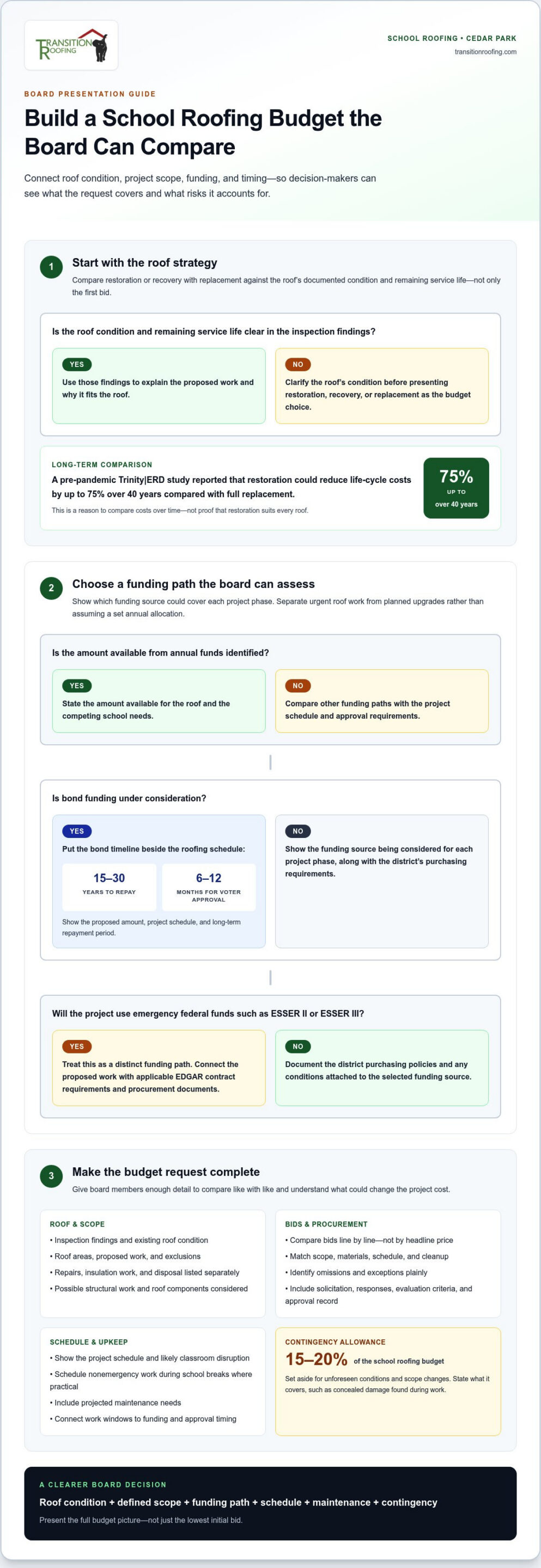
A Cedar Park district can compare annual operating funds, bond funding, and eligible grant funding. Since available funding varies, show which source could cover each project phase rather than assuming a set annual allocation. Separate urgent roof work from planned upgrades, then connect each request to its proposed funding path.
General obligation bonds typically have repayment terms of 15-30 years. Voter approval can take 6-12 months, so this route requires advance planning. A district weighing bond funding should show the proposed amount, project schedule, and long-term repayment period. Explain how the roof scope supports educational use and why delaying the work could affect the project timeline.
Emergency federal funds such as ESSER II and ESSER III may require contracts that meet EDGAR requirements. Treat these funds as a distinct funding path, not as a general grant assumption. Present the proposed work, funding source, and procurement documents together so board members can see how the contract relates to funding conditions.
- Annual funds: Identify the amount available for the roof and competing school needs.
- Bond funding: Present the repayment period and approval timeline alongside the project schedule.
- Emergency funds: Connect ESSER II or ESSER III funding with applicable EDGAR contract requirements.
Funding decisions also depend on the roof strategy. Roof restoration could reduce life-cycle costs by up to 75% over 40 years compared with full replacement, according to a pre-pandemic Trinity|ERD study. That gives the board a reason to compare options over time, not just by initial scope. The figure does not establish that restoration suits every roof.
Schedule nonemergency roofing work during school breaks where practical. This can reduce disruption and limit occupants’ exposure to construction debris and particles. Show the proposed work window alongside the funding timeline, especially if bond approval is needed. A clear schedule helps the district weigh funding, roof condition, and educational needs together.
Budget reports and bid support in Austin TX
For a Texas school district, procurement follows applicable district purchasing policies and project funding conditions. A board report should explain the competitive process, how bids were compared, and the basis for the approval request.
Roofing Budget Reports
A roofing budget report links project scope with cost, schedule, and ongoing maintenance needs. It helps board members see what each bid covers and how the work affects school buildings. Pair an itemized bid with the district’s reserve-study line items. For example, list roof repairs, insulation work, and disposal separately so the board can compare bids with matching scopes.
Start with a concise summary page, then include the detailed comparison. Show the existing roof’s condition, proposed work, and exclusions that could change the scope. Include expected maintenance alongside installation needs. This helps the district assess the full budget impact instead of comparing totals for different work.
Bid Support and Procurement Rules
Bid documentation helps the district evaluate submissions consistently. Clear records also explain how a bid meets the project scope and purchasing requirements. Include the solicitation, contractor responses, evaluation criteria, and approval record. Texas school districts must account for their procurement policies and any funding conditions.
Compare bids line by line, not by headline price alone. Check that each submission covers the same roof areas, materials, schedule, and cleanup responsibilities. Explain exceptions plainly. If a bid omits a repair or maintenance item, identify the gap before presenting totals. This creates a fair comparison and shows how student safety and building access informed the review.
- Scope: Identify roof areas, proposed work, and exclusions.
- Comparison: Align bid items with reserve study categories.
- Decision record: Document the evaluation basis and approval.
For a commercial building, a clearly defined commercial roofing project scope can support a more useful bid comparison. Keep repair needs, planned maintenance, and project constraints visible in the same report. That structure helps board members understand what the district is funding and how the work supports its buildings and students.
Preparing a roofing budget for board presentation
Texas school districts can frame capital-project approval around documented roof conditions, a defined scope, funding, and a board decision. Present the roofing system’s risks, project timeline, and likely classroom disruption alongside the financial request.
Capital Project and Roofing Expenditure Approvals
Capital-project approval is the district’s process for reviewing a proposed building investment and authorizing its funding. A clear presentation helps board members understand the need, scope, and decision at hand. Begin with inspection findings, then explain why the roof needs repair, restoration, or replacement. Identify the proposed funding source and requested approval. Show how the project fits the district’s capital-planning and procurement processes.
Keep the request specific. Separate essential work from optional upgrades, and explain how each affects the roofing system’s condition. Add a 15-20% contingency to the school roofing budget for unforeseen conditions and scope changes. State what the contingency covers, such as concealed damage found during work. This gives the board a defined allowance rather than an unexplained increase in the financial request.
Project Risks and Timelines
A project risk and timeline summary shows what could affect cost, schedule, or school operations. It matters because contractors may uncover conditions that change the planned scope. Large-building roof work can take several days or weeks. Show the proposed work window, access areas, and steps for limiting disruption to classes. Explain which schedule choices could affect students and building use.
Use a short risk table to connect each issue with its response:
- Hidden roof damage: Identify the contingency and approval path for added work.
- Schedule changes: Show how weather or scope changes affect the work sequence.
- Class disruption: Map work areas and explain how building access will be managed.
Close with the board’s requested action, funding decision, and next project milestone. A Cedar Park example could put roof-condition findings, a defined scope, a contingency, and the proposed work window on one summary page. This helps board members connect the roof’s condition with the financial request and school calendar.
How to estimate school roof replacement costs per square foot in Cedar Park, Texas?
Start with measured roof area, then compare itemized bids for the same scope. For a 50,000-square-foot roof, divide each complete proposal by 50,000 to get its bid cost per square foot. This calculation only works when bids include comparable work, materials, removal, and project requirements.
Roof area is only one part of an estimate. A professional assessment should examine the deck, vapor retarder, insulation type and thickness, and roof membrane. These components help determine whether the existing assembly can support the proposed system. Ask for replacement work and repairs to be itemized separately so the board can see how each condition affects the scope.
- Roof area: Use measured square footage, not the building’s floor area.
- Assembly: Record deck, vapor retarder, insulation, and membrane details.
- Scope: Separate removal, replacement, repairs, and insulation work.
- Bid comparison: Divide each complete, comparable bid by roof area.
Older buildings may need structural repairs. The estimate in the research places those repairs at an additional 10-15% of the roofing project budget. Carry that item separately from the base roof scope. This shows board members how concealed or damaged structure could affect the total without blending repair work into the roof-system rate.
Permit and engineering fees also belong in a larger project estimate. The research estimates these fees at 3-5% of project cost for larger school roofing installations. Disposal, insulation changes, and roof-deck work should also appear as separate line items when included in a bid. Compare those items across contractors, rather than treating a low per-square-foot figure as the full project cost.
For a Cedar Park board report, show the measured area, assessment findings, bid rate, and excluded work together. State the total project scope and identify assumptions that could change it. This makes a per-square-foot figure easier to assess against the roof’s actual components and condition.
Transition Roofing: Commercial Roof Installation
Transition Roofing helps Cedar Park schools move from an approved scope to commercial roof installation. If inspection findings point to active leaks or localized damage, commercial roof repair may address the immediate concern. For a larger project, the roofing system and building conditions can guide the choice between TPO Roofing Systems and Metal Roofing Systems.
A clear project scope connects the board’s budget decision with the work required. Transition Roofing serves commercial customers with roofing installation and repair for school buildings.
To discuss a school roofing project, contact Transition Roofing.
Move the Board’s Roof Plan Forward
A board-approved roofing plan is a starting point, not the final project scope. The next step is to translate that decision into a clear path from roof condition to scheduled work, with technical input before commitments are made. To present a roofing budget to a school board in Cedar Park, connect the requested investment with school priorities and the work needed to protect its buildings.
Transition Roofing provides Commercial Roof Installation, TPO Roofing Systems, and commercial roof repair. When your district is ready to discuss installation or repair, request a free, no-obligation estimate to clarify the work ahead and plan the next step.
Contact Transition Roofing today to discuss your school roofing project. A well-grounded plan can help the board move forward with confidence.
Frequently Asked Questions
What should a school roofing budget presentation to a school board include?
Include a clear decision request, the reason the roof work is needed, and how the proposed scope supports school operations. A useful Cedar Park format is a one-page summary for board members, followed by documents explaining assumptions, exclusions, and who will oversee the work. This distinguishes the approval being requested from later project decisions.
Are grants, bonds, or other funding sources available for Texas public school roof projects?
Potential funding routes include district funds, general obligation bonds, and eligible federal emergency funds. ESSER II and ESSER III may apply to school roofing projects, and contracts may be subject to EDGAR requirements. Treat each source separately in the funding plan: identify the proposed roof work, funding route, and related conditions. This helps the district avoid building its budget around funds that do not fit the project.